You've been applying consistently. Your resume is polished. You're qualified for the roles you're targeting. And yet your inbox sits empty — no interview requests, no rejections, just silence.
If you've been on job forums or career blogs trying to diagnose the problem, you've almost certainly encountered the same explanation: "ATS software is auto-rejecting your resume before any human sees it."
It's a terrifying, widely repeated claim. It's also not quite right.
What's actually going on is more nuanced, but also more fixable. Once you see how the process works behind the scenes, the path forward gets a lot clearer.
The Myth That's Misleading Millions of Job Seekers
The most viral statistic in job search advice is that "75% of resumes are rejected by ATS before a human ever sees them." It gets repeated in career coaching videos, LinkedIn posts, and resume-writing articles constantly.
Video you may find useful:
The problem? That statistic was fabricated.
Researchers who traced it back found it originated from a 2012 promotional piece by a company called Preptel — a firm that sold resume optimization services. The company went out of business in 2013 and never published any study, survey, or methodology to support the claim. It was a marketing number, not a research finding.
HR professionals who actually work inside these systems are emphatic about this. Former Amazon, Google, and Microsoft recruiter Amy Miller has said plainly: "The idea that the ATS is this mythical, genius, AI-infused tool is crazy. Anyone who has been in an ATS and has used it for work is laughing at this idea."
The reality, confirmed by a survey of 25 US recruiters across tech, healthcare, and finance: only 8% of companies have ATS configured to auto-reject resumes based on content. The remaining 92% reject manually — meaning a human makes the call. And most ATS systems aren't designed to eliminate applicants at all. They're organizational tools that store, sort, and surface applications for human review.
So why aren't you hearing back?
Humans, volume, and timing. Not robots. And you can actually do something about all three.
What's Actually Happening When You Apply
When you hit submit, your resume lands in the company's ATS. Not in a rejection bin — in a queue. Every applicant is in that queue. The system stores and sorts it, but a human still has to work through it.
That's where things break down.
According to a multi-year analysis of US hiring data, applications per hire have risen by approximately 182% since 2021. The average corporate job posting in the US receives around 250 resumes. High-visibility remote roles at tech companies routinely receive 500 to 2,000+ applications within the first week.
Now consider the recruiter on the other end. Most are managing 10 to 30 open roles simultaneously. With hundreds of applications per role, they have minutes — not hours — to build a shortlist.
The gatekeeper isn't a robot. It's a person with too many resumes and too little time, making fast decisions based on imperfect signals.
Which means the question isn't "how do I beat the algorithm?" It's "how do I stand out to a human who's skimming?"
How Recruiters Actually Review Resumes
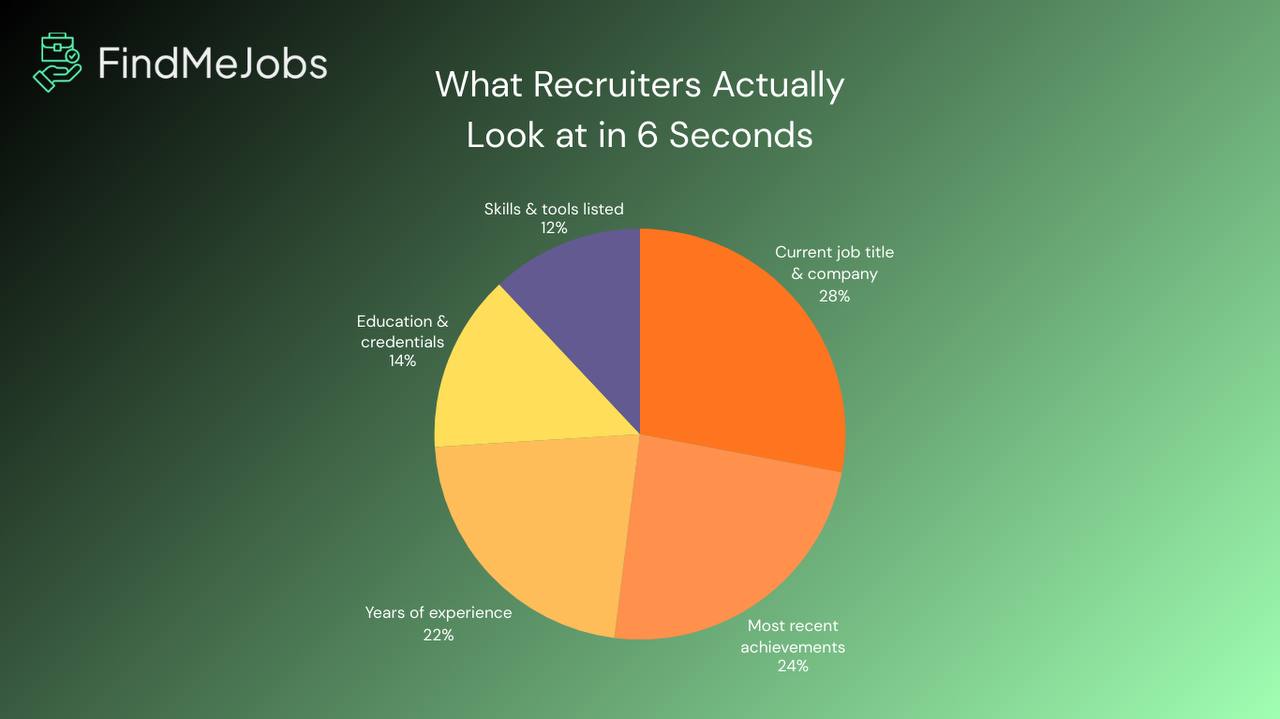
Once you see how recruiters actually work through their queue, the resume mistakes become obvious.
The First Pass: 6 to 8 Seconds
Eye-tracking studies have consistently shown that recruiters spend an average of 6 to 8 seconds on their initial scan of a resume. Not reading — scanning. Their eyes move quickly across the document looking for a handful of signals: current job title, company name, one or two notable achievements, and years of experience.
If those signals don't land clearly and immediately, the resume gets moved to the "no" pile — not because of an algorithm, but because a human being with 300 more resumes to review made a quick judgment call based on what they could absorb in under ten seconds.
What this means for your resume: your most important information needs to be at the top, easy to find, and formatted so it can be absorbed in a glance. Dense paragraphs, complex layouts, and buried achievements all work against you in this phase.
The Keyword Search
This is where ATS software does matter, just not in the way you've been told.
Rather than auto-rejecting resumes, recruiters use ATS keyword search to surface the most relevant applications from a large pool. They type in a skill, a job title, or a required tool, and the system surfaces resumes that contain it.
If your resume doesn't include the specific words the recruiter is searching for — even if you have the exact experience they need — you simply won't appear in their results. Not rejected, just invisible.
Consider: a candidate who writes "built user interfaces" won't surface in a search for "React development," even if they built those interfaces using React. The ATS can't make that inference. It matches text, nothing more.
The Volume Cutoff
A crucial detail that rarely gets mentioned: many recruiters stop reviewing new applications once they have a workable shortlist — typically after the first 24 to 72 hours of a posting being live.
A survey of 25 US recruiters found that 52% review applications in order of arrival. One VP of HR admitted: "First-come, first-served, because I don't have time to review thousands." Many recruiters pause job postings entirely after receiving 300 to 500 strong applications.
This means late applicants — even those with excellent, keyword-optimized resumes — may never get looked at simply because they arrived after the shortlist was already assembled.
Timing is a compounding factor that sits on top of every other resume problem. We wrote about this dynamic in depth in our piece on the first-applicant advantage.
The Real Reasons Your Resume Isn't Getting Responses
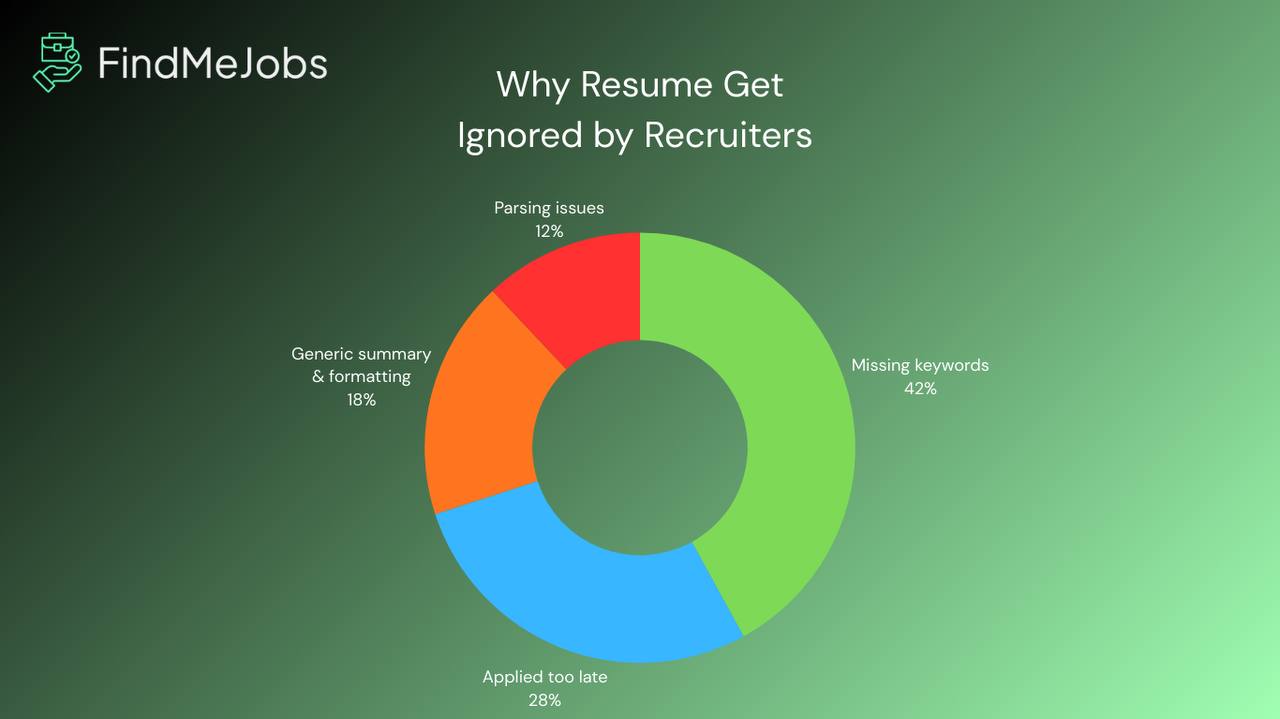
Now that you know what's really going on, here are the actual culprits — ranked by how often they cause good candidates to be overlooked.
1. Your Resume Doesn't Mirror the Job Description
The most common issue, and the easiest to fix. Recruiters use keyword searches to narrow a large field. If you describe your skills and experience in your own words rather than the language of the job description, you won't surface in those searches.
You might write "managed a development team." The job description says "engineering leadership." You might write "improved site performance." The job description asks for "page speed optimization." Same experience. Different words. And in a keyword search, different words means invisible.
The fix is systematic: read the job description carefully, identify the specific skills, tools, and phrases it emphasizes, and make sure those exact terms appear in your resume — where they accurately reflect your experience.
2. Your Formatting Buries the Important Information
Even when a recruiter does look at your resume, formatting can actively hide your best credentials.
Multi-column layouts scatter information across the page and force the recruiter's eye to jump around instead of reading top-to-bottom. Dense walls of text slow down the 6-second scan. Fancy design elements — icons, graphics, colored sidebars — attract the eye away from your actual experience.
The resumes that perform best in the initial human scan are clean, single-column, and information-dense in the right places: a strong summary at the top, job titles and company names in a consistent format, and bullet points that front-load achievements rather than responsibilities.
There's also a secondary formatting problem: some design-heavy resumes don't parse correctly in ATS. The system can extract the text, but the order gets scrambled, making the recruiter's keyword search unreliable. This isn't auto-rejection — it's degraded searchability.
Standard formatting (single column, conventional section headers, no tables or text boxes) solves both problems at once: it's human-scannable and ATS-parseable.
3. You're Applying Too Late
As described above, 52% of recruiters review applications in arrival order and many stop reviewing once they have a shortlist. If you're finding jobs through slow discovery channels — checking boards once a day, waiting for weekly email digests — you're routinely arriving after the shortlist is already forming.
Notice that this isn't a resume problem at all. Your resume might be excellent. But if your timing is consistently late, you're submitting into a queue that's effectively already closed.
Real-time job alerts that notify you within minutes of a matching posting going live solve this completely. Being one of the first 10 to 50 applicants changes your odds at every subsequent stage.
4. Your Resume Reads Like a Job Description, Not an Achievement Record
One of the most consistent complaints from recruiters is receiving resumes full of responsibilities instead of results.
Bullet points like "responsible for managing social media accounts" or "assisted with product development" describe what your role was, not what you accomplished in it. They give a recruiter no signal of your actual impact.
Compare that to: "Grew Instagram following from 12K to 85K in 14 months through organic content strategy" or "Shipped three product features in Q1 that contributed to a 22% reduction in customer churn." These tell the recruiter something — a measurable outcome that makes you a more concrete, credible candidate.
Quantified achievement bullets are consistently cited by recruiters as one of the highest-signal elements of a strong resume. Former Amazon recruiter Lindsay Mustain has been direct about this: vague, "Miss America-style" claims without metrics are among the fastest ways to lose recruiter interest.
5. Your Professional Summary Is Generic
The professional summary sits at the very top of your resume and gets seen in every 6-second scan. It's the highest-value real estate on the entire document. And most people waste it with language like:
"Results-driven professional with a passion for excellence and a track record of success in fast-paced environments."
That sentence says nothing. It contains no keywords, no specifics, and no differentiation from the thousands of other resumes using identical language.
A strong, targeted summary sounds like: "Full-stack engineer with 7 years building React and Node.js applications in high-growth B2B SaaS. Led a team of 5 engineers to ship a real-time analytics product used by 300+ enterprise clients."
That version works on every level: keywords for ATS search, scannable for a human, and specific enough to be credible in two sentences.
6. You're Sending the Same Resume Everywhere
A single, static resume submitted to every job posting is the most common mistake in modern job searching — and the most damaging to your response rate.
Each job posting is different. The skills it emphasizes are different. The language it uses is different. The priorities of the team hiring for it are different. A resume that perfectly matches one posting may be poorly aligned with a similar posting at a different company.
Tailoring your resume to each application — adjusting the summary, reordering bullet points to front-load the most relevant experience, ensuring the key skills from the job description are explicitly named — directly increases your hit rate at every stage of the process.
The objection to tailoring is always time. Doing it thoroughly by hand takes 60 to 90 minutes per application. But that's a process problem, not a tailoring problem. With AI resume tailoring tools, the analysis can happen in seconds — surfacing exactly what needs to change in your resume for a specific posting — and the editing itself takes minutes.
Stop guessing what's wrong with your resume. FindMeJobs monitors top job boards 24/7 and alerts you the moment a matching role appears — then tailors your resume with AI in under 30 seconds so it speaks the exact language of the posting. Start your free trial today.
How to Actually Fix Your Resume Response Rate: A Step-by-Step Process
This is the system we'd recommend if you're starting from scratch.
Step 1: Build a Master Resume
Before you can tailor efficiently, you need a complete source document. Your master resume should contain every role you've held, every skill you have, every tool you've used, and every credential you've earned — all written out fully.
This is never submitted anywhere. It's the raw material from which you tailor individual applications. You want everything available upfront so that tailoring becomes curation, not writing from scratch.
Step 2: Fix Your Formatting Once, Permanently
Audit your resume for structural issues and fix them permanently in your master template:
- Convert to a single-column layout
- Use conventional section headers: "Work Experience," "Education," "Skills," "Summary"
- Remove all tables, text boxes, columns, and graphical elements
- Ensure nothing important is in the document header or footer
- Use a clean, standard font: Calibri, Georgia, or Garamond
- Save as
.docxunless a posting specifies otherwise
This is a one-time exercise. Once your template is clean, you never have to touch structure again — only content.
Step 3: Analyze Every Job Description Before Applying
When a relevant role appears, read the job description with a specific intent: you're identifying the vocabulary the hiring team uses to describe the work you do.
Look for:
- Technical skills and tools mentioned (especially if repeated more than once)
- Soft skills and ways of working described
- Specific industry terms or methodologies
- The exact job title they use and how it compares to your previous titles
- The difference between "required" and "preferred" qualifications — required items carry heavier weight
If a skill or requirement appears multiple times across the posting — in the intro, the responsibilities, and the qualifications sections — it's a high-priority keyword for that role.
Step 4: Update Your Resume in Three Targeted Areas
You don't need to rewrite your resume. You need to make three targeted changes:
The summary. Rewrite it to reflect the specific role. Mirror two or three of the most prominent keywords from the job description. Mention the type of company or industry if it's relevant. This takes three to five minutes manually — or seconds with AI resume tailoring — and dramatically improves both ATS searchability and the 6-second human scan.
Bullet point order. Within each role, reorder your bullets so the ones most relevant to this posting appear first. Don't rewrite them — just move the most aligned ones to the top. The recruiter reads top-down and weights early bullets more heavily.
Skills section. Check every key skill in the job description against your skills section. If you have the skill but haven't named it explicitly using the job description's language, add it. If they say "Figma" and you list "design tools," change it to "Figma."
Step 5: Apply Immediately, Track Everything
Once your tailored resume is ready, apply through the company's preferred channel. The sooner you apply after a posting goes live, the better your odds at every subsequent stage. Real-time job monitoring tools that alert you the moment a matching role appears can make this difference automatic.
Keep a simple tracker: company, role, date applied, channel used, follow-up date. Following up with a brief, professional note to the recruiter five to seven business days after applying is a low-effort step that can meaningfully refresh your visibility in their queue.
The Compound Effect: What Happens When You Fix Both Timing and Content
Most job search advice treats resume quality and application speed as separate problems. They're not. They compound.
A perfectly tailored resume submitted three days late is competing for a shortlist that may already be assembled. An early application with a generic resume may get seen but won't survive the keyword search or the 6-second scan.
The winning combination is consistent: arrive early, with a resume that speaks the specific language of that posting. Early arrival gets you into an open queue. Keyword alignment gets you surfaced in search. A clean format and quantified achievements get you past the 6-second scan. A targeted summary confirms the fit in the first two sentences.
Fix one of these variables and your response rate improves. Fix all of them and the improvement is compound — because each stage you clear multiplies your odds at the next.
What the Numbers Actually Say
Forget the debunked 75% figure. Here's what credible hiring data looks like:
| Metric | Data |
|---|---|
| Average resumes per corporate job posting | 250 (Glassdoor) |
| Applications per hire increase since 2021 | +182% (US ATS analysis) |
| Applicants who reach an interview | ~5% average across industries |
| Recruiters who review in arrival order | 52% |
| Recruiters who pause postings after 300–500 applications | Majority |
| Average time on initial resume scan | 6–8 seconds |
| Resumes rejected for work experience mismatch | 73% of rejections |
| Employers using ATS at Fortune 500 level | ~98% |
| Employers who believe they've missed great candidates due to poor resume alignment | 88% |
That last figure — from a Harvard Business School and Accenture study of over 8,000 employers — is perhaps the most important. 88% of employers say they've lost qualified candidates because those candidates didn't clearly demonstrate they met the role's criteria. Not because an algorithm blocked them. Because the resume failed to communicate fit clearly enough for an overwhelmed human reviewer to see it in limited time.
It's a communication problem. And communication problems have solutions.
The Self-Audit: Five Questions to Diagnose Your Resume Right Now
Before applying to another job, run through these five questions:
1. Does my professional summary mention the specific role and at least two key skills from this job description? If your summary is generic and unchanged across applications, it's costing you every time.
2. Can a recruiter see my most impressive accomplishment within 6 seconds of looking at this page? Put your most compelling credential near the top. If it's buried on page two, most reviewers will never reach it.
3. Does every skill in the job description that I genuinely have appear explicitly on my resume? Don't assume inferences. If you have the skill, name it using the same language the posting uses.
4. Do my bullet points describe outcomes or just responsibilities? "Managed social media" is a responsibility. "Grew LinkedIn engagement 340% in six months through a weekly video series" is an outcome. Wherever possible, convert responsibilities to results.
5. Am I applying within the first 24 hours of a posting going live? If not, what's your current discovery system and how can you make it faster?
The Copy-Paste Test (Do This Before Your Next Application)
Try this two-minute test before your next application:
Copy your entire resume and paste it into a plain text editor — Notepad on Windows, TextEdit on Mac in plain text mode. What you see is roughly what the ATS extracts from your document.
If your content appears jumbled, sections are out of order, or text is missing entirely, the ATS is having trouble parsing your document. Those sections may not appear in keyword searches even if the content is there in the original file. Fix the source formatting until the plain-text version reads cleanly, top to bottom.
This test takes two minutes and can immediately reveal formatting problems that are degrading your ATS searchability without you knowing it.
Frequently Asked Questions
Is ATS really not rejecting my resume automatically?
In most cases, no. Research from interviews with 25 US recruiters found that only 8% of companies configure their ATS to auto-reject based on resume content. The other 92% reject manually. ATS systems are primarily organizational tools — they store, sort, and enable keyword search across applicant queues. The real filter is a human recruiter working through a large volume of applications in limited time.
Then why do I feel like my resume is disappearing into a void?
Because of volume and timing, not automation. Recruiters managing hundreds of applications per role have to move fast. Applications that arrive late may not get reviewed at all once a shortlist is assembled. Applications that don't surface in keyword searches remain invisible. Applications that don't pass the 6-second scan get skipped quickly. None of these involve a robot — they all involve human decision-making under time pressure.
Should I stuff my resume with keywords to maximize searchability?
No. Include every keyword that accurately reflects your experience, but don't repeat them artificially or add skills you don't have. Modern ATS systems can deprioritize keyword-stuffed resumes, and any recruiter who sees your resume will also notice. The goal is comprehensive accuracy, not manipulation — every genuine skill named explicitly, using the language of the job description.
How often should I tailor my resume?
Every application, ideally. At minimum, update your professional summary and check keyword alignment for every role you apply to. The structural template stays fixed — only content changes per application.
What's the single highest-impact change I can make today?
Rewrite your professional summary to be role-specific rather than generic. It's the first thing a recruiter sees, the first thing an ATS parses, and the highest-leverage section on the entire document. A targeted summary that mirrors the language of the job description and leads with a specific, quantified credential will outperform a generic one every single time.
Does the file format of my resume matter?
Yes. .docx files parse more reliably across ATS platforms than PDFs, particularly on older systems. Unless a posting specifically requests a PDF, submit .docx. If you're creating your resume in a design tool rather than Word, convert it to a clean Word document before submitting — design tool PDFs are among the worst-performing formats in ATS parsing.
The Bottom Line
The reason your resume isn't getting responses almost certainly isn't a mysterious algorithm working against you. It's a combination of addressable, human problems: too many applications arriving at overwhelmed recruiters, keyword mismatches making strong resumes invisible in search, generic summaries failing the 6-second scan, and late applications arriving after shortlists are already formed.
All of it is fixable. Build a clean, keyword-aligned master resume. Tailor the summary and top bullet points for every application. Apply as early as possible after a posting goes live. Track everything and follow up.
The job market is legitimately competitive right now — applications per hire are up 182% since 2021. But the people who understand how the process actually works — and adjust accordingly — consistently outperform those who are still blaming robots for a problem that's entirely human.
FindMeJobs monitors job boards 24/7 and pings you the moment a matching role appears — then our AI tailors your resume to that specific posting in under 30 seconds. First in line, every time, with a resume that speaks the language of the role. Start your 7-day free trial today, no credit card required.