You want a new job. But you already have one — and you need to keep it while you look.
This is one of the most common and least talked-about situations in the entire world of job searching, and it comes with a specific set of pressures that unemployed job seekers simply don't face. You can't spend eight hours a day on your search. You can't take calls at your desk. You can't show up to interviews in your work clothes without raising eyebrows. And you live with the quiet anxiety of knowing that if your employer finds out you're looking, things could get very uncomfortable very fast.
Most job search advice ignores all of this. It assumes you're free all day, applying from your couch, available whenever. That's not you — and the strategy that works for that person will not work for you.
This guide is written specifically for the employed job seeker. We'll cover the real data on how long this takes, why the traditional approach fails people in your situation, and a complete system for running an efficient, discreet job search around a full-time schedule.
The Numbers Are Worse Than You Think (But There's a Way Through)
Before the strategy, you need an accurate picture of what you're up against — because most people start a job search with wildly optimistic timelines and end up burning out six weeks in.
Here's what the data actually shows.
The average job search in 2025 takes approximately five months from first application to signed offer. That's not a weekend project. That's a sustained, multi-month commitment running in parallel with your current job, your personal life, and everything else.
At the same time, a survey of 1,000 Americans by Clarify Capital found that employed job seekers average only 5 hours per week on their search — compared to 9 hours per week for those who are unemployed and job hunting full-time. Over five months, that adds up to roughly 100 hours of search time. It sounds like a lot until you break it down: that's about 45 minutes per workday, assuming five-day weeks.
That is a meaningful constraint. Forty-five minutes a day is not enough time to manually browse multiple job boards, tailor your resume from scratch for each application, write personalized cover letters, do company research, maintain your network, and follow up on previous applications. Not consistently. Not for five months.
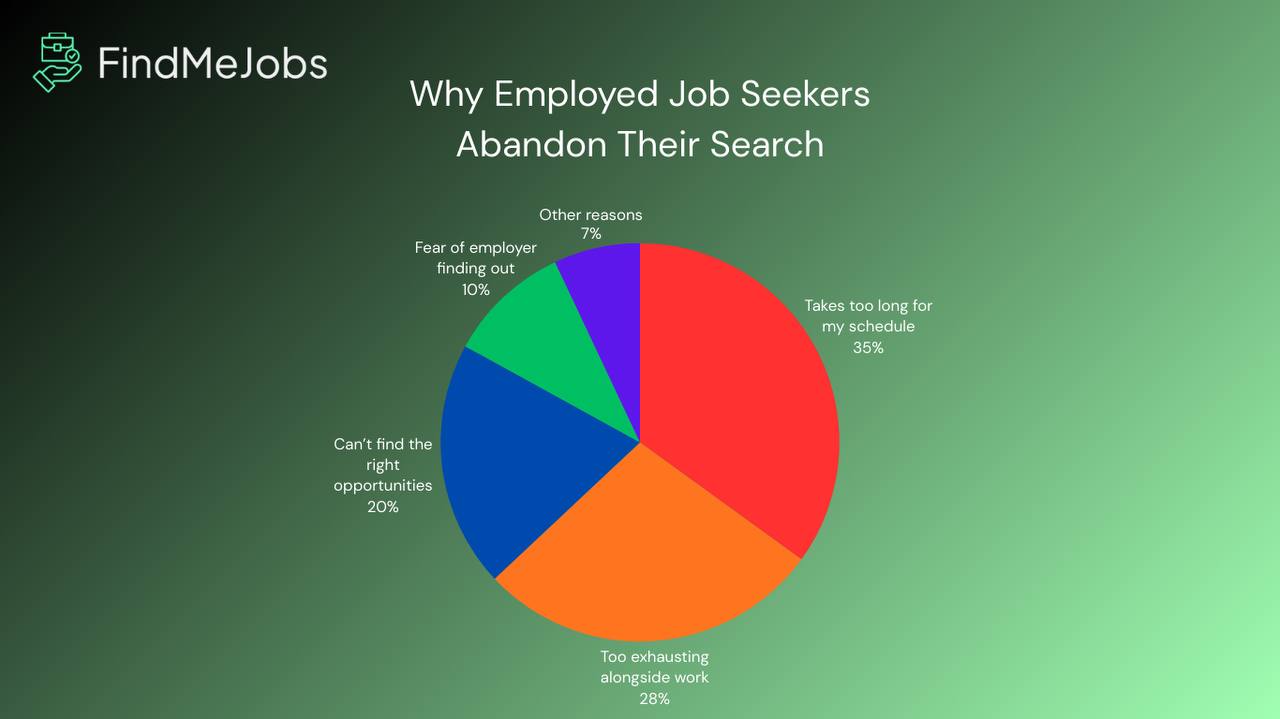
And the consequences of running out of steam are real: that same Clarify Capital survey found that 60% of job seekers have given up on a job application mid-process because it took too long or cost too much. Sixty percent. The attrition in employed job searches is enormous — not because people stop wanting a new job, but because the process is so time-intensive that it eventually breaks down under the weight of a full-time schedule.
The solution isn't to want it more. It's to build a system that fits your actual life.
Why the Standard Job Search Approach Fails Employed Searchers
The conventional job search approach looks something like this: scroll job boards for an hour or two, find some interesting postings, spend an afternoon tailoring your resume and writing cover letters, apply to a batch of jobs, wait, repeat.
For someone with unlimited time, this is slow but functional. For someone with 45 minutes a day, it's a recipe for one of two failure modes:
Failure mode 1: The quality trap. You spend your limited time doing everything perfectly — carefully tailoring each application, writing detailed cover letters, researching every company. You apply to three or four roles a week. The quality is high but the volume is too low for the probabilistic realities of job searching to work in your favor. Months pass with little progress.
Failure mode 2: The volume trap. Frustrated by slow progress, you start blasting a generic resume to every posting you find. Volume goes up, but hit rate plummets because untailored applications don't survive keyword searches or the six-second human scan. You apply to 80 jobs and get one callback. Burnout follows.
The employed job seeker needs a third path: a system that produces targeted volume — enough applications to generate real momentum, each one tailored enough to actually perform, delivered at a pace that fits inside 45 minutes a day without requiring heroic levels of discipline.
That system exists. Here's what it looks like.
The Employed Job Seeker's System: Five Components
Component 1: Protect Your Time Like It's Booked
The first and most important move is treating your job search like a recurring calendar commitment — not something you squeeze in when you happen to have a free moment.
"When I have time" is a fantasy for employed people. Spare time evaporates. Meetings run long. You're tired at the end of the day. An intention without a time slot is just a wish.
Book your search time in advance and protect it. For most employed job seekers, the most reliable windows are:
Early morning before work. Twenty to thirty minutes before you open your work email is remarkably effective. Your mind is fresh, there are no interruptions, and you start the day having made progress instead of chasing it.
Lunch break. Not the whole break — fifteen to twenty minutes, done from your phone or a personal laptop, is enough to review new alerts and triage opportunities.
One focused evening session per week. Block ninety minutes one evening specifically for deeper work: updating your resume, preparing for interviews, following up on applications. This is your "deep search" session; everything else is triage.
Total: roughly 5 to 6 hours per week, broken into small enough chunks that it doesn't consume your life or show up obviously in your schedule.
What you never do: use your work computer, work email, work phone, or work Wi-Fi for any job search activity. This isn't paranoia — IT departments at larger companies can see network activity, and using employer resources for personal job searching crosses a professional line you don't want to cross.
Component 2: Use Real-Time Alerts Instead of Manual Searching
The single biggest time sink in any job search is discovery — the act of finding out that a relevant job exists in the first place. Manual searching on job boards is inherently inefficient: you visit a site, run a search, scroll through results, find that most are irrelevant or already days old, and repeat the process across multiple platforms.
For an employed searcher with 45 minutes a day, spending 20 of those minutes on manual discovery is a catastrophic waste of limited time.
The solution is to completely eliminate manual discovery by setting up automated job monitoring agents. These tools watch the boards for you — 24 hours a day, across multiple platforms simultaneously — and alert you the moment a matching role appears. You don't go looking for jobs. The jobs come to you, immediately, the moment they're posted. Specifically, real-time LinkedIn job alerts delivered via a job alert app that lives inside Telegram mean a new matching role reaches you within seconds — not at the end of a daily digest.
This matters for two reasons:
It saves you the discovery time entirely. Instead of scrolling for 20 minutes every morning, you get a ping when something relevant appears and spend 30 seconds deciding if it's worth pursuing.
It keeps you in the first-applicant window. As we covered in our piece on the early applicant advantage, the first 24 hours of a job posting going live is when the vast majority of recruiter attention is concentrated. Employed job seekers who rely on manual searching typically discover roles hours or days after posting — which means they consistently miss this window. Automated alerts solve this completely.
Set up your agents once, with precise filters — job title, location, salary floor, required skills, seniority level — and then stop thinking about discovery entirely. Your time is now free for action, not searching.
Component 3: Compress Resume Tailoring to Under Two Minutes
Tailoring a resume manually is a 60-to-90-minute project done thoroughly. For an employed job seeker, this single bottleneck is often what causes the whole system to break down.
Here's the mental math: if tailoring takes 90 minutes and you have 45 minutes a day, you can realistically do one thorough tailored application every two days. That's roughly three applications per week — far below the pace needed to generate real momentum.
The fix is AI-powered resume tailoring that collapses this process from 90 minutes to under two minutes. Instead of reading the job description, manually identifying gaps between the posting's requirements and your resume, and rewriting sections from scratch, AI does the analysis automatically: it reads the posting, cross-references it against your existing resume, and surfaces specific, targeted suggestions for what to add, reorder, or adjust.
You're not outsourcing your voice or your credentials — you're outsourcing the analysis work that consumed most of the tailoring time. The result is a resume that speaks the specific language of each role, optimized for the recruiter's keyword search, delivered in a fraction of the time.
At two minutes per application rather than 90, you can realistically apply to eight to ten tailored roles per week inside your five-hour budget. That changes the math of your job search entirely.
Component 4: Keep Your Search Completely Private
Job searching while employed requires discretion that most job search advice doesn't address. Carelessness here has real consequences — awkward conversations with your manager, changed responsibilities, being passed over for projects, or in worst-case scenarios, being let go before you've landed something new.
Here are the specific rules that keep your search private:
Never tell colleagues you're looking. This includes your closest work friends. Information travels in organizations in ways you can't predict. One well-meaning comment from a colleague to the wrong person can change your working situation overnight. The only people who need to know are people completely outside your organization.
Update your LinkedIn carefully. Activating LinkedIn's "Open to Work" feature with the "visible to all" setting is a clear signal to your employer. Use the "share only with recruiters" setting instead — this makes your profile discoverable to recruiters who've opted into LinkedIn Recruiter without showing a banner to your entire network. Be thoughtful about suddenly updating your entire profile, adding new skills, and changing your headline in a short window — this pattern of activity is noticeable in your connections' feeds.
Schedule interviews strategically. This is one of the biggest logistical challenges of job searching while employed. Early morning slots (before 9 AM) and end-of-day slots (after 5 PM) are available from many employers who understand candidates are currently employed. Lunch-hour phone screens are also manageable. When you need to take time off for an in-person interview, use personal or vacation days rather than calling in sick repeatedly — sick days used in clusters for "appointments" are a recognizable pattern.
Be honest about your availability with recruiters. You don't need to explain that you're trying to keep your job search secret. Simply say you're currently employed and ask for interview slots outside of typical business hours. Most experienced recruiters understand this immediately and will accommodate it without further question.
Don't use references from your current employer. Your reference list should be former managers and colleagues who are no longer at your company. Reaching out to current employer references is a near-certain way for word to travel back.
Component 5: Build a Simple Tracking System
The employed job seeker's biggest enemy isn't motivation — it's context collapse. You're working a full-time job, running a job search across multiple companies and stages simultaneously, and managing everything in fragmented 20-minute windows spread across the week.
Without a tracking system, things fall apart. You forget which version of your resume you sent to which company. You miss the follow-up window because you forgot when you applied. You apply to the same role twice. You can't remember where you are in the process with six different companies.
A simple spreadsheet with these columns eliminates all of this:
- Company name
- Role title and link
- Date applied
- Resume version used (label your tailored versions by company)
- Application channel (company website, LinkedIn, email)
- Recruiter name if known
- Follow-up date (5 to 7 business days after applying)
- Current status (Applied / Phone screen / Interview / Offer / Rejected)
- Notes
This takes two minutes to update per application and saves you from the cognitive overhead of keeping everything in your head across a weeks-long search. Review it once a week during your dedicated evening session and you'll always know exactly where you stand.
How Long Will This Actually Take?
Let's set realistic expectations, because unrealistic timelines are one of the main reasons employed job searches collapse.
Huntr's Q2 2025 Job Search Trends Report, which analyzed 461,000 applications and surveyed 455 job seekers, found that the median time from search initiation to first offer extended from 56 days in April to 68.5 days by June 2025 — and that's trending longer, not shorter. The most common outcome for job seekers who landed an offer was submitting between 10 and 20 applications, though 14% required over 100 applications before receiving one.
What does this look like for an employed job seeker applying to eight to ten tailored roles per week?
In a realistic scenario, you'd submit 30 to 40 applications in your first month. You might get three to five phone screens from that batch. One or two might progress to full interview processes. By month two, you're in active conversations with two or three companies. By month three, you have your first offer if you've been consistent and strategic.
That's faster than the average five-month timeline — because the combination of early application (via alerts), targeted tailoring, and consistent pace puts you in the statistical upper tier of job seekers in terms of application efficiency.
The job seekers who take six months while employed are typically the ones who search in bursts — intensely for two weeks, then nothing for three, then intensely again. The compounding effect of consistent early applications doesn't work if you're only doing it half the time.
The Week-by-Week Schedule That Actually Works
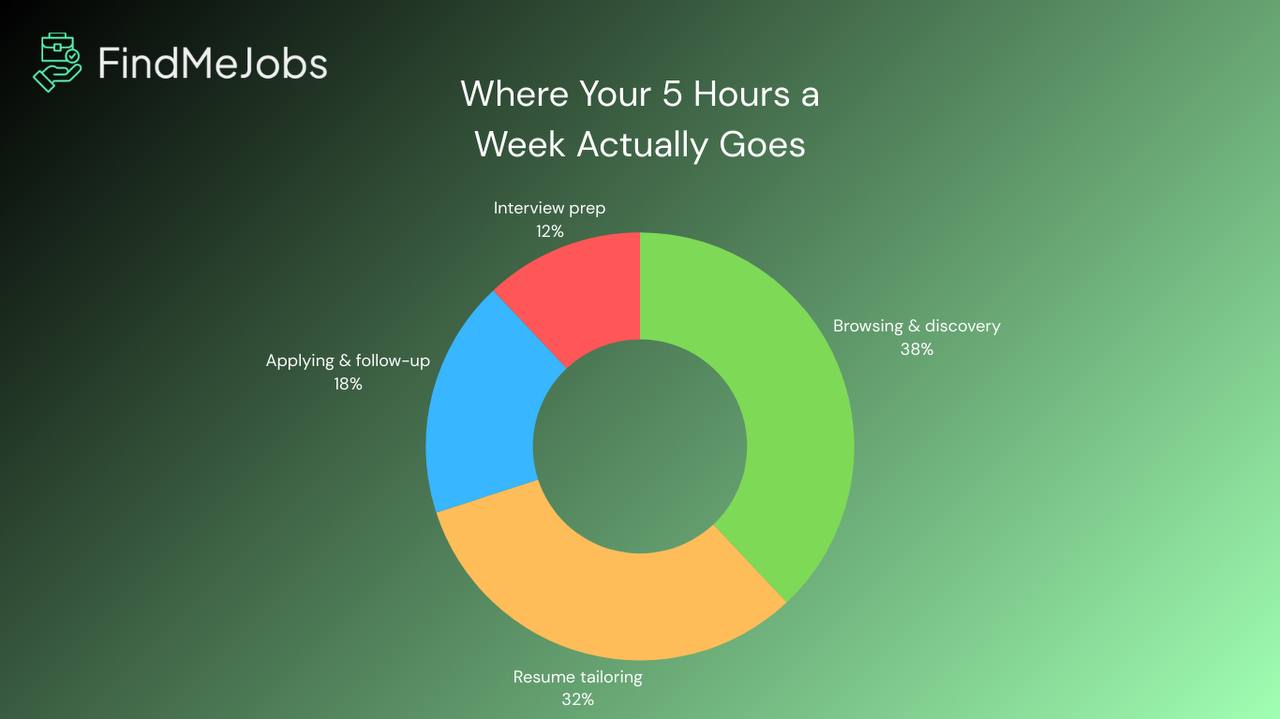
Here's what a sustainable employed job search looks like when structured properly:
Every weekday morning (15-20 min): Review any new job alerts from overnight. Flag the ones worth pursuing. On the best matches, apply immediately — write a quick note on why it's a fit, run your resume through AI tailoring, and submit. Being first costs you 10 minutes; waiting costs you your position in the queue.
Every weekday lunch (10-15 min): Quick email/LinkedIn check for recruiter outreach or application updates. Respond promptly to any recruiter messages — speed signals interest. Update your tracker if anything has moved.
One weekday evening per week (90 min): This is your strategic session. Review your tracker. Send follow-up notes to applications that are 5 to 7 days old with no response. Prepare for any upcoming phone screens or interviews. Update your master resume if you've added new experience or skills. Review your alert criteria — are you getting too many irrelevant notifications? Too few? Adjust the filters.
Weekend (30-60 min total, flexible): Optional but useful. This is a good time for deeper company research before interviews, networking outreach on LinkedIn, or applying to roles that need a slightly longer application.
Total: roughly 5 to 6 hours per week, never more than 20 to 30 minutes in any single sitting (except the evening session), and completely invisible to your employer.
How to Handle the Interview Gauntlet While Employed
Interviews are where the employed job search gets logistically complicated. A typical interview process at a mid-size company involves three to five rounds: an initial phone screen with a recruiter, a hiring manager call, a technical or skills assessment, a panel interview, and sometimes a final call with a senior leader. Spanning this across two to four weeks while working full time requires planning.
For phone and video screens: Most can be done from your car, a quiet conference room you've booked under a neutral reason, or from home if you have a flexible start or end to your workday. Early morning and post-5 PM slots are your default ask.
For in-person interviews: Use personal time or PTO. One half-day per interview process is reasonable. If a company requires multiple in-person rounds, consider being transparent with the recruiter: "I'm currently employed and able to commit to one in-person visit — could we consolidate the panel into a single session?" Many companies will accommodate this when asked directly.
For the "tell me why you're leaving" question: This comes up in virtually every interview and there's a right way to handle it. Focus on what you're moving toward rather than what you're leaving: growth opportunity, a larger scope, a sector you're passionate about, a specific skill you want to develop. Never disparage your current employer — it reads as a red flag and gives the interviewer nothing useful. Keep this answer polished and practiced because you'll say it a lot.
For reference checks: Prepare your reference list before your first application goes out. Former managers from previous roles who can speak to your abilities are ideal. Brief them before giving their names — let them know you're exploring new opportunities, what kinds of roles you're targeting, and what you'd like them to emphasize. A surprised or unprepared reference is almost as bad as a bad one.
The Specific Mistakes That Get Employed Job Seekers Caught
Beyond the general advice, these are the specific behaviours that most commonly result in a job search becoming visible to a current employer.
Connecting with the recruiter on LinkedIn from your work network. Your colleagues see your connection activity in their feeds. A sudden spike in connections with recruiters at other companies is a recognizable pattern. Check your LinkedIn notification settings and be thoughtful about the timing and volume of recruiter connections.
Doing phone screens at your desk. Background noise, the acoustics of your open-plan office, and the risk of a colleague walking by are all real. Never take a job-related call at your desk or anywhere in the office. Step outside, go to your car, or use your lunch break away from the building.
Dressing differently on interview days. If you work in a casual-dress office and you show up on a Thursday in a blazer and dress shoes, people notice. Many experienced job seekers keep interview clothes in their car or change before and after. Some schedule interviews at the beginning or end of the day precisely so they can dress for the interview without a mid-day contrast.
Accepting LinkedIn recommendations suddenly. Asking for and accepting a batch of LinkedIn recommendations from former colleagues signals to your network — and potentially your current employer if they're connected to you — that you're building your professional profile for visibility. Spread this out or do it well in advance of starting your search.
Using your personal email on your work computer. Most corporate IT infrastructure logs web traffic. Accessing personal email, job board accounts, or career-related sites from a work device is a traceable activity at organizations with active IT monitoring. Use personal devices exclusively.
What to Do When You Get an Offer (But Haven't Resigned Yet)
When an offer arrives, you'll face a compressed decision window that's genuinely stressful. Here's how to handle it cleanly.
Negotiate before accepting. You have the most leverage at the offer stage. Don't accept the first number reflexively. Review the full package — base salary, equity if applicable, benefits, PTO, remote flexibility, start date — and ask for what you need. Most companies expect negotiation and build room for it into initial offers.
Ask for time. "I'm very excited about this opportunity and would like 48 to 72 hours to review the full offer before formally accepting" is completely standard. Use that time to be certain, handle any loose ends in active interview processes with other companies, and prepare mentally for the conversation ahead.
Tell your current employer after you've signed, not before. Your resignation notice and the start date on your new offer are what determine your transition timeline. Giving notice before you've signed creates a risk of being immediately let go with no start date secured. Sign first, then resign.
Handle your resignation professionally. Give the amount of notice your contract requires (typically two weeks, sometimes more for senior roles). Offer to help with transition documentation. Don't burn bridges, regardless of how you feel about leaving — professional networks are small and long memories are common.
Frequently Asked Questions
Is it ethical to job search while employed?
Yes, completely. Looking for new opportunities while employed is normal, legal, and practiced by the majority of working professionals at some point in their careers. Your employer is not owed notice that you're exploring the market, just as you aren't owed notice if they're planning to eliminate your role. The professional expectation is that you continue performing your current job well until the day you leave — which is a reasonable standard and one you should hold yourself to.
Should I tell my manager I'm looking?
In almost all circumstances, no — not until you've accepted an offer elsewhere. There are rare exceptions: a manager you're genuinely close to, in a small company, where the culture handles it gracefully. But in most workplaces, telling your manager you're considering leaving creates real professional risk with no meaningful upside. They may pull you from high-profile projects, change your responsibilities, or begin managing you out to control the timing. Wait until you have an offer in hand.
Can my employer fire me for looking for another job?
In most US states with at-will employment, technically yes — an employer can terminate you for almost any non-discriminatory reason. However, in practice, most employers don't fire employees simply for exploring other opportunities. The bigger risks are subtler: being passed over for promotions, removed from key projects, or managed differently once your manager knows you have one foot out the door. This is why discretion matters so much — it's not about legality, it's about protecting your current position while you secure your next one.
What if my LinkedIn says I'm "Open to Work" — can my employer see it?
Yes, if you use the public badge. LinkedIn offers a setting that limits the "Open to Work" signal to recruiters who use LinkedIn Recruiter — this keeps it invisible to your network, including colleagues and managers who are connected to you. Always use this setting rather than the public badge while employed.
How do I handle a background or reference check without alerting my current employer?
Most companies do not contact your current employer during a background check without your explicit consent — and you can decline to list your current employer as a reference. Your background check will typically verify employment history (dates, title, company) through public records or employment verification services, not through a call to your manager. If a company insists on contacting your current employer before you've resigned, that's a red flag about their process. Ask them to make a conditional offer first and contact your current employer as part of the transition.
How long does it take to find a new job while employed?
Based on Huntr's 2025 data, the median time to first offer is roughly 68 days — just over two months. However, employed job seekers searching with limited hours per week often take longer, with five months being the average. The biggest variable isn't your qualifications — it's consistency. Job seekers who maintain a steady pace of 8-10 tailored applications per week significantly outperform those who search in bursts. With automated alerts and AI tailoring reducing the time per application, employed seekers can realistically compress this to two to three months.
How do I explain gaps in my interview history or "why now?"
You don't need to explain that you've been searching quietly for months. A clean answer is: "I've reached a point in my current role where I'm looking for [specific growth opportunity] and your company is one of the few I've been genuinely excited to explore." This is truthful, focused on the future, and requires no disclosure of your search timeline.
How many jobs should I apply to per week while working?
Eight to ten targeted, tailored applications per week is a sustainable and effective pace for employed job seekers with approximately five hours per week to dedicate to their search. This is achievable with AI tailoring and automated alerts reducing the time burden of manual searching and resume customization. Below five applications per week, the probabilistic realities of job searching mean progress is very slow. Above fifteen, quality typically drops or the pace becomes unsustainable alongside full-time employment.
The Bottom Line
Job searching while employed is genuinely harder than searching without a job — not because you're less motivated, but because time is your most constrained resource and the traditional job search process is designed for people who have unlimited amounts of it.
The employed job seeker who succeeds is the one who treats the search as a system rather than a series of sporadic efforts. Automated alerts replace manual searching. AI tailoring replaces the 90-minute tailoring sessions that don't fit inside 45 minutes a day. Structured weekly time blocks replace the "when I get to it" approach that never actually happens consistently.
Five months is the average timeline. With the right system — early alerts, fast tailoring, consistent pace, strategic discretion — you can beat that timeline without sacrificing your performance at your current job or tipping off your employer that you're on the way out.
You need a new job. You have a current one. The two goals aren't in conflict. You just need the right infrastructure to pursue both at once.
FindMeJobs was built for exactly this situation. Real-time alerts the moment a matching job goes live. AI resume tailoring in under 30 seconds. You stay in the first-applicant window even with a full-time schedule. Start your 7-day free trial today. No credit card required.