It's one of the most Googled questions in job searching — and one of the most inconsistently answered.
Ask ten career coaches and you'll get ten different numbers: some say two or three per day, others say ten to fifteen per week, others say volume doesn't matter and quality is everything. Job search forums are full of people who applied to hundreds of roles and got nothing, and others who applied to five and landed their dream job in three weeks.
So which is it? Does volume win, or does quality win? How many applications is too few to generate real momentum — and how many is so many that quality inevitably collapses?
In 2025, we finally have enough data to answer this question with genuine precision. And the honest answer is: it depends on your situation, but there are clear benchmarks, computable ratios, and a specific strategic framework that dramatically outperforms both the spray-and-pray approach and the overly precious "only apply to perfect fits" approach.
This guide breaks all of it down. By the end, you'll know exactly how many applications to target each week based on your employment status, career level, and the current market — and more importantly, you'll understand why that number, which is what allows you to adapt when the math isn't working.
First: The Honest State of the 2025 Job Market
Before we talk about how many applications you should send, you need an accurate picture of what each application is actually worth in the current market — because most job seekers have a wildly optimistic view of their per-application odds.
Here's what the data actually shows.
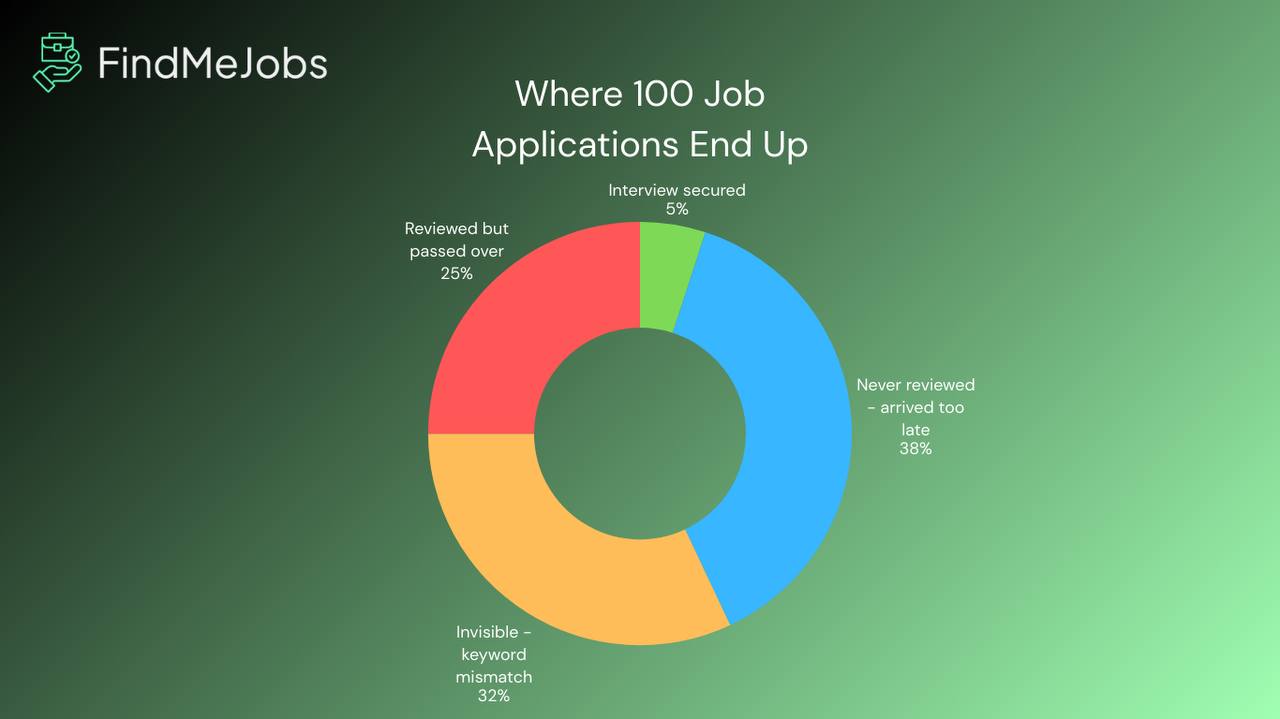
The applicant-to-interview ratio in 2024–2025 sits at approximately 3% according to CareerPlug's 2025 Recruiting Metrics Report, which analyzed over 10 million applications from 60,000+ businesses. This means that for every 100 people who apply to a given job posting, only three get invited to interview.
That's a brutal number. And it's gotten worse over time: the same data shows the applicant-to-interview rate has dropped from 15.25% in 2016 to roughly 8.4% by 2023 — a 34% decrease in just seven years — and the trend has continued into 2025.
The causes are structural and unlikely to reverse:
"Easy Apply" has exploded application volume. LinkedIn's Easy Apply and similar one-click features have made submitting applications almost frictionless. This is good for job seekers in theory, but it means companies are receiving far more applications per posting than they did five years ago — without meaningfully more hiring capacity to process them. More applicants per role, same number of interviews available.
AI screening tools have raised the floor. More companies are using automated tools to filter applications before human review, which means an application with the wrong keywords or format can be triaged out even faster than before.
Remote roles attract national applicant pools. A role that once competed locally now competes nationally or globally, which multiplies the applicant count dramatically for any posting with remote flexibility.
The implication of all this: your per-application success rate has fallen significantly from where it was even three to four years ago. The right response to this is not despair — it's recalibrating your strategy to account for the actual math.
The Core Math: Working Backwards From an Offer
The cleanest way to determine how many applications to send per week is to work backwards from what you're trying to achieve — a job offer — and calculate what inputs that requires at each stage of the funnel.
Here's the hiring funnel as the 2025 data describes it:
| Funnel Stage | Conversion Rate | Source |
|---|---|---|
| Application → Recruiter screen | ~3% average (varies by role) | CareerPlug 2025 |
| Recruiter screen → Hiring manager interview | ~40–60% | Industry benchmark |
| Hiring manager interview → Final round | ~30–50% | Industry benchmark |
| Final round → Offer | ~20–40% | Industry benchmark |
| Application → Offer (end-to-end) | ~0.5–2% | Aggregated across studies |
To generate one job offer, most job seekers need somewhere between 50 and 200 applications, depending heavily on how well those applications are targeted and tailored. The median across multiple 2025 studies is approximately 100 applications per offer for the average searcher — though that number drops dramatically for candidates applying strategically (more on this shortly).
Now let's translate this into weekly targets:
| Search Timeline Goal | Applications Needed (est.) | Applications Per Week Needed |
|---|---|---|
| Offer in 3 months | ~100 applications | ~8–10 per week |
| Offer in 2 months | ~100 applications | ~12–14 per week |
| Offer in 6 weeks | ~100 applications | ~16–20 per week |
| Offer in 4 weeks | ~100 applications | ~25+ per week |
These numbers assume average conversion rates. If your applications are consistently well-tailored and early (both of which improve conversion), your per-application success rate rises — meaning you need fewer total applications for the same outcome and can achieve your timeline with lower weekly volume.
The Most Important Statistic in This Article
Before we get to the specific weekly targets, you need to understand the single data point that changes everything about how you approach this question.
Huntr's Q2 2025 Job Search Trends Report, which analyzed 461,000 applications, found a striking difference in conversion rates based on whether applicants tailored their resumes:
- Tailored resume: 5.75% application-to-interview conversion rate
- Generic resume: 2.68% application-to-interview conversion rate
- Difference: 115% improvement from tailoring alone
Let that settle. Simply tailoring your resume to the job description — matching its language, emphasizing the most relevant experience, adjusting your summary — more than doubles your per-application success rate. Every tailored application is worth roughly 2.1 generic applications in terms of interview probability.
This is the core tension in the "quality vs. quantity" debate, quantified. It's not that quantity doesn't matter — it does. It's that untailored quantity is dramatically less efficient than tailored quality. Sending 20 tailored applications is statistically equivalent to sending 42 generic ones.
This means the real strategic goal is not maximum volume. It's maximum tailored volume — as many tailored applications as your time allows, delivered as early as possible after each posting goes live.
The Right Number by Situation
The ideal weekly application count varies based on your current employment status, career level, and how much time you can realistically dedicate to your search. Here's a breakdown of the right targets for each situation.
Unemployed and Searching Full Time
When you're not working, you have the most time available for your search — but that doesn't mean unlimited volume is the right answer.
Target: 15–20 tailored applications per week
At this pace, you're applying to three to four positions per workday, which allows time for genuine tailoring on each one while maintaining enough volume to generate real momentum. Going significantly above this threshold tends to produce quality degradation — applications become less tailored, targeting becomes less precise, and the per-application success rate falls enough to undermine the volume advantage.
The exception: if you have a strong, well-configured AI tailoring tool in your workflow, you may be able to maintain quality at higher volumes (20–25 per week) because the most time-intensive part of tailoring is automated.
Below 10 applications per week when unemployed, your search will feel slow and frustrating — the pipeline doesn't generate enough interviews to create the optionality that leads to good offers.
Your daily breakdown:
- Morning: Review new alerts, apply to 2–3 new roles immediately (critical for first-applicant advantage)
- Afternoon: Deeper work — follow-ups, interview prep, networking outreach
- Evening: Review tracker, prepare for next day
Currently Employed and Searching
When you're working full time, your weekly capacity is genuinely limited. As we covered in a previous article, employed job seekers average roughly 5 hours per week for their search.
Target: 5–10 tailored applications per week
This is achievable within a 5-hour weekly budget, especially with AI tailoring reducing the per-application time investment. At this pace, you'll submit 20–40 applications per month, which is enough to generate meaningful pipeline — but only if those applications are well-targeted and submitted early.
The timing constraint employed job seekers face is actually their biggest threat to application quality. Manual discovery (scrolling boards) eats the majority of limited search time. Automated real-time alerts solve this by eliminating discovery time entirely, freeing every available hour for actual application work.
Below 5 applications per week while employed, progress is very slow and the search typically extends well beyond the average 5-month timeline.
Senior or Executive Level
At senior IC, director, VP, and C-suite levels, the application math changes significantly. These roles have smaller applicant pools, longer hiring timelines, and a much heavier dependence on networking and referrals relative to cold applications.
Target: 3–7 applications per week, with heavy networking emphasis
At senior levels, the quality-over-quantity principle becomes even more pronounced. A badly targeted senior application wastes more time (both yours and the recruiter's) and can actually create negative impressions. The focus at this level should be on highly selective, deeply researched applications — and on generating warm introductions through your network rather than cold applications wherever possible.
The data is clear that referrals dramatically outperform cold applications at all levels, but the effect is especially pronounced for senior roles where "who vouches for you" carries significantly more weight.
Career Changer
If you're transitioning industries, functions, or both, you're effectively competing with your experience discount against candidates who have direct experience in the target role. Your application-to-interview conversion rate will be lower than average until you've built more direct signals of fit.
Target: 10–15 applications per week, but with more selective targeting
For career changers, the quality imperative is at its highest. A generic application in a new field has almost no chance — but a highly tailored application that explicitly connects your transferable skills to the role's specific requirements can be surprisingly competitive. The key is making the transfer explicit in your cover letter and resume summary rather than leaving the recruiter to infer the relevance of your background.
Quality vs. Quantity: The Full Breakdown
The debate gets framed as binary — quality OR quantity — when the reality is a spectrum. Here's how different strategies actually perform against the 2025 data:
| Strategy | Weekly Volume | Tailoring Level | Est. Weekly Interviews Generated | Burnout Risk |
|---|---|---|---|---|
| Spray and pray | 50–100+ | None | 1–2 (poor per-app rate) | Very High |
| Pure quality | 2–5 | Extensive | 0–1 (insufficient volume) | Low |
| Quality-first with moderate volume | 10–15 | Strong | 2–4 | Moderate |
| Optimised: AI-assisted tailored volume | 15–20 | Strong (AI-accelerated) | 4–6 | Low–Moderate |
The "Spray and Pray" strategy generates interviews at first glance — if you send 100 applications, even a 2% conversion rate gives you 2 interviews a week. But this only works in the short term before burnout sets in, and it typically produces interviews for poorly matched roles that don't convert to offers. The emotional toll of hundreds of rejections is also significant.
The "Pure Quality" approach produces excellent applications but at volumes too low to generate consistent pipeline. Two tailored applications per week that convert at 8% still only generates 0.16 interviews per week — meaning you'd wait months for a single first-round interview.
The optimized approach is AI-assisted tailored volume: enough weekly applications to keep the pipeline moving, each one well-targeted and keyword-matched, delivered early. This is what the math consistently points to as the most efficient job search strategy in 2025.
Where You Apply Matters as Much as How Many
Here's a finding from the Huntr Q2 2025 data that most job search advice ignores entirely: the job board you use has a massive impact on your callback rate, independent of application quality.
| Platform | Job Save Share (H1 2025) | Response / Callback Rate |
|---|---|---|
| Google Jobs | ~5% of saves | 9.3% |
| ~80% of saves | 3.3% | |
| Indeed | Growing (up 65% since Jan) | ~3–4% |
| Company career pages | Low volume | Highest (referral-level) |
| Niche / industry boards | Low volume | High |
Google Jobs delivers nearly 3x the callback rate of LinkedIn, despite capturing a small fraction of total job saves. This likely reflects a selection effect — fewer people think to use Google Jobs, so each applicant faces less competition — and LinkedIn's sheer volume means its applicant pool is saturated with "Easy Apply" submitters who haven't tailored at all.
The strategic implication: don't just optimize how many you send — optimize where you send them.
A few applications sent early through direct company career pages or discovered via Google Jobs will statistically outperform a larger batch submitted through LinkedIn Easy Apply. The highest-converting channel of all is still referral — but that's a separate strategy that runs in parallel with applications, not instead of them.
Your Application-to-Interview Ratio: The Real Diagnostic
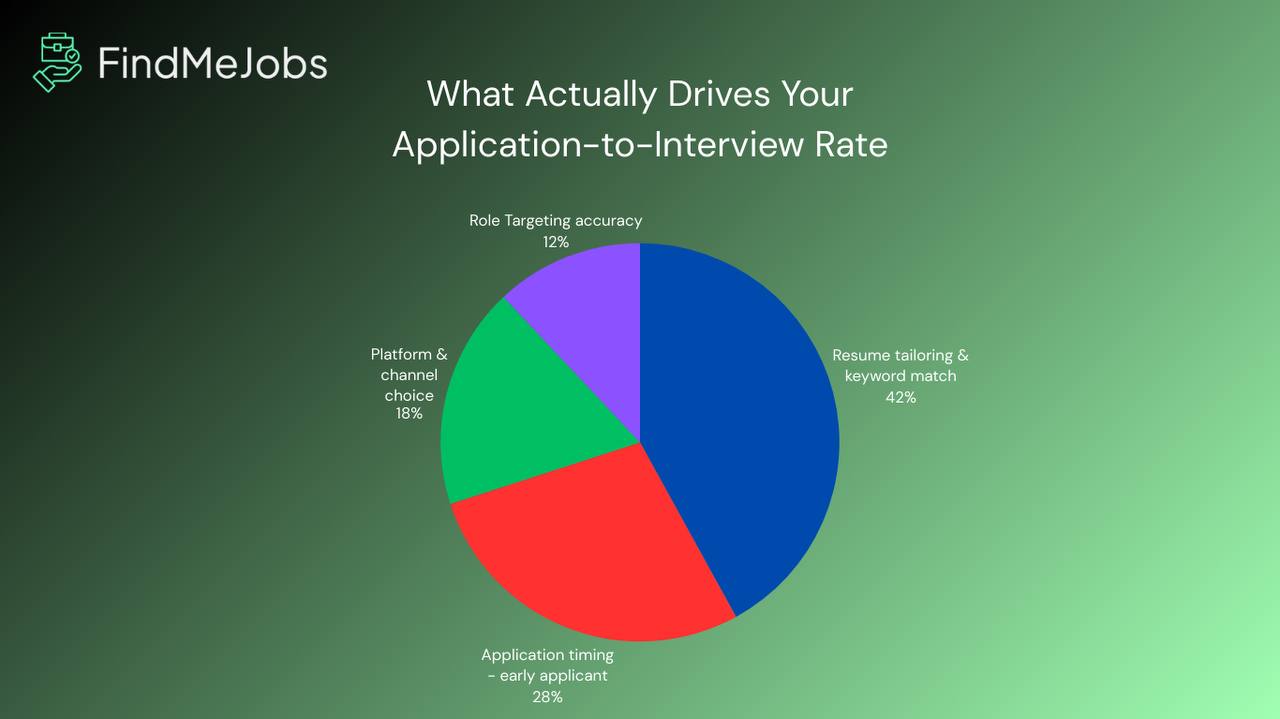
Rather than focusing purely on a weekly volume target, the most useful metric to track in your job search is your application-to-interview ratio. This is the single most actionable number in your search because it tells you whether your applications are performing or whether something in your approach needs to change before you scale up volume.
How to calculate it: Divide the number of interviews you've received by the total number of applications you've submitted. Multiply by 100 for a percentage.
What the benchmarks mean:
| Your Ratio | What It Signals | Recommended Action |
|---|---|---|
| Below 1% | Serious targeting or quality issue | Stop adding volume — fix resume, targeting, or both before continuing |
| 1–3% | Slightly below market average | Minor adjustments — check keyword alignment, broaden role targeting slightly |
| 3–5% | At market average | Solid baseline — focus on maintaining quality while pushing volume |
| 5–8% | Above average | Good signal — scale volume confidently |
| 8%+ | Excellent | Optimize for speed — apply faster and earlier to maximize first-applicant advantage |
If you've sent more than 30 applications without a single interview, the problem is not volume. Adding more applications to a broken strategy just means more rejections faster. The problem is in your resume, your targeting, your keyword alignment, or some combination — and the fix is to audit and adjust before continuing to apply.
This diagnostic is what most job search advice misses. They tell you to send more applications when the real answer might be to stop, fix what's broken, and then scale.
The Week-by-Week Application Cadence That Works
Beyond the weekly volume target, the distribution of your applications across the week matters more than most people realise. Here's why: job postings go live throughout the week, and as we covered in detail in our guide to the first-applicant advantage, applying in the first hours after a posting appears dramatically improves your odds.
This means batching all your applications on Sunday night — a common habit — is a losing strategy. You're systematically missing the early-window advantage on every posting that went live Monday through Saturday.
The optimal cadence for an employed job seeker with 5 hours per week:
| Time Slot | Activity | Time |
|---|---|---|
| Weekday mornings (daily) | Review overnight alerts, apply immediately to best matches | 15–20 min |
| Weekday lunch (daily) | Check for recruiter responses, update tracker | 10 min |
| One weekday evening | Follow-ups, resume updates, interview prep | 90 min |
| Weekend (optional) | Networking outreach, company research | 30–45 min |
For an unemployed full-time searcher:
| Time Slot | Activity | Time |
|---|---|---|
| Morning block (daily) | Alert review + 2–3 immediate applications | 60–90 min |
| Mid-morning | Networking, LinkedIn engagement, recruiter outreach | 45 min |
| Afternoon | Deeper applications for complex roles, interview prep | 60 min |
| End of day | Tracker review, follow-ups | 20 min |
The key principle in both: apply immediately when a good match appears. Not "later today." Not "this weekend." Immediately. The first-applicant advantage is real and the window compresses fast.
You may find useful:
Signs You're Applying to Too Many Jobs
More applications is not always better. Here are the signals that your volume has exceeded your ability to maintain quality:
You can't remember which version of your resume you sent where. If you're not tracking this, you're either not tailoring (bad for quality) or tailoring chaotically (bad for consistency and follow-up).
Your cover letters have stopped feeling personal. When you're writing ten cover letters a day, they start to merge. Recruiters can feel a form letter and it reflects poorly.
You're applying to roles you wouldn't genuinely accept. Spray-and-pray volume often means applying to roles outside your target salary, location, or function just to hit a number. This wastes everyone's time and clutters your pipeline with conversations that will never convert.
You're too burned out to prepare for the interviews you do get. An interview you haven't prepared for is worse than no interview — it's a wasted opportunity and leaves a bad impression with a company you might want to approach again later.
Your application-to-interview ratio is falling as you increase volume. If adding more applications is dropping your hit rate, it's a clear signal that quality is declining at the margin.
Signs You're Applying to Too Few
The opposite problem is more common than people admit — especially among perfectionists and career changers who spend so much time crafting each application that the pace becomes unsustainably slow.
You've been searching for more than 6 weeks with fewer than 20 applications sent. At this pace, you're not generating enough pipeline to make statistical progress.
You're waiting for the "perfect" role before applying. Perfect roles are rare. Excellent roles that you're a strong-but-not-perfect fit for are common — and they often produce better outcomes than the roles that seem ideal on paper.
You've tailored the same application five times without sending it. Over-editing is a form of avoidance. A good, tailored application sent today beats a perfect one sent next week because of the first-applicant window.
You haven't had a single interview in two months. At that pace, you need to either increase volume, expand your targeting criteria, or both — depending on what your application-to-interview ratio tells you.
The Framework: Setting Your Personal Weekly Target
Here's a simple decision framework for setting your own weekly application target, based on your situation:
Step 1: Determine your baseline capacity
How many hours per week can you realistically dedicate to your job search? Be honest — not aspirational.
- Under 3 hours: 3–5 applications per week maximum
- 3–5 hours (employed): 5–10 applications per week
- 5–8 hours (employed, efficient): 10–15 applications per week
- Full time (unemployed): 15–20 applications per week
Step 2: Check your AI tooling
If you have an AI tailoring tool in your workflow that reduces per-application time from 60–90 minutes to under 5 minutes, add 30–50% to your baseline capacity. The time constraint loosens significantly.
Step 3: Calibrate by career level
- Entry to mid-level: Use your full baseline target
- Senior IC / management: Reduce by 30–40%, add networking time
- Director, VP, C-suite: Reduce by 50–60%, add networking time
Step 4: Track and adjust after 2 weeks
After your first two weeks, calculate your application-to-interview ratio. If it's below 1%, don't add volume — fix quality. If it's above 5%, you can confidently push volume higher. Adjust your weekly target every two weeks based on real performance data, not intuition.
Frequently Asked Questions
Is it better to apply to many jobs or few jobs?
Neither extreme is optimal. The research consistently points to a middle path: enough volume to generate statistical momentum (at least 10 per week for most active job seekers), with each application meaningfully tailored to the specific role. Tailoring alone more than doubles your per-application conversion rate, so well-tailored moderate volume consistently outperforms high-volume generic applications.
How many job applications should I send per day?
For most active job seekers, two to four applications per day is a sustainable and effective pace that allows genuine tailoring on each one. That translates to 10–20 per week. Below two per day, progress is slow. Above five per day (without AI assistance), quality typically starts to degrade.
Is applying for 3 jobs a day enough?
Three applications per day (roughly 15 per week) is a strong pace for most job seekers — it sits right in the sweet spot between volume and quality. This rate generates enough pipeline to produce 2–4 interviews per month at average conversion rates, while still allowing time to tailor each application properly. If you're using AI tools to accelerate tailoring, you may be able to push to four or five per day without sacrificing quality.
What if I've sent 50 applications and haven't heard back?
Stop and diagnose before you continue. Calculate your application-to-interview ratio — if it's below 1%, something structural is broken. The most common culprits are: resume not mirroring job description keywords, formatting that's hard to parse, applying to roles where you're significantly under or overqualified, or consistently applying to roles that are already days old when you find them. Fix the underlying issue before sending more applications.
Does it help to apply to the same company multiple times?
Only if you're applying to genuinely different roles you're qualified for. Applying to five roles at the same company in a week signals desperation and clutters their applicant queue. If two legitimate roles exist at a target company, apply to both — but space them by a week and ensure your resume is tailored differently for each.
How long should I sustain my weekly application pace?
Until you have a signed offer. Many job seekers slow down once they're in active interview processes, which is a mistake — interview processes collapse regularly (companies freeze hiring, offers fall through, candidates get ghosted). Maintain your application pace throughout the search and only stop when you've accepted and signed.
Does the day of the week matter for applications?
Somewhat. Recruiters most actively review queues at the start of the work week — Monday and Tuesday tend to produce stronger early-window advantages. Friday afternoon and weekend applications are least likely to land at the top of an active review queue on Monday because they've been buried by the weekend's accumulation. That said, applying early after a posting goes live matters more than which day of the week it is.
The Bottom Line
The question "how many jobs should I apply to per week" has a real answer — it's not "as many as possible" and it's not "focus only on quality." It's a specific number calibrated to your situation, tracked against a performance ratio, and adjusted every two weeks based on real data.
For most active job seekers, that number sits between 10 and 20 well-tailored applications per week. For employed searchers with limited time, 5 to 10. For senior candidates, 3 to 7 with heavy networking emphasis.
The variable that matters most across all of these is tailoring. A 115% improvement in conversion rate from tailoring alone means that two tailored applications consistently outperform four generic ones. The goal is never raw volume — it's the highest tailored volume your time and tools allow, delivered early, to the right roles, through the right channels.
Track your ratio. Fix what's broken before you scale. Apply the moment a strong match appears. And keep going until you have a signed offer in hand.
Related reading:
findmejobs.co was built to maximise your tailored volume without eating your time. Real-time alerts the moment a matching role goes live. AI resume tailoring in under 30 seconds, per application, every time. First in the queue with a tailored resume — the combination the data says wins. Start your 7-day free trial, no credit card required.