Ask ten recruiters whether cover letters matter and you'll get ten different answers — some passionate, some dismissive, almost all contradictory.
Career coaches insist they're essential. LinkedIn posts declare them dead. One survey says 94% of hiring managers say cover letters influence their decisions. Another says 61% of recruiters think they don't matter. A third finds that 41% of hiring managers simply never read them.
Who's right? And more practically: should you spend time writing one?
The honest answer is that all of these statistics are simultaneously true — and understanding why resolves the contradiction entirely. Cover letters don't have a universal value. They have a conditional value that varies sharply based on company size, industry, role level, and how carefully they're written. Knowing those conditions is what separates job seekers who spend hours on letters that go unread from job seekers who write targeted, high-converting ones that meaningfully change their odds.
This guide breaks down what the research actually says, exactly when a cover letter is worth your time, when it isn't, what to say when you do write one, and what the data says about length, format, and common mistakes that cause strong candidates to get rejected at this stage.
What the Research Actually Says (It's Messier Than You Think)
The conflicting statistics on cover letters aren't the result of bad research — they reflect a genuine split in the recruiter population that most job search advice glosses over. Let's look at what the best available data shows and why it seems to contradict itself.
The Case That Cover Letters Still Matter
A Resume Genius survey of 625 US hiring managers — one of the most comprehensive studies available — produced striking findings:
- 94% of hiring managers say cover letters influence their decision about who to interview
- 83% read the majority of cover letters they receive
- 73% read them even when the job posting doesn't require one
- 49% say a strong cover letter can convince them to interview an otherwise weak candidate
- 18% say a weak or poorly written cover letter will cause them to reject an otherwise strong candidate
- 60% of companies require applicants to submit a cover letter
- 72% of hiring managers expect one even when listed as "optional"
That last point deserves emphasis. When a job posting says "cover letter optional," three-quarters of hiring managers still expect you to submit one. They treat the option as a test of motivation — candidates who take the extra step are signalling genuine interest; candidates who skip it are signalling they don't care enough to bother.
In a separate finding from the same research: 45% of hiring managers say not including a cover letter could lead them to automatically reject an application, even when the posting doesn't explicitly require one.
The Case That Cover Letters Don't Matter
Now the other side of the data.
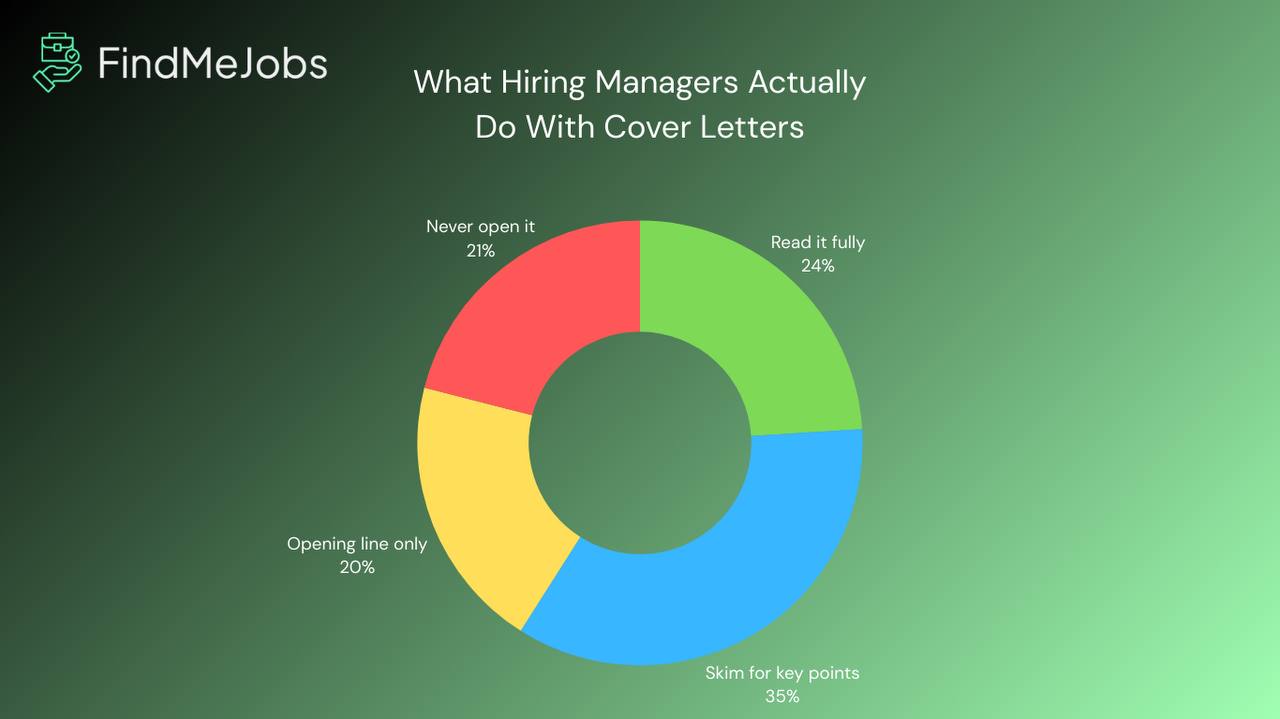
A survey of 450 hiring managers by career researcher Josh Bob found a dramatically different picture: 24% read every cover letter, 35% read some but not all, and 41% don't read them at all. That means more than four in ten hiring managers are making decisions purely from your resume, cover letter or not.
A ResumeLab survey of hiring decision-makers found that 61% said cover letters don't matter in their hiring process. And data on reading time suggests that even when cover letters are read, they're often skimmed — 37% of recruiters spend 30 seconds or less on each one.
Why the Data Contradicts Itself
These surveys aren't measuring the same thing because they aren't talking to the same people. The pro-cover-letter data skews toward:
- Medium and large companies with formal hiring processes
- HR departments where cover letters are part of the intake workflow
- Roles where writing ability, communication, and culture fit are being evaluated
The anti-cover-letter data skews toward:
- In-house recruiters at high-volume tech companies
- Agencies processing hundreds of applications with speed as the priority
- Roles where technical credentials dominate the evaluation
Both populations are real. Both are large. And the implication for job seekers is that the value of a cover letter depends entirely on which type of employer you're applying to — not on some universal truth about whether cover letters matter.
The Cover Letter Value Matrix: When to Write One and When to Skip It
Given the split in the research, here is the clearest framework for deciding whether a cover letter is worth your time on any given application.
| Situation | Cover Letter Value | Recommendation |
|---|---|---|
| Posting explicitly requires one | Critical | Always write a tailored one — skipping it will likely auto-reject you |
| Posting says "optional" | High | Write one — 72% of HMs still expect it |
| Career change or unexplained gap | Very High | Essential — your resume can't tell this story alone |
| Small company or startup (under 100 people) | High | Founder or hiring manager likely reads every word |
| Mid-size company (100–1,000 people) | Moderate–High | Formal HR process, cover letters are part of intake |
| Large enterprise / Fortune 500 | Moderate | Volume means less time per application — quality matters more |
| High-volume tech company, LinkedIn Easy Apply | Low | Often never read — spend time on resume and tailoring instead |
| Senior or executive-level role | High | At this level a strong narrative matters more, not less |
| Internal transfer or promotion | Moderate | 47% of hiring managers rate it as fairly to very important |
| Role where communication is the job (writing, marketing, PR, comms) | Very High | Your cover letter IS the work sample — treat it as such |
| Technical role with portfolio or skills test | Low–Moderate | Portfolio speaks louder; a brief letter adds context without noise |
The pattern is consistent: the more a role depends on judgment, communication, culture fit, or narrative context — and the smaller or more deliberate the hiring process — the more a cover letter matters. The more a role is evaluated on hard credentials, technical output, or volume-driven recruiting infrastructure, the less it matters.
The Numbers That Should Change How You Write (Not Just Whether You Write)
Assuming you've decided a cover letter is worth writing for a particular role, the research on what actually works is more specific than most advice acknowledges.
Length: Shorter Wins
The data on cover letter length is surprisingly consistent across multiple studies:
| Length | Recruiter Preference | Notes |
|---|---|---|
| Under 150 words | Too short | Signals low effort or inability to articulate value |
| 150–250 words | Strong | Ideal for most roles — tight, scannable, impactful |
| 250–400 words | Strong | Better for senior roles or career changers with context to provide |
| 400–600 words | Moderate | Acceptable but risks losing recruiter attention mid-read |
| Over 600 words | Weak | Most recruiters stop reading — brevity signals good judgment |
66% of job seekers believe the ideal cover letter is half a page or less — and the hiring manager data supports them. The most effective letters are tight enough to be read in under two minutes (37% of recruiters spend 30 seconds; only 15% spend two minutes or more). Every sentence needs to earn its place.
The Opening Line Determines Whether the Rest Gets Read
For 41% of hiring managers, the introduction is the most important part of the cover letter. The first sentence is where most candidates lose the reader — and it's almost always because they open with something generic.
Weakest openings (used by the majority of applicants):
- "I am writing to express my interest in the [Role] position at [Company]."
- "I was excited to see your posting for [Role] on LinkedIn."
- "Please find my application for [Role] attached."
These sentences say nothing, signal no research, and waste the 30 seconds the recruiter is willing to spend.
Strongest opening patterns:
- Reference something specific the company is currently working on or has recently achieved
- Open with a single sharp, quantified credential that directly addresses the role's core requirement
- Lead with the answer to the most obvious question the recruiter has about your candidacy
The principle: treat the opening sentence the way a great journalist treats a headline. It's not an introduction — it's a hook.
What Recruiters Are Actually Looking For
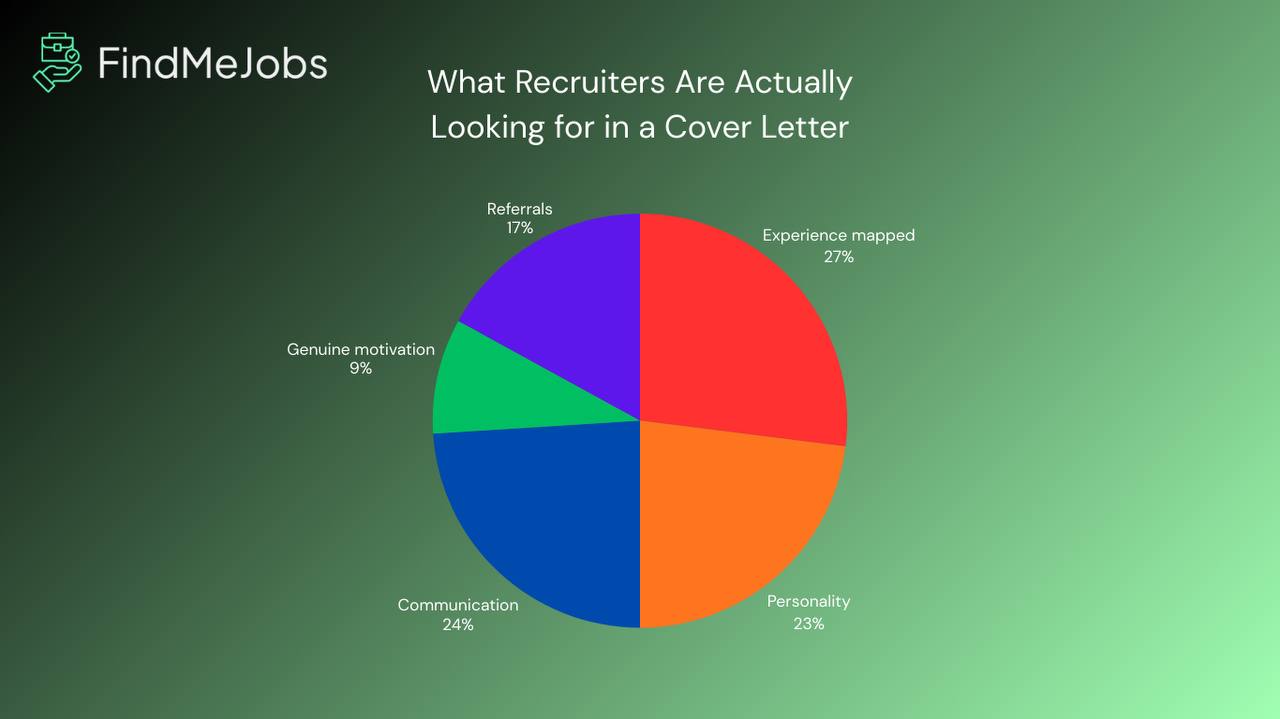
The Resume Genius data is specific about what hiring managers want to see in a cover letter:
| What recruiters look for | % of hiring managers |
|---|---|
| Connection between experience and the role's demands | 27% |
| Communication skills and writing ability | 24% |
| Candidate's motivation and genuine interest | 9% |
| Personality and cultural fit indicators | 23% |
| Referrals or mutual connections mentioned | 19% |
The implications are clear: recruiters are not reading your cover letter to learn your life story. They want to understand, quickly, how your specific experience maps to their specific problem — and whether you can communicate that clearly.
"I am a results-driven professional with a passion for excellence" communicates nothing about either. "I've spent five years building B2B content programs at companies very similar to yours — here's how that experience maps to what you're trying to do" communicates exactly what they want.
When a Cover Letter Can Save a Weak Application (And Sink a Strong One)
You may find useful:
One of the most underappreciated findings in the Resume Genius data:
49% of hiring managers say a strong cover letter has convinced them to interview a candidate whose resume alone wasn't strong enough to get through.
This is significant. For career changers, recent graduates, people returning from career gaps, or anyone whose resume doesn't tell the full story of their capability, a cover letter is not a nice-to-have — it's the mechanism that bridges the gap between what your resume shows and what you can actually do.
The flip side is equally stark:
18% of hiring managers say a weak or poorly written cover letter caused them to reject an otherwise strong candidate.
A bad cover letter actively harms you. Typos and grammatical errors are the most common rejection triggers — 68% of recruiters say they would dismiss an applicant for a single mistake in a cover letter. This is higher than the resume standard because a cover letter is, by definition, a writing sample. If you can't proofread a document you wrote specifically to impress the reader, the inference about your attention to detail in the role itself is obvious.
The other common rejection trigger: a cover letter that is clearly generic and not written for this specific role. 80% of recruiters say they receive what they describe as "junk" resumes and cover letters on job boards. A generic template letter is immediately distinguishable from a tailored one, and the former signals mass-application behaviour that undermines any claim of genuine interest in the company.
The AI Cover Letter Problem (And Why It's Getting Worse)
One of the most significant developments of recent years is that AI-generated cover letters have become widespread — and hiring managers have noticed.
As of 2026, 72% of HR professionals use AI in their hiring processes, and they are increasingly capable of identifying AI-generated application materials. The tell isn't that the writing is bad — it's that it's impersonal, structurally identical across candidates, and uses patterns (certain phrases, sentence structures, opening formulas) that have become recognisable fingerprints of AI generation.
A cover letter that was written by an AI tool with minimal customisation communicates something unintended: that you applied to this role the same way you applied to fifty others. The cover letter that signals genuine interest is the one that references something specific — something that couldn't appear in a letter sent to any other company.
The right use of AI in cover letter writing is as a drafting and editing tool that accelerates your authentic voice — not as a ghostwriter that replaces it. Use it to structure your thoughts, tighten your language, and check your writing. Don't use it to generate the substance from a single prompt, because the substance is the only part that actually matters to the reader.
Harvard Business Review's March 2025 piece on cover letters put it well: the cover letter's value lies precisely in what it can't be faked — evidence of genuine research, specific knowledge of the company's situation, and a clear articulation of why this role and this company, not just any role at any company.
How to Write a Cover Letter That Actually Gets Read: A Step-by-Step Framework
This is the actionable section. Here is the specific structure and approach that the research and recruiter feedback consistently supports.
Step 1: Do the Pre-Work (5 Minutes)
Before writing a word, answer these three questions:
- What is the single most important thing this company needs from the person in this role?
- What in my specific experience most directly addresses that need?
- Is there anything in my background that needs explaining or bridging for this to make sense?
These three answers are your cover letter. Everything else is filler.
Step 2: Write an Opening Line That Earns the Next 30 Seconds
Your opening should do one of three things:
- Name a specific, current challenge or priority at the company that your experience directly addresses
- Lead with a credential so relevant and specific that the recruiter immediately wants to keep reading
- Reference a mutual connection or something concrete about the company that demonstrates you researched them
Example of a weak opening: "I am thrilled to apply for the Head of Growth position at Acme Corp. I am a passionate marketer with eight years of experience across multiple industries."
Example of a strong opening: "You recently crossed 10,000 customers but your LinkedIn activity suggests you're still running growth entirely through paid acquisition — which is exactly where I spent the last three years at [Company], taking us from 8K to 50K customers by building the organic and referral channels that cut CAC by 40%."
One of these earns the next paragraph. The other doesn't.
Step 3: Connect Your Experience to Their Specific Requirements
In two to three sentences, draw an explicit line between your background and the role's core requirements. Don't list everything you've done — pick the two or three things most relevant to this specific posting and state them concisely.
Use the language of the job description. If it asks for "cross-functional stakeholder management," don't say "worked with different teams." Mirror the vocabulary. This simultaneously speaks the recruiter's language and serves as keyword alignment for any ATS scanning on the cover letter text.
Step 4: Address the Obvious Question (If There Is One)
Do you have an employment gap? Are you changing industries? Is your most recent title a step down from the role you're applying for? Is there a geographic mismatch?
If there's an obvious question a recruiter will have when reading your resume, address it briefly and confidently in the cover letter. Don't apologise for it — contextualise it. A career gap spent caring for a family member, upskilling, or running a business doesn't need to be defended. It needs to be stated plainly so the recruiter doesn't have to speculate.
Leaving obvious questions unanswered creates uncertainty. Uncertainty leads to pass decisions when there are 249 other applications in the queue.
Step 5: Close With a Specific Ask
Don't close with "I look forward to hearing from you" — it's passive and forgettable. Close with something that moves the conversation forward and signals confidence without arrogance.
"I'd welcome the chance to talk through how my experience with [specific thing] could apply to [specific company challenge]. Happy to work around your schedule for a brief call."
Short, specific, easy to say yes to.
Step 6: Proofread Twice, Then Have Someone Else Read It
68% of recruiters dismiss candidates for a single typo. Proofread once immediately after writing, then leave it for an hour and proofread again cold. Read it aloud — errors you miss visually are often caught auditorily. If the role is one you particularly care about, have someone else read it before you send.
The Cover Letter Checklist
Before submitting, run through this list:
| Check | Pass Criteria |
|---|---|
| Opening line | Specific, not generic — references the company or role directly |
| Length | 150–400 words depending on role level |
| Tailoring | At least 2–3 specifics that could only apply to this role |
| Experience bridge | Clear link between your background and their core requirement |
| Obvious question addressed | Any resume anomalies briefly contextualised |
| Tone | Confident, not desperate; interested, not sycophantic |
| No typos or errors | Proofread cold, ideally by a second person |
| Generic phrases removed | No "results-driven", "passionate about", "team player", "fast-paced environment" |
| Format | PDF unless posting specifies otherwise |
| Length of opening line | Does not begin with "I am writing to apply for..." |
Common Cover Letter Mistakes That Cause Strong Candidates to Get Rejected
Retelling your resume. Your cover letter should add information your resume doesn't have — not summarise what's already there. If the recruiter reads your cover letter and thinks "I could have just read the resume," it didn't do its job.
Writing about what you want. A cover letter focused on what the role would do for your career signals self-interest rather than value creation. Recruiters want to know what you bring to them — not what they bring to you. You can demonstrate genuine enthusiasm without making the letter about your own development goals.
Using superlatives without evidence. "I am an exceptional communicator with a strong track record of results." Every candidate claims this. None of them prove it in the letter. Use specific examples, numbers, and outcomes instead.
Opening with "To Whom It May Concern." It takes thirty seconds to find the hiring manager's name on LinkedIn or the company website. Using this phrase signals you didn't look. Use the hiring manager's name if you can find it, or "Dear [Company] Hiring Team" as a fallback.
Making it too long out of thoroughness. More content is not more impressive. A 600-word cover letter that meanders communicates poor editing judgment. A 250-word letter that's perfectly focused communicates good judgment. Given that 37% of recruiters spend 30 seconds or less, a longer letter doesn't get read more carefully — it just gets less of it read.
Sending the same letter with the company name swapped. Recruiters can tell. The absence of anything specific to the company or role is immediately apparent. Personalise beyond the name and title.
Frequently Asked Questions
Does a cover letter actually make a difference?
Yes — but conditionally. Research shows candidates who include a cover letter are 1.9 times more likely to get an interview callback. However, the letter must be tailored to the specific role and company. A generic cover letter adds little value, while a targeted one that connects your experience to the role's requirements can convince 49% of hiring managers to interview candidates whose resumes alone weren't strong enough.
Are cover letters useless now?
No, but their value depends on context. At high-volume tech companies using LinkedIn Easy Apply, cover letters are rarely read. At companies under 1,000 employees with formal hiring processes, 83% of hiring managers read them. The key is knowing which situation you're in and writing one only when it will actually be reviewed — and making it count when you do.
Can recruiters tell AI cover letters?
Yes, increasingly so. As of 2026, 72% of HR professionals use AI in hiring and have become skilled at identifying AI-generated materials. The tells are impersonal tone, structurally identical formatting across candidates, and recognizable AI phrase patterns. Use AI to draft and refine, but supply the specific details about the company and your experience yourself.
Do I need a cover letter if the job posting says it's optional?
In most cases, yes. 72% of hiring managers expect a cover letter even when the posting marks it optional, and 45% say not including one could lead to automatic rejection. The only time you might skip it is when applying through a platform that doesn't support cover letter submission, or when an insider confirms the company doesn't read them.
How long should a cover letter be in 2026?
150 to 400 words is the research-supported sweet spot. For most mid-level roles, 200 to 250 words is ideal — enough to make a compelling case, short enough to be read in under two minutes. For senior roles or career changers, up to 400 words is appropriate. Never exceed one page.
Does a cover letter matter more for career changers?
Yes, significantly. 49% of hiring managers say a strong cover letter has convinced them to interview a candidate whose resume alone wasn't strong enough. For career changers, the cover letter does essential work bridging the gap between what your resume shows and what you can do in a new context. It's the mechanism that explains your transition and makes your candidacy coherent.
What should I never say in a cover letter?
Avoid generic phrases that carry zero information: "results-driven professional," "passionate about [industry]," "fast-paced environments," "quick learner," and "To whom it may concern." Also avoid retelling your resume, writing about what the role would do for your career, or using superlatives without evidence. Replace every such phrase with a specific, evidenced claim.
Is a cover letter necessary for an internal job application?
47% of hiring managers rate cover letters as fairly to very important for internal applications. A well-written internal cover letter demonstrates professionalism, shows you understand the new role's requirements, and makes the case for your candidacy explicitly rather than leaving it to inference. Don't skip it.
The Bottom Line
Cover letters are not universally dead, and they are not universally essential. They are conditionally valuable — and understanding the conditions is the skill that separates effective job seekers from the ones debating the question instead of answering it.
At companies where communication and culture matter (which is most companies), in roles where hiring managers have the time and inclination to read them (which is common at under-1,000-person businesses), and for candidates who have a story their resume can't tell alone (career changers, gap-returners, career starters), a well-written cover letter can be the difference between an interview and a rejection.
The data point that should settle the debate: candidates who include a cover letter are 1.9 times more likely to get an interview callback than those who don't.
You may invest 20 minutes writing one that doesn't get read. Or you may invest 20 minutes writing one that gets you the interview — and the job. Given those stakes, the question is never really "do cover letters matter?" It's "am I writing one worth reading?"
findmejobs.co monitors job boards 24/7 and alerts you the moment a matching role appears — so you're always in the first-applicant window. Our AI tailors your resume to each specific posting in under 30 seconds. Be the first, best-matched applicant in the queue every time. Start your 7-day free trial — no credit card required.