You've sent out dozens of applications. You've tailored your resume. You've written thoughtful cover letters. You've hit submit on role after role — and then waited. And waited. And heard absolutely nothing.
No interview requests. No rejections. Not even an automated "we received your application" email from some of them. Just silence.
If this is you, the first thing you need to know is that you are not uniquely failing. The silence you're experiencing isn't a reflection of your qualifications, your resume quality, or your value as a candidate. It's a systemic feature of how hiring works in 2025 — and the data behind it is more shocking than most people realise.
The second thing you need to know: understanding exactly why it happens gives you a concrete set of tools to improve your response rate, stop wasting time on applications that were never going to go anywhere, and protect your mental health during what has become one of the most psychologically taxing experiences in modern professional life.
Let's get into the real numbers first.
The Data Is Brutal — And Getting Worse
Here's what's actually happening to applications in 2025, sourced from the research that exists:
75% of job applications receive zero response. Research from the Human Capital Institute found that three out of four job seekers never hear back from employers after applying — not even an automated rejection. Their application simply vanishes.
61% of candidates are ghosted after a job interview. The Greenhouse 2024 State of Job Hunting Report, which surveyed 2,500 workers across the US, UK, and Germany, found that nearly two-thirds of job seekers were ghosted after actually meeting with a hiring team. That number has risen nine percentage points since early 2024 alone.
27% of candidates never heard back after a final-round interview. A Glassdoor study found that more than one in four applicants who made it all the way to the final stage of the hiring process received no response — no offer, no rejection, no explanation.
You're now 3x less likely to hear back than you were in 2021. The ghosting rate has more than doubled since 2020, driven by structural changes in how hiring works that we'll break down below.
72% of job seekers say the search has negatively affected their mental health. This is not a personality weakness or a failure of resilience. It is a documented, measurable consequence of a hiring system that has broken down in a very specific and very fixable way.
The average "Candidate Time Tax" per ghosted application process is 47 hours. That includes time spent researching the role, tailoring a resume, writing a cover letter, preparing for interviews, attending multiple rounds — and then receiving nothing. Across an entire job search, the cumulative waste is enormous.
These numbers are not designed to discourage you. They're designed to reframe the silence you've been experiencing. It's not about you. It's about a system under extraordinary pressure — and once you understand the pressure points, you can navigate around them.
Why Employers Are Ghosting Candidates: The Real Causes
The ghosting epidemic didn't appear from nowhere. Several converging trends created the current environment, and understanding them explains why traditional job search advice — apply, wait, follow up politely — produces such poor results in 2025.
Cause 1: Application Volume Has Exploded
Between 2021 and 2024, weekly job application rates tripled. The primary driver is the proliferation of one-click "Easy Apply" features on LinkedIn and other platforms, combined with AI-assisted tools that help candidates mass-apply to roles.
The result: recruiters who previously managed 200 applications per role now regularly see 500 to 1,000+. Internal Greenhouse data shows recruiter workload increased 26% in Q4 2024 alone. A recruiter managing 20 open roles, each receiving 400 applications, is theoretically processing 8,000 applications simultaneously. There is no humanly possible way to provide personalised responses at that volume.
This is not an excuse for ghosting — it's an explanation. The system was not built to handle current volumes, and the candidates who suffer the consequences of that failure are the job seekers, not the recruiters.
Cause 2: Ghost Jobs Are More Common Than You Think
This is the one that will genuinely shock most job seekers: a significant portion of job postings are not real.
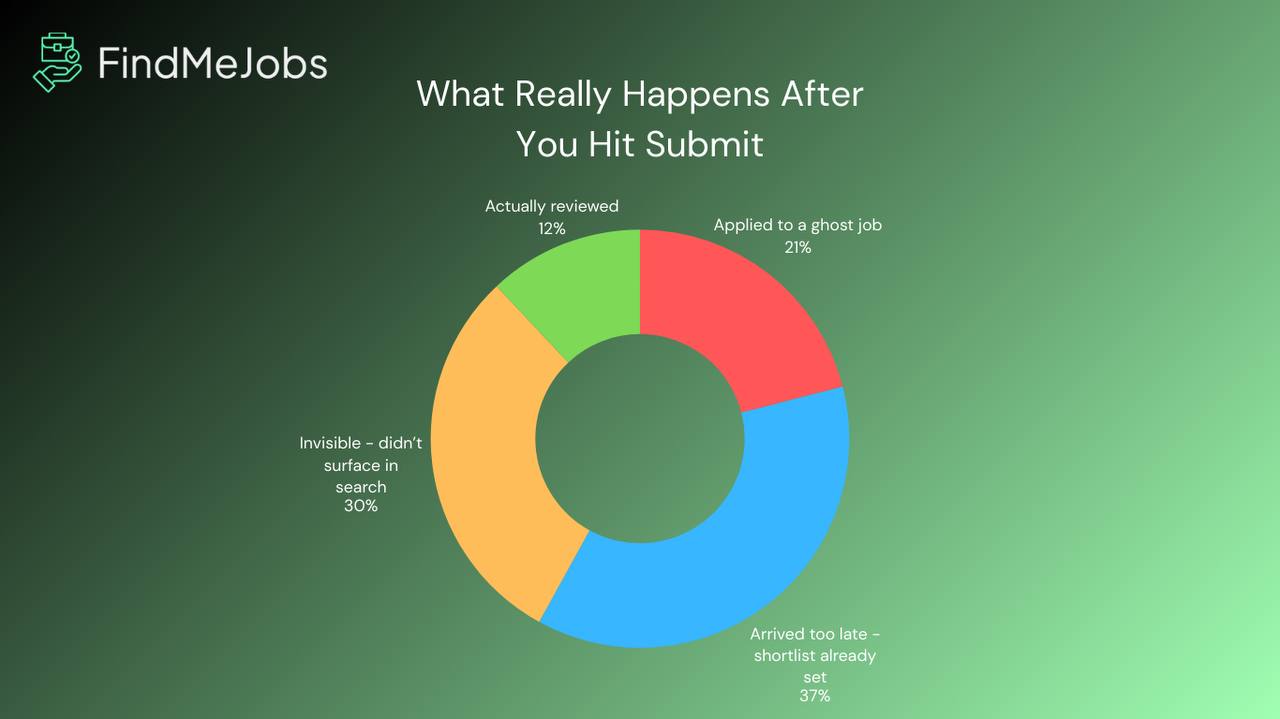
Greenhouse's platform data shows that in any given quarter, 18 to 22% of all jobs posted on their platform are ghost jobs — positions advertised with no active intent to hire. Sixty percent of US job seekers have applied to what they suspect was a ghost job.
Companies post ghost jobs for a range of reasons. Some are building candidate databases for future hiring needs. Some are testing salary expectations in the market. Some maintain listings to give the appearance of growth or stability. Some posted a role, had it put on hold due to a budget freeze, and never took the listing down. Some are simply disorganised.
If 1 in 5 of the roles you're applying to never had a hiring manager actively reviewing applications, that alone explains a significant chunk of your silence — and those applications were never going to produce a response no matter how good your resume was.
Cause 3: Hiring Decisions Are Taking Longer
The average time-to-hire in 2025 is approximately 42 to 44 days from posting to offer. For many roles, particularly senior ones, it stretches significantly longer. What this means in practice: even when a company is actively hiring, the process moves slowly enough that "we received your application" may arrive two weeks after you applied, the first interview might be four weeks in, and the whole process might span three months.
During this window, communication is often sparse even with genuine candidates. For everyone who didn't make the initial shortlist, it's typically nonexistent. Companies prioritise communicating with candidates they're moving forward — everyone else gets silence by default because there's no scalable infrastructure to do otherwise.
Cause 4: AI Screening Adds More Filters With Less Feedback
As automated screening tools become more embedded in the hiring process, more application filtering happens before a human ever reviews a resume. AI screening doesn't send rejection emails — it just doesn't surface your application for human review. You're not rejected. You're invisible. And invisible applications don't generate responses.
This is distinct from the ATS keyword issue we covered in a previous article — it's a higher-level filter that operates on top of basic ATS parsing, applied by increasingly sophisticated tools that score applications before a recruiter opens the queue.
On the candidate side, the counter-play is exactly the opposite of fighting screening tools: instead of trying to out-keyword the filters, apply earlier and more selectively so fewer of your applications ever hit the backlog in the first place. Tools like AI job search read each new posting against your actual experience range and skip the ones that don't fit, so you only see the roles that would survive screening anyway.
Cause 5: Roles Get Filled Before They're Taken Down
Companies are not required to take job listings down when a role is filled. Many postings remain active on job boards for weeks or even months after the position has been hired — either because no one updated the system, because they want to maintain a pipeline for similar future roles, or because the platform auto-renews listings.
This means a meaningful percentage of applications you've submitted went to roles that were already filled when you applied. No response is guaranteed — there's nothing to respond about.
How to Tell If a Job Is a Ghost Job (Before You Waste Time Applying)
Given that 18 to 22% of active listings are ghost jobs, developing the ability to identify them before investing time in an application is a genuine competitive skill. Here are the signals that consistently indicate a posting may not represent an active, filled-intent role:
| Signal | What It Looks Like | Risk Level |
|---|---|---|
| Posting age | Listed for 60+ days with no "reposted" indicator | High |
| Vague requirements | Unrealistically broad or contradictory skill mix | High |
| No named recruiter or contact | Generic company email or no contact info at all | Moderate |
| Multiple identical listings | Same role posted under slightly different titles | High |
| No company link in posting | Candidates told to "Google the company" | Moderate |
| Salary range missing | On platforms where most listings show salary | Moderate |
| Company recently in news for layoffs | Posting roles while simultaneously cutting staff | High |
| Role has been reposted repeatedly | Same title reappears every few weeks | High |
No single signal definitively proves a ghost job — but when three or more are present, the odds that this is an active, fill-intent role drop significantly. Applying anyway is your choice, but do it with your eyes open and don't invest heavy tailoring time in a high-signal ghost posting.
Response Rates by Platform: Where Your Applications Actually Have a Chance
Not all job boards are created equal. Response rates vary dramatically by platform, and knowing where to focus your time is one of the most underrated strategic decisions in a job search.
| Platform | Response / Callback Rate | Notes |
|---|---|---|
| Direct company career page | Highest | No intermediary, reaches recruiter directly |
| Employee referral | Highest | Bypasses all filters, treated as pre-vetted |
| Indeed | ~20–25% | Highest response rate among major boards |
| Google Jobs | ~9.3% | Low applicant volume = less competition |
| LinkedIn Easy Apply | ~3.3% | High volume, mass-apply culture kills response rate |
| Generic job aggregators | 1–3% | Lowest — often republish ghost jobs |
The pattern is consistent: the more friction in the application process, the higher the response rate. LinkedIn Easy Apply has made applying so frictionless that it's flooded with mass-apply submissions, which tanks response rates for every individual application. A role that requires you to navigate to the company's careers page and fill out a proper application form has a smaller, more intentional applicant pool — and a meaningfully higher response rate.
This is counterintuitive but important: sometimes the most effective strategy is to choose the slightly harder application path, because fewer people take it.
The Follow-Up System That Actually Moves the Needle
Most job seekers either never follow up after applying (leaving a meaningful opportunity on the table) or follow up in ways that don't help — a generic "just checking in" message that adds no value and often gets no response.
Here's a structured follow-up system with specific timing and messaging that consistently improves response rates.
Step 1: The Application Confirmation (Day 1)
Immediately after applying, if you can identify the recruiter or hiring manager on LinkedIn, send a brief connection request with a short personalised note. Not a pitch — just an introduction.
"Hi [Name] — I just applied for the [Role] position at [Company] and wanted to connect. I have [one specific relevant thing: e.g. 5 years in B2B SaaS growth marketing] and would love the chance to learn more about the team's priorities."
This does two things: it puts a real face behind the application, and it signals you're an active, engaged candidate rather than a mass-apply submitter.
Step 2: The First Follow-Up Email (Day 5–7)
If you have a direct recruiter email (from the job posting, the company website, or LinkedIn), send a brief, value-first follow-up five to seven business days after submitting your application.
Subject: Following up — [Your Name] / [Role Title]
"Hi [Name], I submitted an application for [Role] on [date] and wanted to follow up directly. I'm genuinely interested in [specific thing about the company or role — one sentence]. I've attached my resume for reference and would welcome the chance to connect. Happy to work around your schedule."
Keep it under five sentences. No desperation, no lengthy pitch, no "I know you're busy." Short, specific, easy to respond to.
Step 3: The LinkedIn Nudge (Day 10–14)
If you've connected on LinkedIn and still haven't heard back, a brief message via LinkedIn DM is appropriate. This should be even shorter than the email — two to three sentences maximum.
"Hi [Name] — wanted to follow up on my application for [Role]. Still very interested in the position. Would love five minutes to chat if timing works."
Step 4: The Final Close (Day 21)
If you've followed up twice with no response, one final message is appropriate before you close the loop mentally. This one serves a dual purpose — it confirms your continued interest and also creates a natural exit.
"Hi [Name] — I wanted to reach out one last time regarding [Role]. I remain very interested in [Company] and would welcome any update on the process. If the timing isn't right, I'd love to stay connected for future opportunities."
After this, move on. Following up more than three times shifts from persistence to pressure, and it can create a negative impression with a recruiter you may encounter again for future roles.
The Full Follow-Up Timeline at a Glance
| Day | Action | Channel | Goal |
|---|---|---|---|
| Day 1 | LinkedIn connection request | Put a face to the application | |
| Day 5–7 | First follow-up | Confirm interest, surface from queue | |
| Day 10–14 | LinkedIn nudge | LinkedIn DM | Light secondary reminder |
| Day 21 | Final close | Email or LinkedIn | Graceful final check-in |
| Day 22+ | Move on | — | Mental closure, keep pipeline active |
What to Do When You've Been Ghosted After an Interview
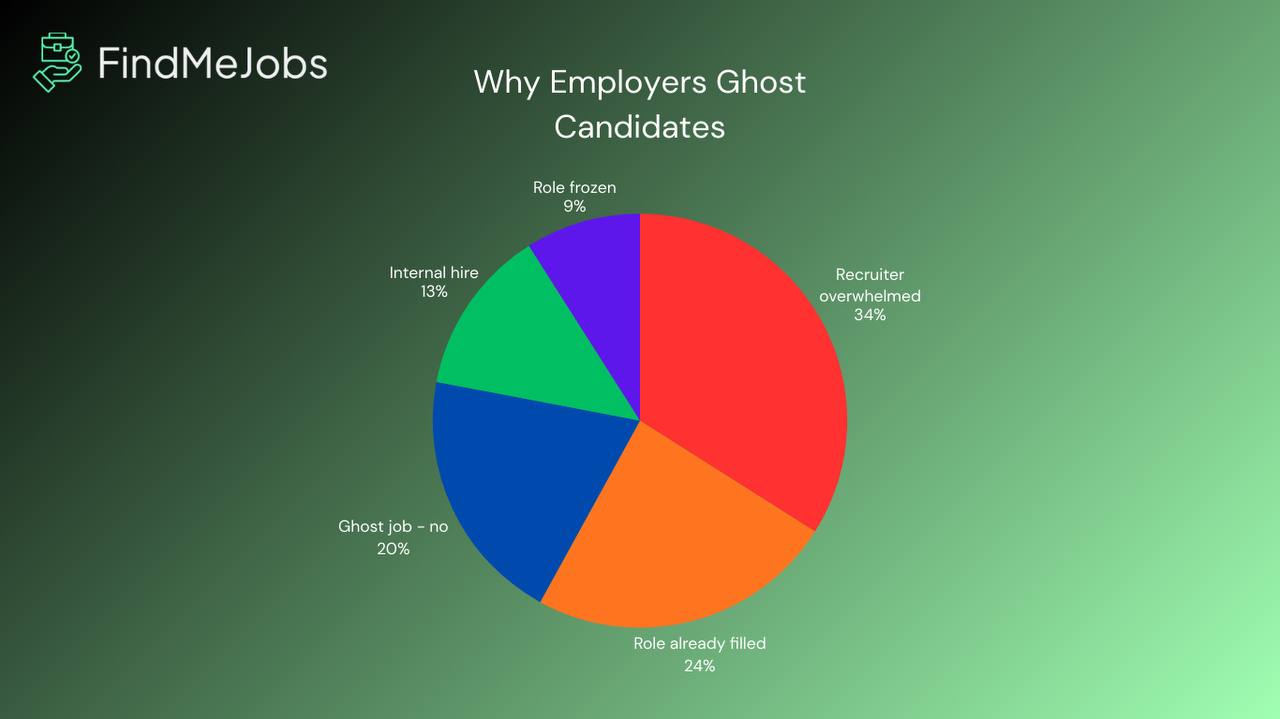
Post-interview ghosting is arguably worse than application ghosting because the time and emotional investment is so much higher. You prepared, you showed up, you performed — and then nothing. Twenty-seven percent of candidates who made it to a final-round interview experienced exactly this.
Here's the structured response:
First: separate the signal from the noise. Post-interview silence for the first five to seven business days is normal — hiring decisions take time. Don't interpret early silence as rejection.
At day 5–7: Send a brief thank-you / status-check email if you haven't already.
Subject: Thank you — [Your Name] / [Role Title]
"Hi [Name], thank you again for the time on [date]. I enjoyed learning about [something specific from the interview]. I wanted to follow up and ask if there's an update on the timeline. I remain very enthusiastic about the role and the team."
At day 14: If still no response, one more brief email is appropriate.
"Hi [Name], I wanted to follow up once more on my candidacy for [Role]. I'm still very interested and happy to provide any additional information that would be helpful. Could you share an update on the expected timeline?"
At day 21+: If you've followed up twice after the interview and received nothing, you have been ghosted. This is not a reflection of your performance. It's a reflection of a broken process.
What to do now:
- Send one final note making clear you're withdrawing from consideration and moving on. This often — counterintuitively — triggers a response, because it creates urgency.
- Leave an honest Glassdoor review of the candidate experience if you feel inclined. The data shows employer ghosting has real brand consequences — your review contributes to accountability.
- Keep your pipeline full. This is the most important lesson from every post-interview ghost. Never stop applying during an active interview process. Processes collapse regularly and without warning.
Protecting Your Mental Health During a Ghost-Heavy Search
The data is unambiguous: 72% of job seekers report that the job search process has negatively affected their mental health. When you're investing real time, energy, and hope into applications and hearing nothing in return, the psychological toll is genuine and legitimate.
A few practices that help:
Detach outcomes from self-worth at the application stage. A ghosted application is not a comment on your value as a professional. It is, statistically, most likely one of several possible explanations: the role was a ghost job, the shortlist formed before your application landed, your resume didn't surface in the keyword search, or a recruiter with 800 applications made a quick judgment call. Almost none of these explanations are about you.
Set a fixed number of applications as your daily or weekly target, not a quality-of-response target. Measuring your success by "did I hear back today" hands control of your wellbeing to a system that is fundamentally broken. Measuring success by "did I apply to my target number of well-matched roles this week" keeps control with you.
Treat the search as a numbers game with a defined timeline, not an open-ended quest. Knowing that the median job search in 2025 takes approximately 60 to 90 days with consistent effort makes the silence feel less like failure and more like a predictable part of a process that has a defined end.
Take breaks. A job search at full intensity for weeks without rest is a path to burnout. Scheduled time off from the search — even just one day a week where you don't check job boards or recruiter emails — is not laziness. It's how you sustain the pace long enough for the statistics to work in your favour.
The Ghost Job Screening Checklist
Before investing tailoring time in any application, run through this checklist:
| Check | How to Do It | Pass/Flag |
|---|---|---|
| Posting age | Check when listing was first posted (LinkedIn shows this) | Flag if 45+ days old |
| Company recently hiring freeze / layoffs | Quick news search for company + "layoffs" or "hiring freeze" | Flag if found |
| Same role posted repeatedly | Search "[Company] [Role Title]" on Google/LinkedIn | Flag if 2+ identical listings |
| Named recruiter or hiring manager listed | Check posting and company LinkedIn page | Flag if anonymous |
| Realistic requirements | Do skills listed make sense together for this level? | Flag if contradictory |
| Active hiring signals | Any news of growth, product launches, funding rounds? | Pass if found |
| Role removed and reposted | Has posting been "reposted X days ago" when it was posted much earlier? | Flag if reposted |
If a role flags on three or more of these checks, either skip it or apply with a low-effort generic resume rather than a heavily tailored one. Reserve your best work for roles that pass the checklist.
How to Improve Your Response Rate: The Consolidated Playbook
Everything in this article points to a set of concrete actions. Here's the complete playbook:
Apply early. Response rates drop significantly as posting age increases. Recruiters assemble shortlists from the earliest applications and often stop reviewing once they have enough. Applying the same day a role goes live — ideally within hours — dramatically improves your odds of being in the reviewed pile. See our full breakdown in our guide to the first-applicant advantage.
You may find useful:
Target quality platforms over volume platforms. Direct company career pages and Indeed consistently outperform LinkedIn Easy Apply on response rates. Google Jobs has a 9.3% callback rate — nearly 3x LinkedIn's 3.3%. Choose where you apply as carefully as you choose what you apply to.
Screen for ghost jobs before investing tailoring time. Use the checklist above. Applying to ghost jobs is a guaranteed waste of your time. Identifying them before you apply is a skill that compounds across an entire job search.
Tailor every application that passes your ghost-job screen. Tailored resumes produce a 115% higher application-to-interview rate than generic ones. The tailoring investment is worth it for real roles — and not worth it for ghost jobs.
Follow up with the structured system. Most candidates don't follow up at all. A well-timed, value-forward follow-up puts you in a minority and can revive an application that was buried in a large queue.
Keep your pipeline full always. Never stop applying because you're in an active interview process. Processes collapse. Ghost offers happen. A healthy pipeline is the only true buffer against the emotional devastation of a promising process that suddenly goes silent.
Frequently Asked Questions
How long should I wait before following up after a job application?
Five to seven business days is the appropriate window for a first follow-up after submitting an application. Less than five days and you risk coming across as impatient to a recruiter who may still be in the middle of reviewing the initial pool. More than ten days without a follow-up and your application has likely been buried under new submissions. After the first follow-up, wait another seven days before a second attempt, then close the loop at day 21.
Is it normal to not hear back after applying for a job?
It is extremely common — 75% of applications receive no response whatsoever. That does not make it normal in the sense of being acceptable professional behaviour, but statistically it is now the most likely outcome of any individual application. Understanding this reframes the silence: it's not uniquely happening to you, and it is not a signal about your qualifications.
What does it mean if I applied and the job was reposted?
Usually one of a few things: the previous application pool didn't produce a strong enough shortlist and they're opening the net wider, a selected candidate withdrew or turned down an offer, or the role is a ghost job being periodically refreshed to appear active. If you applied to the original posting, you can apply again to the repost with an updated, freshly tailored resume — many ATS systems treat it as a new application and resurface you in the queue.
Should I call the company to follow up?
In most industries and for most roles, calling unsolicited to follow up on an application is not recommended. It can come across as boundary-overstepping in environments where written professional communication is the norm. The exception is industries where phone-forward culture is standard — certain sales, retail, and trade roles. For the majority of office-based and technical roles, email and LinkedIn are the appropriate follow-up channels.
Why was I ghosted after my final round interview?
The most common explanations are: a budget freeze or internal headcount change that paused or killed the role after interviews were complete, a candidate from another source (referral, internal transfer) was selected, a key decision-maker changed their mind about the requirements of the role, or the company was acquired or restructured during the hiring process. In almost all cases, post-final-round ghosting is an organisational failure, not a candidate failure.
Are ghost jobs illegal?
In most US states, no — though legislation is beginning to change this. New Jersey proposed a bill in 2024 that would fine employers up to $5,000 for failing to provide candidates with a clear timeline and for maintaining listings after a role is filled. Ontario, Canada passed legislation requiring companies with 25+ employees to inform interview candidates of their status within 45 days, effective January 2025. This legislative movement reflects how widespread the problem has become — but in most places, posting a job with no intent to fill it remains legal.
How do I know if a job posting is fake?
Use the ghost job checklist above — posting age, vague requirements, no named contact, identical duplicate listings, and reposted patterns are the strongest signals. There is no guaranteed way to identify a ghost job before applying, but combining multiple signals produces a reliable enough filter to meaningfully reduce wasted applications.
The Bottom Line
The silence you're experiencing is real, it's widespread, it's getting worse, and it has almost nothing to do with your individual qualifications or the quality of your application.
Seventy-five percent of applications get no response. Sixty-one percent of candidates who complete interviews never hear back. Between 18 and 22% of active job listings are ghost jobs that were never going to produce a response regardless of what you submitted.
This is a broken system — and the job seekers who navigate it most successfully are the ones who understand its specific failure modes and build a strategy around them: applying early to real roles, screening for ghost jobs before investing tailoring time, choosing higher-response platforms, following up with structure and precision, and keeping a full pipeline that doesn't depend on any single process going right.
The search is hard. The silence is demoralising. But it is solvable — and it starts with understanding exactly what's happening on the other end of your submitted application.
Related reading:
- How to Job Search While Working Full Time
- Why Your Resume Isn't Getting Responses
- Does Applying to Jobs Early Increase Your Chances?
findmejobs.co monitors job boards 24/7 and alerts you the moment a real, matching role appears — so you're always in the first-applicant window before the shortlist forms. Our AI tailors your resume to each posting in under 30 seconds, so every application you send is doing real work. Start your 7-day free trial, no credit card required.