How to Explain an Employment Gap in an Interview (2026) | FindMeJobs
How to Explain an Employment Gap in an Interview (2026)
February 28, 2026|13 min read|FindMeJobs Team
job searchcareer adviceinterview tipsresume tips
The moment the interviewer glances at your resume and says, "I noticed there's a gap here — can you tell me about that?" is one of the most dreaded moments in any job search.
Your palms get slightly damp. Your mind races through everything you didn't do during those months. You wonder if the honest answer is going to end the interview before it really begins.
Here's what you need to know before anything else: you are not unusual, you are not disqualified, and you do not need a heroic story.
According to survey data, 3 in 5 Americans — 59% — have employment gaps in their career for one or more reasons. A 2022 LinkedIn survey of 23,000 global workers found that nearly two-thirds had taken some form of career break. This is not a niche situation. It is the majority experience. The interviewer sitting across from you has, statistically, a reasonable chance of having had their own gap — and even if they haven't, they have almost certainly interviewed dozens of people who did.
What they are evaluating is not whether your gap happened. It is how you explain it. The candidates who lose the offer are almost never the ones with the gap — they're the ones who handle the explanation badly. Defensively, vaguely, apologetically, or with too much detail. The candidates who get the offer own their story with clarity and confidence and pivot immediately back to why they're the right person for the role.
This guide gives you everything you need to do exactly that.
The recruiter landscape on employment gaps has shifted significantly since the pre-pandemic era — but the shift is more nuanced than most job search advice acknowledges. Here's what the data actually shows.
In 2021, only 38% of employers thought that resume gaps were acceptable. By 2022, that number had risen to 46%. The trajectory is consistent: post-pandemic labour market disruptions, the Great Resignation, widespread tech layoffs, and the normalisation of career breaks for caregiving, mental health, and personal development have all contributed to a more pragmatic recruiter mindset.
24/7 job-alert agent
Stop refreshing job boards
FindMeJobs runs a 24/7 agent that watches for new openings and alerts you on Telegram within minutes of a match going live. Be the first to apply, not the 200th.
LinkedIn recognised this shift by introducing a "Career Breaks" feature that allows candidates to showcase skills acquired during professional pauses. When the world's largest professional network builds infrastructure specifically for career gaps, it signals that the professional community has accepted them as a standard feature of modern working life — not an anomaly requiring explanation.
But here's the nuanced truth most career advice misses: softening attitudes doesn't mean gaps are invisible. Harvard Business School research shows that while attitudes are softening, gaps aren't completely neutral — effects differ by region and functional role. Recruiters will ask. They will notice. And how you respond will shape their assessment of your judgment, self-awareness, and readiness to return to work — which is ultimately what they're evaluating.
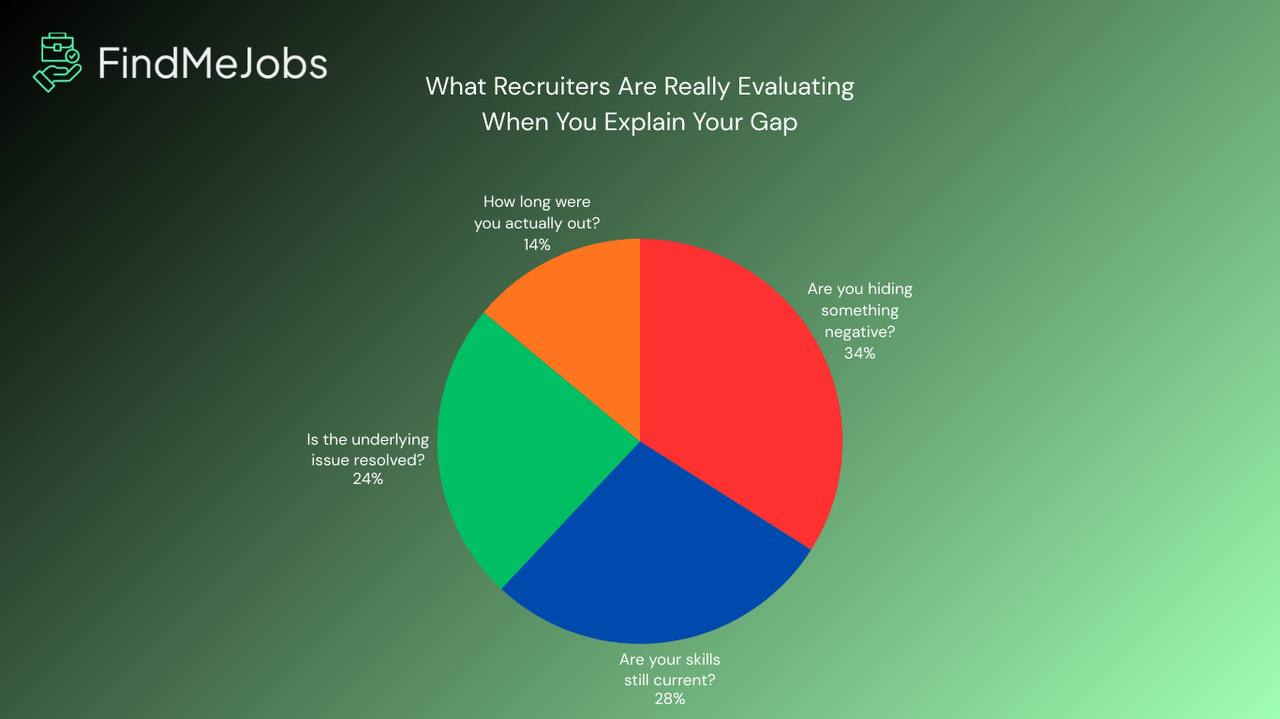
Understanding what the question is really asking gives you a huge advantage in answering it. When a recruiter asks about your employment gap, they are typically exploring one or more of four concerns:
What They Ask
What They Actually Mean
"Can you tell me about this gap?"
Are you hiding something negative — termination, performance issues, something worse?
"What were you doing during that time?"
Have you stayed engaged professionally, or has your skill set gone stale?
"Why are you ready to return now?"
Is the underlying issue resolved, or will it recur if we hire you?
"How long were you out?"
Is this a short break or a years-long withdrawal from the workforce?
Every strong gap answer addresses these four concerns — whether the interviewer asks them explicitly or not. The answer that leaves all four questions unresolved is the one that costs you the offer. The answer that resolves all four in under ninety seconds is the one that moves the conversation forward.
One of the most common anxieties around employment gaps is about duration. Here's how recruiters actually interpret gap length, based on industry consensus and recruiter feedback:
Gap Duration
Recruiter Perception
What You Need to Show
Under 1 month
Not considered a gap
No explanation needed
1–3 months
Minor — very common
Brief mention is fine; most see this as a normal job search window
3–6 months
Normal
Clear reason + one or two things you did during the period
6–12 months
Noticeable — requires explanation
Solid reason + evidence of staying professionally active
1–2 years
Significant — will definitely be asked
Clear context, specific productive activity, confident pivot to readiness
2+ years
Substantial — needs direct addressing
Honest framing, structured account of the period, strong skills currency argument
The duration matters — but it matters far less than the explanation. A two-year gap explained clearly and confidently, with evidence of skill maintenance and a compelling reason for return, will outperform a six-month gap fumbled through apologetically. Recruiters are evaluating your judgment and communication, not just the calendar.
A practical formatting tip: For gaps under twelve months, listing employment dates by year only rather than month and year (e.g., "2023–2024" instead of "March 2023–January 2024") significantly reduces visual prominence of the gap on a resume. This is standard, accepted practice — not deception. Use it for short gaps. For gaps over a year, address the period directly on your resume rather than hoping the recruiter won't notice.
This is the least stigmatised gap in the current market. Layoffs carry almost no stigma in 2026, particularly mass layoffs in tech — naming it directly is a complete explanation.
How to frame it:
State the facts briefly: role eliminated, company restructured, X number of positions affected. Then pivot immediately to what you've done since and why this role is the right next step.
Example answer:"My position was eliminated in a company-wide restructuring — about 200 roles were affected across the organisation. Since then, I've spent time completing [specific certification], consulting on [type of project], and being deliberate about finding the right next role rather than jumping at the first offer. That process led me here, because [specific thing about this company or role]."
What not to say: don't over-explain the company's financial situation, don't express bitterness toward the previous employer, and don't make the layoff sound like a personal failure.
Caregiving gaps — for children, ageing parents, or ill family members — are among the most common and most understood reasons for a career break. Family reasons are the primary reason why employees take gaps between employment, with 18% taking time to raise a family, 15% for maternity/paternity leave, and 15% to care for sick family members.
How to frame it:
State the reason simply and without over-explanation. You are not required to share medical details, and you should not apologise. Then demonstrate that the situation has resolved and you are fully available and ready.
Example answer:"I took time away to provide full-time care for a parent with a serious illness. That situation is now resolved, and I've been actively searching for the right opportunity since [date]. During that time I kept my skills current by [freelance work / online course / staying active in my field], and I'm genuinely excited to bring my full focus back to [type of work]."
What not to say: don't share more medical or personal detail than necessary, don't imply the situation might recur if you haven't resolved it, and don't frame the experience as entirely unrelated to work — caregiving develops real project management, emotional intelligence, and organisational skills.
This is the gap type most candidates are most afraid to discuss — and the one where good judgement matters most. Mental health is increasingly destigmatised in professional culture, but the interview is not the place for a detailed clinical history.
How to frame it:
You can be honest about needing time to recover without providing a diagnosis or detailed explanation. The key is demonstrating that the underlying issue is resolved and that you're returning from a position of strength, not desperation.
Example answer:"I reached a point where I needed to step back and address my health — which I did deliberately rather than pushing through at the expense of doing good work. I took [X months] to fully recover, and I've also used that time to [certify in something / consult / reflect on what I want from the next chapter of my career]. I'm in a strong place now, and I'm looking for a role where I can make a sustained, long-term contribution — which is why this opportunity caught my attention."
What not to say: don't provide clinical detail, don't apologise for having had health needs, and don't signal ongoing fragility. Confidence in your recovery is what resolves the recruiter's concern.
A deliberate career break to retrain, upskill, or pivot fields is one of the strongest possible gap narratives — if you can show genuine progress and a clear line to the current role.
How to frame it:
Treat this like a project. What was the goal? What did you do? What was the outcome? How does it connect to this role?
Example answer:"I made a deliberate decision to transition from [previous field] into [target field]. Rather than doing it while distracted by a full-time role, I took [X months] to complete [specific course/certification], build [portfolio/project], and develop a genuine foundation in the field. That's how I ended up with [specific credential or skill] — which I know is directly relevant to what you're building here."
What not to say: don't frame this as "I didn't know what I wanted to do." Even if true, reframe it as "I wanted to be intentional about the next chapter rather than reactive."
This is the gap type candidates most often try to hide — and the one where honesty, carefully framed, actually works better than evasion.
How to frame it:
Acknowledge the difficulty of the market (which is real and well-documented), show evidence of continued effort, and reframe your selectivity as a positive. Being deliberate about fit is not a weakness.
Example answer:"The market has been genuinely competitive over the past [X months], and I made a deliberate choice to hold out for the right fit rather than accept a role I'd leave in six months. During that time I've been [freelancing / volunteering / consulting / completing certifications], and I've had several processes that didn't result in offers. That experience has only clarified what I'm looking for — which is why I'm particularly interested in this role."
What not to say: don't say you "couldn't find anything" — it implies the rejection was mutual across hundreds of applications. Frame it as selectivity combined with active effort.
Regardless of which type of gap you have, every strong interview answer follows the same structure. This framework works for every gap, every length, every industry.
Part 1: Acknowledge (1–2 sentences)
Address the gap directly and briefly. Don't wait for the interviewer to drag it out of you, and don't dance around it. State the reason clearly and without apology.
Part 2: Bridge (2–3 sentences)
Describe what you did during the gap. Even if the answer is "less than I'd like," you can frame what you did learn, do, or gain — and what the experience taught you about what you want from your next role.
Part 3: Pivot (1–2 sentences)
Connect back to the role in front of you. This is the most important part and the most commonly skipped. End your answer moving forward, not backward. Make the interviewer think: "I understand, that makes sense, and now we can move on."
The full structure looks like this:
Part
Purpose
Target Length
Acknowledge
State the gap reason honestly and plainly
1–2 sentences
Bridge
Describe what you did / learned / gained
2–3 sentences
Pivot
Connect to this specific role and company
1–2 sentences
Total
Enough to answer fully, brief enough to move on
Under 90 seconds spoken
The most common mistake is spending 80% of the answer on Part 1 (the gap itself) and 20% on Parts 2 and 3 (the forward-looking content). Invert that ratio. The gap is old news. Where you're going is what matters.
Based on recruiter feedback and hiring manager surveys, here is a direct comparison of what works and what doesn't:
What Recruiters Want to Hear
What Recruiters Dread
A clear, confident one-sentence statement of the reason
A vague, evasive non-answer that raises more questions
Evidence of at least one productive thing during the period
A gap described entirely as "time off" with no context
A clean resolution — the underlying situation is over
Signals that the issue might recur after hiring
A specific pivot to this role and this company
A generic "I'm ready to get back to work" with no specificity
Honest brevity — answer fully, then stop
Over-explanation that signals anxiety or has something to hide
Confidence, not apology
"I know it looks bad, but..." — starting from the defensive
A connection between gap experience and the role
Treating the gap period as a complete professional void
The pattern is consistent: recruiters are not looking for a perfect story. They're looking for a clear, honest, forward-looking one. Perfection is irrelevant. Clarity is everything.
Before you even get to the interview, your resume is the first place your gap appears — and how you present it on the page shapes the recruiter's posture before they've said a word to you.
For gaps under 6 months: Use year-only date formatting throughout your resume (e.g., 2022–2024 rather than March 2022–January 2024). This minimises visual prominence of the gap without misrepresenting anything. Be consistent — apply the same format to all roles.
For gaps of 6–12 months: Consider adding a brief entry in your experience section. A one-line item for "Career Break — Caregiver" or "Professional Development" with one or two specific bullet points is far better than leaving a blank space the recruiter will fill with speculation.
For gaps over 12 months: Address the gap directly on your resume with a proper entry. Title it clearly ("Career Break," "Sabbatical," "Family Leave") and include one to three bullet points describing what you did during the period. Treat it like a role with intentional framing.
For gaps where you were doing some work (freelance, consulting, volunteering): List it as a role. Even one client, one project, or one volunteer commitment listed properly demonstrates professional continuity and shows the gap period wasn't a complete withdrawal.
Example resume entries:
Career Break — Caregiver (2024–2025)
Provided full-time care for a family member during critical illness
Maintained professional development through [course/certification]
Stayed current with [industry trend/tool] throughout the period
Developed growth marketing strategies for three early-stage startups
Led brand positioning projects for [type of clients]
Completed [certification] during this period
The goal in both cases is the same: don't leave the blank space. Fill it with something honest that gives the recruiter context rather than imagination.
Interviewers rarely ask "please explain your employment gap" in exactly those words. Here are the real questions you'll face:
"Walk me through your resume."
This is your opportunity to tell your career story proactively, including the gap, on your terms. Address the gap briefly as part of the narrative — don't wait for them to stop you at it. Treat it as one chapter among many, not the centrepiece.
"What have you been doing since [last job]?"
Use the three-part framework. Acknowledge, bridge, pivot. Don't ramble. End on the current opportunity.
"Why weren't you working for [X period]?"
State the reason plainly in your first sentence. Don't begin with "well, it's kind of complicated" — that's an invitation for concern. Complicated = unclear = risk.
"Are you currently interviewing with other companies?"
This isn't really about the gap — it's about your market position. Answer honestly. If you're actively interviewing, saying so signals you're in demand. If you're not, say you're being selective.
"Why are you ready to return now?"
This is the most important gap question of all — and the one most candidates under-prepare. Your answer should be specific: not "I feel ready" but "the situation that required me to step back has resolved" or "I've completed the retraining I needed" or "I've been deliberate about finding the right role and this one specifically fits for [concrete reason]."
These are the gap answer patterns that consistently damage candidacy, based on recruiter feedback:
"I needed a break from the stress." Without context, this raises immediate concerns about your ability to handle the demands of a normal job.
"I was looking but couldn't find anything." This frames your gap as involuntary failure rather than deliberate selectivity. Reframe: "I was selective about finding the right fit."
"I was dealing with some personal issues." Too vague to resolve the concern. You don't need to be clinical, but you do need to be specific enough that the recruiter can mentally file it and move on.
Lengthy negative descriptions of your previous employer. The layoff that wasn't your fault becomes a liability the moment you spend three minutes explaining how badly your old company was run.
Any version of "I know this looks bad." Opening defensively puts the recruiter in the position of agreeing with you. State your gap the way a confident professional states a fact — because that's what it is.
Lying or misrepresenting dates. Employment verification is standard. Dates of employment are almost always verified. A discovered lie about dates ends the process immediately and creates a reputation risk that follows you beyond this application.
How do you answer an employment gap question in an interview?
Use the three-part framework: acknowledge the gap directly in one to two sentences, bridge with what you did during the period (courses, freelance work, volunteering), and pivot specifically to why this role and company are the right next step. Keep the full answer under 90 seconds. The goal is not to make the gap disappear — it's to resolve the recruiter's concerns quickly and move the conversation forward.
Is a 2 year gap bad on a resume?
A two-year gap is significant and will definitely be asked about, but it is not disqualifying. Recruiters have successfully hired candidates after gaps of two, three, and even five years when the explanation was clear, skills were demonstrably current, and readiness was credible. Address it directly on your resume with a proper entry — title it clearly and include bullet points showing what you did during the period.
What is a good reason for a career gap?
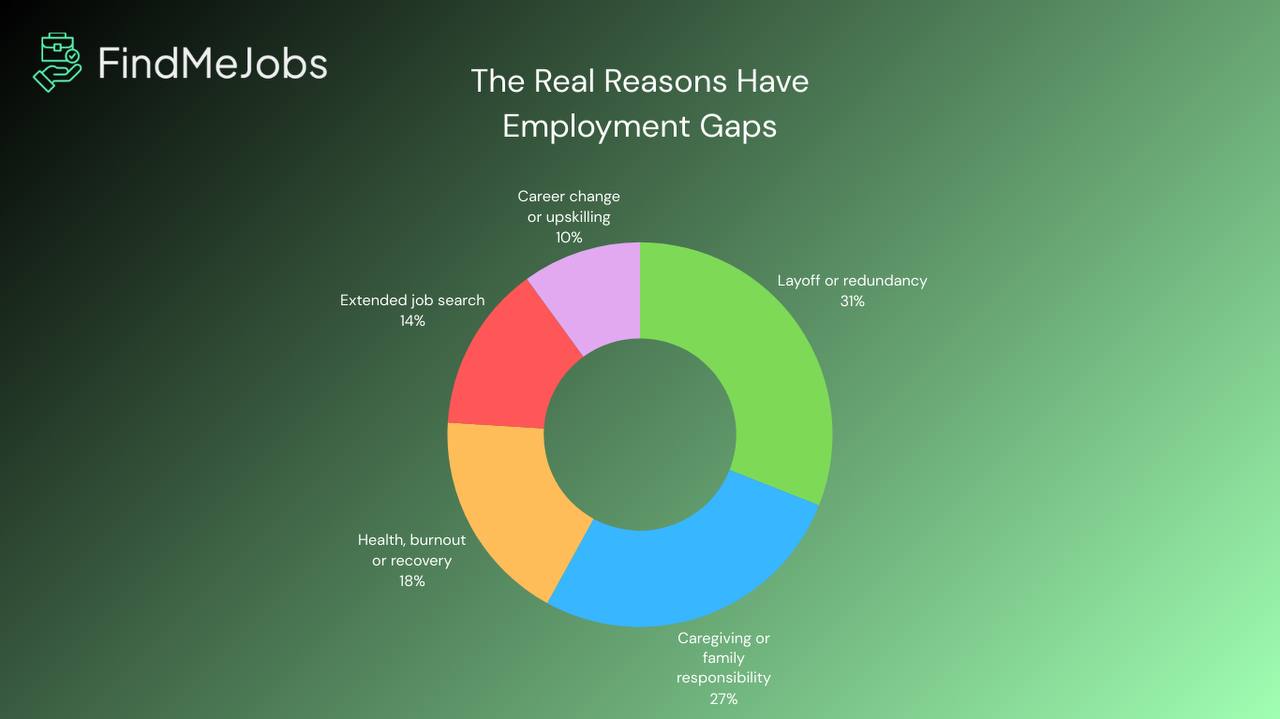
The most common and well-understood reasons include layoffs or redundancy, caregiving for children or family members, health recovery, career change or retraining, and extended job searches in competitive markets. Every reason is valid — what matters is how you frame it. A clearly explained personal recovery gap will be received better than a vaguely explained layoff gap. Honesty with confident delivery beats a "perfect" reason every time.
What is a red flag in resume gaps?
The biggest red flags are not the gaps themselves but how candidates handle them: vague or evasive non-answers, defensiveness, excessive apologising, misrepresenting employment dates, or speaking negatively about previous employers. Recruiters also watch for signs that the underlying issue hasn't resolved — if a candidate seems uncertain about their readiness to return, that's a concern regardless of the gap's reason or length.
Nearly two-thirds of workers globally have had a career break of some kind. The recruiter who asks about yours is, in many cases, asking about something they've experienced themselves or seen hundreds of times. They are not looking for a perfect story. They are looking for an honest one, told with clarity and confidence, that resolves their concern and moves the conversation forward.
The gap happened. You cannot change that. What you control entirely is the thirty to ninety seconds that follow the question about it — and those seconds are what determine whether the gap becomes an obstacle or simply a detail in a larger, more interesting story.
Prepare your answer using the three-part framework. Practice it until it feels like a fact you're stating, not a confession you're making. Lead with the forward, not the backward. And then let the interviewer ask the next question, because that's the interview you actually want to be in.
Finding the right role after a career break starts with knowing where to look — and being first when the right opportunity appears. findmejobs.co monitors job boards 24/7 and alerts you the moment a matching role goes live, so you're always in the first-applicant window. Our AI tailors your resume to each specific role in under 30 seconds. Start your 7-day free trial — no credit card required.
Apr 2, 2026|13 min read|FindMeJobs Team
How to Prepare for a Job Interview (A Complete Guide)
Only 2% of applicants get interviews. This complete preparation guide covers research, STAR method answers, checklists, and follow-up strategies.
 1. Layoff / Redundancy