Only 2% of applicants who apply for a job opening are selected for an interview. The application stage is the most brutal filter in the entire hiring process — and by the time you receive an interview invitation, you have already beaten the other 98%.
What happens next should reflect that. Instead, the most consistent finding across every major survey of hiring managers is that the most common mistake they see — cited by 70% of them — is candidates arriving unprepared.
Not unqualified. Unprepared. The distinction matters. Interviewers are not generally surprised when a candidate lacks a specific skill or experience. They are consistently disappointed when a candidate who has the background for a role clearly did not take the interview seriously enough to prepare for it. Company knowledge gaps, vague answers to predictable questions, no questions asked at the end — these are preparation failures, not qualification failures. And preparation is entirely within your control.
This guide gives you a complete, systematic method for preparing for any job interview — organised by what to do in the week before, the day before, the morning of, and inside the room itself. It includes a preparation checklist, a framework for answering behavioural questions, and a clear-eyed account of what actually determines outcomes.
What Interviewers Are Actually Evaluating
Before the preparation method, the evaluation criteria — because understanding what is being assessed determines what you prepare.
Most candidates prepare as though an interview is a test of their qualifications. It is partly that — but the interviewer already has your CV and has decided it's sufficient to warrant the conversation. What they're now assessing is something different:
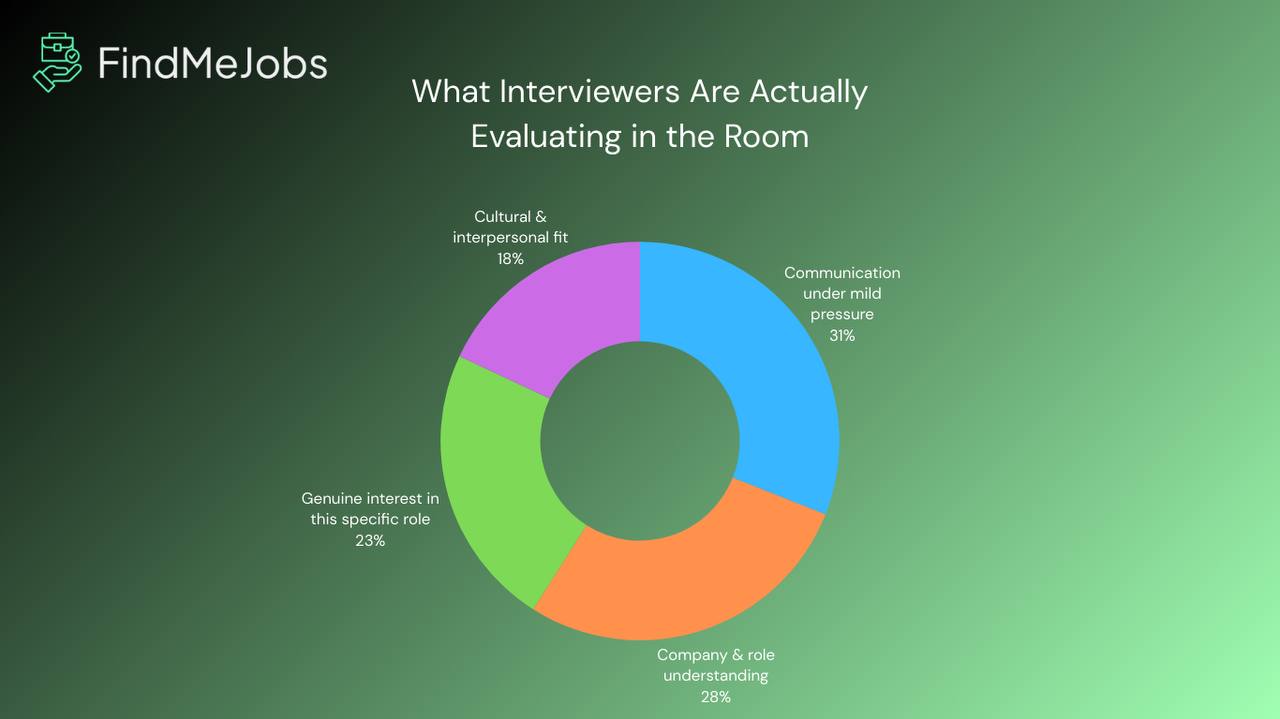
Whether you can communicate clearly under mild pressure. The interview format — structured, time-limited, with a person who has evaluative authority — creates a specific kind of low-level pressure. How you communicate in this context is a proxy for how you'll communicate in meetings, presentations, client conversations, and high-stakes situations in the role itself. Candidates who are vague, overly verbose, or visibly rattled by normal questions signal something beyond nervousness.
Whether you understand the role you're interviewing for. Not just the job title — the specific version of this role at this company, at this stage in its development, with this team's current priorities. The single biggest preparation differentiator between successful and unsuccessful candidates is whether they walk in with a genuine understanding of what the role actually requires and why it matters. Research consistently finds that 47% of candidates fail interviews specifically because they lack sufficient knowledge about the company they're applying to — a finding that is both striking and entirely preventable.
Whether you want this specific role. Interviewers can generally tell the difference between a candidate who is genuinely interested in the role and a candidate who is interviewing everywhere and treating this as one of many. Genuine interest shows in the specificity of your answers, the quality of your research, and the questions you ask. It is not possible to convincingly fake it for 40 minutes with someone who interviews candidates regularly — but it is easy to demonstrate naturally when you have actually done the preparation.
Whether you'd fit the team. Cultural and interpersonal fit is assessed throughout the conversation — from how you respond to unexpected questions, to whether you listen carefully before answering, to how you talk about previous colleagues and managers. This is the dimension least amenable to preparation in the traditional sense — but it responds powerfully to being genuinely engaged rather than performing engagement.
The Preparation Timeline
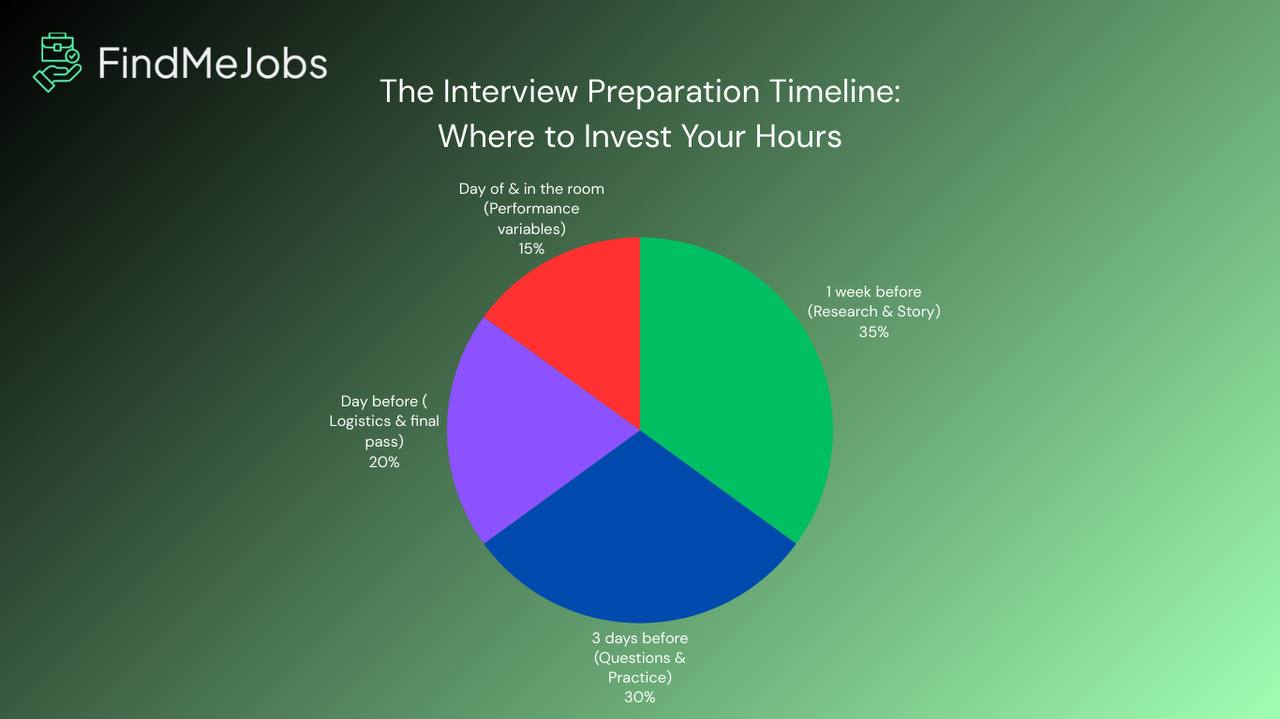
One Week Before: Research and Foundation Work
The preparation that matters most is done before the day before. A week out is when the substantive work happens — the research that takes time to absorb, the story development that requires reflection, and the question preparation that needs iteration.
Company research — four layers deep
Most candidates do surface-level research: the company website, the About page, the products or services. This is the floor, not the ceiling. Surface research produces answers that every other candidate could give. What distinguishes a prepared candidate is research at the level that requires actual investment:
- The business situation: What are the company's current priorities? What challenges are they navigating — in their market, with their product, competitively? Recent earnings reports, press coverage, the CEO's public statements, and the company's blog are all sources. For private companies, funding announcements, LinkedIn headcount trends, and recent product or expansion news fill the gap.
- The team and function: Where does this role sit in the organisation? Who leads the function? What has the team been working on recently? LinkedIn is the primary tool here — not just for the company page but for the profiles of people in the team you'd be joining.
- The role in context: Why does this role exist? Is it growth, backfill, or a new function? What does the organisation's investment in this function signal about its priorities? The job description is the starting point, but the context around it is what produces specific, intelligent answers.
- The interviewer: If you know who you're speaking with, review their LinkedIn before the conversation. What's their background? How long have they been at this company? What did they do before? This context shapes how you frame your experience and which aspects of your background to emphasise.
Your story — structured and specific
The most-asked question in any interview — "tell me about yourself" — has a simple best-practice format: present (what you do now and what you're specifically strong at), past (the key experiences that built those strengths), future (why this role and this company specifically). The answer should take 60 to 90 seconds. Most candidates give a chronological work history that takes four minutes and lands nowhere.
Spend time on this. Write it out, say it aloud, record yourself. The structure should feel natural and the content should be specific — not "I have strong leadership experience" but "I've led teams of six to ten people across two companies and I'm specifically good at the transition from zero-to-one, which is what drew me to this role."
Key accomplishments — quantified and ready
For every major claim you might make about your experience, you need a specific example. This is the substance of behavioural interview questions ("tell me about a time when..."), competency questions ("describe your approach to..."), and the implicit evidence required for any assertion about your skills.
Prepare five to eight specific accomplishments from your career that cover the range of competencies the role is likely to require. For each one, have: the context (brief), the specific challenge or opportunity, the action you took (and why), and the measurable result. The result should include a number wherever one exists — percentages, timescales, sizes, revenues, user counts. Numbers make claims believable in a way that adjectives do not.
Three Days Before: Question Preparation and Practice
Predict the questions, prepare the structure
Job interviews are less unpredictable than they feel. Most interviews are built from a predictable set of question types: behavioural questions, competency questions, situational questions, and role-specific questions. Preparing for the patterns rather than the specific questions is more efficient and more durable.
The questions you should have a prepared structure for in every interview:
- "Tell me about yourself" — the 90-second version
- "Why do you want to work here?" — specific to this company, not generic
- "What's your greatest strength?" — one specific strength with evidence
- "What's your greatest weakness?" — genuine, with a genuine mitigation
- "Tell me about a challenge you faced and how you handled it"
- "Tell me about a time you worked with a difficult colleague"
- "Where do you see yourself in five years?"
- "Why are you leaving your current role?" (or "why did you leave?")
- "What makes you the right person for this role?"
For each of these, prepare a specific answer using the framework below — not a script, but a structured response you can deliver naturally.
The STAR framework — and its limitation
The STAR framework (Situation, Task, Action, Result) is the industry standard for structuring behavioural answers and for good reason — it imposes the narrative logic that makes answers coherent. Use it as a scaffold, not a script.
The most common error in STAR answers is spending too much time on the Situation and Task (the setup) and not enough on the Action (what you specifically did) and the Result (what it produced). Interviewers are not particularly interested in the context — they are interested in your judgment and what you did with it. The Action and Result should take up at least 70% of any behavioural answer.
The second most common error is giving answers that describe what "we" did rather than what "I" specifically did. Collaborative outcomes are real and admirable — but in an interview, the interviewer is assessing your contribution, not your team's. Frame the action in terms of your specific decisions, your specific initiative, your specific judgment.
Practice aloud, not in your head
The difference between preparing in your head and practising aloud is the difference between knowing how to swim and being able to swim. Saying answers aloud surfaces the gaps — the places where the structure breaks down, where you run out of specifics, where your language becomes vague. These gaps do not appear until you try to speak the answer.
Practice in conditions that approximate the actual interview: seated, without notes, answering the question from start to finish without stopping. Record yourself if possible — playback is uncomfortable but revealing. You will notice verbal patterns (filler words, hedging language, starting every answer with "so") that you can't detect in real time.
The Day Before: Logistics and Final Preparation
Resolve every logistical uncertainty
The day before an interview, every logistical question should already be answered:
- Route and travel time confirmed, with buffer for delays
- For video interviews: platform tested, audio and camera confirmed, background checked, lighting reviewed
- What you're wearing, confirmed clean and ready
- What you're bringing: CV copies (for in-person), a notepad, your question list
- The interviewer's name and title confirmed
The morning of an interview is the wrong time to discover that the video platform requires a download, that the address you have is for the wrong entrance, or that your first-choice outfit needs ironing. These are solvable problems that eat cognitive and emotional bandwidth you need for the interview itself.
Final research pass
Review the job description once more, alongside your key accomplishments. Identify the two or three things the interviewer is most likely to specifically care about, and make sure you have a strong, specific answer to the implicit question behind each one.
Check for any news about the company or the industry published in the last 48 hours. Not because you need to reference it — but because an interviewer who asks "what do you know about what's going on for us right now?" deserves an answer that reflects current awareness, not last week's research.
The Day Of: Performance Variables
Arrive in the right state
Research from TopInterview found that 70% of hiring managers cite being unprepared as the most common interview mistake — and preparation, more than anything else, is what determines whether you arrive in a state of confidence or anxiety. A separate survey found that 93% of candidates experience interview anxiety — meaning the question is not whether you'll feel nervous but how you manage it. The practical variables that affect your state on the day of an interview are well-evidenced: sleep quality, nutrition, and physical movement. None of these are within your control the morning of — but they are all within your control the evening and morning before.
The functional preparation the morning of: review your key accomplishments notes briefly (not exhaustively), reread your "why this company?" answer, and go through your question list. This is not the time for new research or new preparation — it is the time for grounding in what you've already done.
For video interviews specifically: test everything 30 minutes before the interview starts, not five minutes before. Log in early. Have a backup plan for audio failure (phone number if the video drops). The technical reliability of your setup is a proxy for your professionalism — an interviewer whose first experience of you is managing a technical problem has a different impression from one whose first experience is a clean, well-set-up screen presence.
The first five minutes
Interviewers form their initial opinion of a candidate within the first seven minutes of an interview, and 69.5% make their hiring decision within the first five. This is not a reason to perform inauthentically or to treat the first few minutes as distinct from the rest of the interview. It is a reason to be fully present from the moment you walk in (or appear on screen) — not still settling, not still processing the logistics of arrival, but engaged and ready.
The variables that matter most in the first five minutes: eye contact, the firmness and warmth of your greeting, how you sit (upright, not sprawled, not rigidly tense), and the quality of your answer to the opening question. "Tell me about yourself" is almost always the opening question. You have practised it. Answer it well.
The Interview Preparation Checklist
| Stage | Task | Done |
|---|---|---|
| 1 Week Before | Research company — business situation, recent news, strategy | ☐ |
| Research team and interviewer on LinkedIn | ☐ | |
| Read job description and identify key competencies | ☐ | |
| Prepare "tell me about yourself" (60–90 seconds, specific) | ☐ | |
| Prepare 5–8 accomplishments with quantified results | ☐ | |
| Prepare "why this company?" answer (specific, not generic) | ☐ | |
| 3 Days Before | Prepare answers to 9 predictable question types | ☐ |
| Practise answers aloud — record if possible | ☐ | |
| Prepare 8–10 questions to ask the interviewer | ☐ | |
| Identify 2–3 key things to emphasise given this role | ☐ | |
| Day Before | Confirm logistics: route, travel time, platform, dress | ☐ |
| Test video setup if remote (audio, camera, background, lighting) | ☐ | |
| Final review of job description and key accomplishments | ☐ | |
| Check for recent company news (last 48 hours) | ☐ | |
| Print CV copies / charge devices / prepare notebook | ☐ | |
| Morning Of | Brief review of accomplishments notes and question list | ☐ |
| For video: log in 30 minutes early, test everything | ☐ | |
| For in-person: arrive 10–15 minutes early | ☐ | |
| In the Room | Lead with "tell me about yourself" — prepared and specific | ☐ |
| Use STAR structure for behavioural answers | ☐ | |
| Ask 3–5 questions — at least one company-specific | ☐ | |
| Close with: "Is there anything you'd want me to clarify?" | ☐ | |
| Within 24 Hours | Send thank-you email referencing specific interview content | ☐ |
After the Interview: The Follow-Up That Most Candidates Skip
Preparation does not end when you leave the room. The follow-up within 24 hours is a direct extension of the interview itself — and it is skipped by the majority of candidates.
A well-executed thank-you email does three specific things that a generic one does not: it references something specific from the interview conversation (which proves you were paying attention), it directly addresses the key quality the interviewer said they were looking for (which requires you to have asked the right closing question), and it reaffirms your genuine interest in the role with one specific reason grounded in what you learned in the conversation.
This combination — specificity, relevance, and genuine interest — is the thing that tips borderline decisions. It works because almost no other candidates do it. The bar is genuinely low, and the signal it sends is disproportionately large.
Frequently Asked Questions
How long should I spend preparing for a job interview?
Research from Indeed suggests candidates typically spend five to ten hours preparing for an interview — reviewing their CV, researching the company, and practising questions. This is a reasonable target for a standard role at a company you're genuinely interested in. For a high-stakes final round or a role you've been pursuing for weeks, the upper end of that range or beyond is justified. The distribution matters as much as the total — research and story development benefit from time to absorb, while question practice benefits from being as close to the interview as possible.
What is the most important thing to prepare for a job interview?
Company-specific research and a clear, structured answer to "tell me about yourself." These are the two most differentiated variables between well-prepared and unprepared candidates. 47% of candidates fail specifically because they lack sufficient company knowledge — a proportion that would be zero if everyone prepared adequately. Your opening answer sets the tone for everything that follows. Get both of these right and everything else is easier.
How do I prepare for a job interview with no experience?
Replace accomplishment examples with evidence from relevant contexts: academic projects, internships, volunteer work, personal projects, or transferable situations from adjacent experience. The STAR framework works for any example — the question is whether the action and result demonstrate the competency, not whether the context was a formal professional role. Lead with what you do have — genuine interest, specific preparation, transferable skills — rather than apologising for what you don't. Many interviewers respond more positively to a well-prepared candidate with limited experience than a poorly prepared one with more.
How do I prepare for a behavioural interview?
Identify the key competencies the role requires from the job description — usually five to eight things like leadership, collaboration, problem-solving, communication, and any technical or domain-specific capabilities. Prepare one strong STAR example for each competency, making sure the Action section is specific and first-person and the Result includes a measurable outcome. Then practise delivering each example aloud until it feels natural and takes less than three minutes. Behavioural interviews are the most predictable type of interview because they follow directly from the competencies in the job description — the preparation is mechanical if you approach it systematically.
What should I do if I don't know the answer to an interview question?
Say so, briefly, then do your best with what you do know. "That's a scenario I haven't encountered directly — the closest thing I can draw on is..." is a far stronger answer than a vague, rambling attempt to appear more experienced than you are. Interviewers generally respond well to intellectual honesty and the ability to reason through novel problems. They respond poorly to candidates who clearly don't know something but try to hide it with volume of words. If you genuinely need a moment to think, take it: "Let me think about that for a second" is not a weakness.
Is it okay to bring notes to a job interview?
Yes — for a list of questions to ask and a brief reference for key dates, figures, or facts you want to have ready. What notes should not be is a crutch for delivering answers you haven't internalised. Reading from notes while answering a question about your own experience signals that you haven't genuinely prepared the material — only transcribed it. Use notes as a reference, not a script.
What should I do the night before a job interview?
Finalise your logistics (route confirmed, outfit ready, bag packed), do a brief review of your accomplishments and question list — not exhaustive new preparation but grounding in what you've already done — and then protect your sleep. The marginal benefit of an additional hour of preparation the night before is almost always outweighed by the benefit of a full night's sleep on interview performance. Cognitive function, emotional regulation, and verbal fluency — all of which directly affect interview performance — are meaningfully impaired by poor sleep in ways that are not recoverable with coffee.
How do I prepare for a video job interview specifically?
Video interviews require all the same preparation as in-person interviews plus specific technical and environmental preparation. Test your audio and camera quality at least 30 minutes before the interview starts — not five minutes before. Check your background and lighting (natural light from in front of you is better than a window behind you). Log in early so any technical issues can be resolved before the scheduled start time. Position your camera at eye level so you're looking into it rather than up or down. Maintain eye contact by looking at the camera, not the faces on screen — this is the single most common video interview mistake and it reads as disengagement even when it isn't. Dress as you would for an in-person interview — the fact that the interviewer can only see your top half is not a reason to dress down.
The Bottom Line
You earned the interview. You were selected from the 98% who weren't. The preparation that follows is not an optional extra — it is the mechanism by which the quality of your application is converted into an offer.
The candidates who do this consistently are not unusually talented or unusually confident. They are unusually prepared. They know what the company is doing and why it matters. They have specific, quantified examples ready for the competencies the role requires. They have practised their answers until the structure is internalised. They have questions ready that show they were paying attention.
None of that is difficult. All of it takes time. And almost every candidate who doesn't do it wishes they had.
Related reading:
- How Many Jobs Should You Apply to Per Week?
- How to Job Search While Working Full-Time
- Why Your Resume Isn't Getting Responses
Getting to the interview is the hardest part of the job search — only 2% of applicants make it. findmejobs.co monitors job boards 24/7 and alerts you the moment a matching role posts, so you're always in the first-applicant window and competing for more of those 2% moments. Start your 7-day free trial — no credit card required.