How to Evaluate a Job Offer: A 5-Point Scorecard (2026) | FindMeJobs
How to Evaluate a Job Offer: A 5-Point Scorecard (2026)
April 2, 2026|14 min read|FindMeJobs Team
job searchcareer advicejob hunting tips
Getting a job offer feels like the finish line. For most job seekers, the search has been long enough that when the offer arrives, the overwhelming impulse is relief — and relief has a way of making people say yes to things they haven't fully examined.
The data suggests this is happening at scale in both directions. Offer acceptance rates just hit 51% in Q2 2025, down from 74% in 2023 — meaning nearly half of all offers extended are now being declined. At the same time, a significant share of the candidates who do accept offers regret the decision within months, as the gap between what was promised in interviews and what the role actually involves becomes clear.
Both errors — accepting too quickly and declining too quickly — have the same root cause: no structured framework for evaluation. The offer arrives, the candidate reacts emotionally (in either direction), and a decision that will shape the next two to five years of their professional life is made on feeling rather than analysis.
This guide gives you the framework. A systematic way to evaluate any offer across the dimensions that actually determine whether a role is good for you — compensation, role quality, growth, culture, and risk — along with the red flags that warrant walking away, the triggers that warrant negotiating before deciding, and the questions to ask yourself before you respond.
The first and most important step in evaluating a job offer has nothing to do with the offer itself. It is asking for time to consider it properly.
Most employers expect candidates to ask for time. Standard practice is 24 to 72 hours for straightforward offers and up to five business days for complex packages involving equity, relocation, or significant compensation decisions. Asking for time is not a signal of low enthusiasm — it is a signal of professionalism. A candidate who asks for 48 hours to review an offer carefully is demonstrating the same considered judgment they'd apply to any significant decision in the role itself.
24/7 job-alert agent
Stop refreshing job boards
FindMeJobs runs a 24/7 agent that watches for new openings and alerts you on Telegram within minutes of a match going live. Be the first to apply, not the 200th.
The way to ask: "Thank you — I'm genuinely excited about this opportunity. I'd like to take a couple of days to review the full details carefully before responding. Would [specific date] work for you?" Name a date. Don't ask how long you have. Naming a date is more confident and gives the employer a clear expectation to work with.
Use that time to run through every dimension below — in writing, not just in your head.
Most candidates evaluate compensation by looking at base salary and stopping there. This systematically undervalues some offers and overvalues others. Total compensation includes several components that vary significantly across employers and roles, and the differences compound over time.
Base salary is the most visible number and the anchor for everything else — pension contributions, overtime calculations, and future raises are typically based on it. Compare base salary against current market rate for the role, level, and geography using multiple sources. A single data point from one salary site is not a reliable benchmark.
Bonus structure requires more scrutiny than most candidates give it. The headline bonus percentage means little without understanding: what triggers it, how consistently it has been paid historically, whether it's discretionary or formulaic, and whether the targets are realistic given current business conditions. A 20% bonus that requires hitting targets no one has reached in three years is worth less than a 10% bonus that is consistently paid.
Benefits translate directly into monetary value and are frequently underweighted in offer comparisons. Health insurance quality and employee premium costs can vary by thousands of dollars annually across employers. Pension or retirement contribution matching is deferred compensation — an employer contributing 6% of salary into a pension is providing meaningful additional compensation that doesn't appear in the salary figure. Parental leave, sick pay, and life insurance cover have direct financial value in scenarios that are genuinely likely to occur.
Equity (options or restricted stock units) requires the most careful analysis of any compensation component. For early-stage companies, equity can be worth significant money or nothing — the outcome depends on factors you cannot control and information you may not have access to. For public companies, restricted stock units are more straightforward to value but still require understanding the vesting schedule, any performance conditions, and what happens to unvested equity if you leave or the company is acquired.
Non-monetary compensation has real value that is harder to quantify but worth estimating. Remote flexibility is worth roughly 8% of salary in commuting costs, time, and lifestyle quality for many workers. A generous learning and development budget has compounding career value. An employer that covers professional membership fees or conference attendance is investing in your market value. These are not perks — they are components of total compensation.
The quality of the role itself — what you will actually be doing, with what resources, and to what effect — is where most offer evaluations are thinnest, because it is the hardest thing to assess from a job description and an interview process.
The most important question to answer before accepting any role is: what does a successful first year in this role actually look like? Not the job description. Not what you were told in the interview. What are the specific outcomes you'd need to produce to be considered excellent at this job in 12 months? If you don't have a clear answer, you don't yet have enough information to evaluate the role.
The secondary questions that determine role quality: How well-resourced is the function? (A marketing director with no budget or team is a very different role from one with both.) What is the decision-making authority of the position? (Titles can be misleading — ask specifically what you would be empowered to decide without escalation.) How does this role interact with other functions? (Roles that are structurally positioned to be ignored by adjacent teams are less effective regardless of the quality of the person in them.)
Scope is also a dimension worth examining. Is the role defined or being defined? Ambiguity cuts both ways — it can mean genuine opportunity to shape something, or it can mean chronic under-resourcing with no clear success criteria. The difference is detectable from the hiring manager's answers to questions about what the first 90 days look like and what the biggest challenges of the role will be.
A role that pays well and involves good work is still a poor decision if it leads nowhere professionally. Evaluating growth means assessing both the upward path within the organisation and the market value the role builds externally.
Internal growth signals: Has the person previously in this role been promoted? (If yes — where are they now? How long did it take?) Is the hiring manager the kind of person you can learn from? Does the company have a track record of promoting from within, or does it typically hire externally for senior roles? What is the typical tenure of people at your level — are they staying and advancing, or leaving after 12 to 18 months?
External growth signals: Will this role give you skills, credentials, or experience that makes you more valuable in the market regardless of whether you stay? Is the company well-regarded enough that having it on your CV opens doors? Are the problems you'll be working on genuinely interesting and transferable, or highly specialised in ways that narrow your options?
The most durable careers are built by compounding valuable experiences — each role adding something that the next employer specifically wants. Evaluate the offer for what it adds to that compound, not just what it pays.
Culture is often dismissed as a soft consideration, but it is the dimension most directly correlated with day-to-day experience and long-term tenure. A role with excellent compensation in a culture that consistently makes you miserable is a bad offer. A role at slightly below-market salary in a culture that energises you and a manager you trust is often a better decision.
The practical challenge is that culture is hard to evaluate from interviews, which are structured to show both sides at their best. The signals that are more revealing:
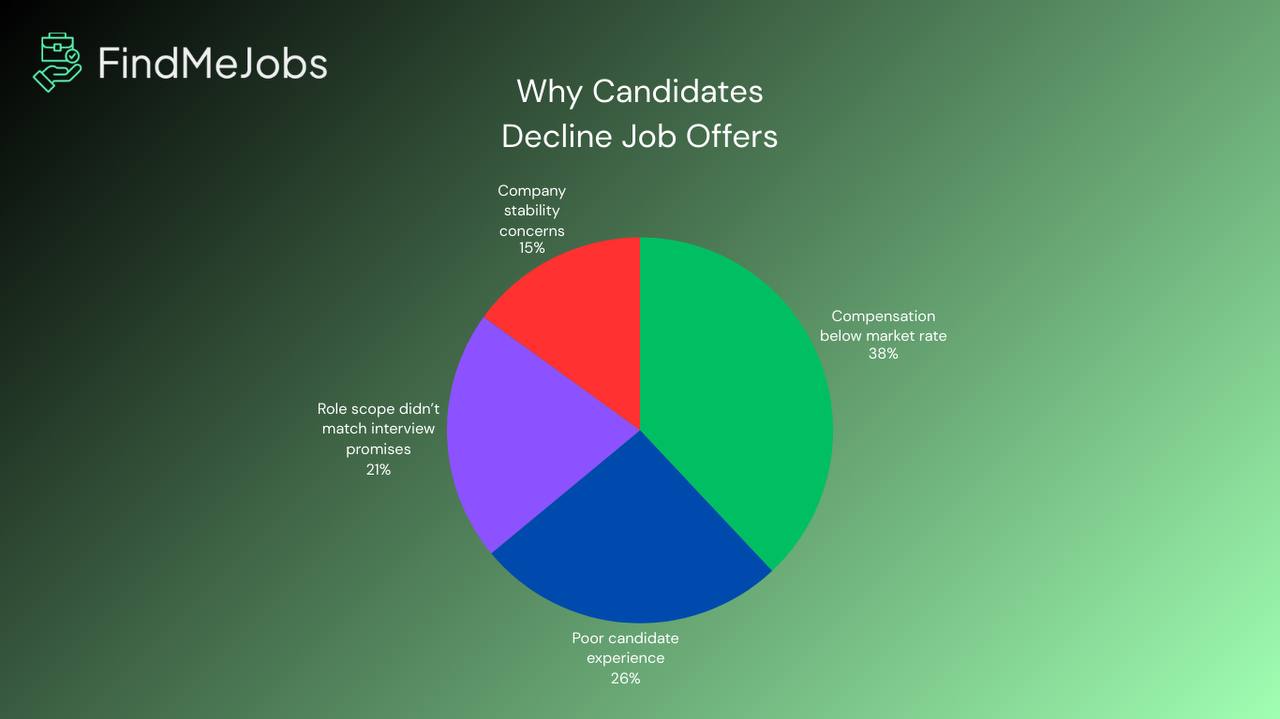
How did the company behave during the hiring process?CareerPlug's 2024 Candidate Experience Report found that 26% of job seekers declined offers specifically because of poor communication or unclear expectations during the hiring process — not because of the offer itself. The candidate experience during hiring is a reliable predictor of the employee experience after joining. A process that was disorganised, slow to communicate, or dismissive of your time will not transform into a well-run, respectful workplace once you're inside. Conversely, a process that was thoughtful, clear, and considerate is a meaningful positive signal.
What did former employees say? Glassdoor reviews are imperfect but directionally useful — especially when multiple reviews describe the same specific issues. Pay more attention to specific recurring themes than to overall star ratings. A pattern of reviews mentioning poor management, unclear expectations, or broken promises about role scope is credible signal even if the average rating is moderate.
What is the manager like, specifically? Your direct manager will have more effect on your daily experience than any other single factor. The questions you asked in the interview ("how do you give feedback?", "what's something you've changed about how you manage?") give you data points here. Trust your reading of the answers — not just what was said, but how it was said.
Every job offer carries risk — and evaluating an offer without assessing the risk profile of the employer is incomplete due diligence.
Company stability is the most material risk factor, particularly for early-stage or private companies. Questions worth researching before accepting: When did the company last raise funding, and at what stage? What is the current runway? Is the company profitable or operating at a loss? Has there been recent significant executive turnover or layoffs? How is the industry performing overall?
For public companies, the relevant signals are in earnings reports, analyst coverage, and news. For private companies, the picture is harder to assemble but not impossible — funding announcements, LinkedIn headcount trends, press coverage, and the quality of the investors are all proxies for company health.
Role stability is a separate question from company stability. Even at a healthy company, some roles are structurally precarious — recently created positions that haven't yet proven their value, roles being backfilled for the fourth time in three years, or functions that are widely known to be undervalued by leadership. Data tracking offer trends through 2025 shows that offer acceptance fell to 51% in Q2 2025, down from 74% in 2023 — a signal that candidates are scrutinising roles more carefully before committing, and that role stability is increasingly part of that scrutiny. Asking "why is this role open?" and listening carefully to the answer provides useful signal. "We're growing the team" and "we're finally replacing someone who left eighteen months ago" are very different situations.
Personal fit risk is the risk that the role, even if everything else goes well, is not the right fit for your skills, working style, or career direction. This is the most honest and most frequently avoided part of any offer evaluation. Ask yourself: would I be excellent at this job, or would I be adequate? Is this a step in the direction I want my career to go, or a step sideways because I needed to end the search?
Use this table to score any offer systematically across the five dimensions before making a decision. Rate each factor 1 to 5, where 1 = significant concern and 5 = strong positive. A total score below 30 warrants either negotiation or serious hesitation. A score above 40 across most dimensions is a strong indicator of a genuinely good offer.
Dimension
Factor
Your Score (1-5)
Notes
Total Compensation
Base salary vs market rate
Bonus — structure, trigger, history
Benefits monetary value
Equity / pension (if applicable)
Non-monetary comp (remote, L&D)
Role Quality
Clarity of success criteria
Resources and decision-making authority
Scope — defined vs ambiguous
Quality of day-to-day work
Growth Trajectory
Internal promotion track record
Learning from the hiring manager
External CV / market value built
Culture & Manager
Hiring process as culture signal
Manager quality and style fit
Team dynamics from interview signals
Risk Profile
Company financial stability
Role stability (why is it open?)
Personal fit — will you be excellent?
TOTAL
/90
Score interpretation:
70-90: Strong offer across most dimensions. Negotiate confidently where gaps exist, then accept.
50-69: Good offer with identifiable weaknesses. Understand which low scores are negotiable and which are fixed before deciding.
30-49: Significant concerns in multiple areas. Negotiate aggressively or walk away — accepting without addressing these creates known risk.
Below 30: Serious red flags across multiple dimensions. The offer as it stands is unlikely to produce a good outcome.
Some things are not negotiable and not fixable — and recognising them before you accept saves you the much harder decision of leaving six months in.
The role has been vacant for a long time without a clear explanation. A role that has been open for six months or more typically has a story. Either multiple candidates have declined it, multiple hires have failed, or the role is genuinely hard to fill for structural reasons (unclear scope, difficult manager, unrealistic expectations). None of those stories improves after you join.
The compensation structure is heavily back-loaded on uncollectable components. An offer where the vast majority of the value depends on hitting bonus targets that have never been hit, equity in a company with no realistic path to liquidity, or commission structures that are historically almost impossible to achieve is not the offer it appears to be on paper.
The manager was evasive about specific questions during the interview. Hiring managers who can't or won't answer direct questions about success metrics, team challenges, or why the previous person left are signalling something. Vague answers to direct questions in an interview become harder realities after you join.
The company asked you to start immediately with no transition time. A company that cannot accommodate a standard notice period for a candidate joining from another job is either in crisis or indifferent to your existing professional obligations. Both are meaningful signals about how they will treat you as an employee.
Multiple Glassdoor reviews mention the same specific issue. One negative review is noise. A pattern of reviews describing the same management problem, the same broken promises, or the same toxic dynamic is signal. The candidates and former employees leaving those reviews had the same experience you are about to have.
Many candidates treat "evaluate" and "negotiate" as sequential — evaluate first, then negotiate if they decide to accept. The more effective approach is to identify negotiation triggers during evaluation and address them before making your decision, because the answer to those negotiations changes whether you should accept.
The salary is below market rate. This is the most common and most straightforward negotiation trigger. Market data is widely available and a well-evidenced counteroffer based on market positioning is reasonable for almost any employer to engage with.
The benefits gap is material. If the offered health insurance is significantly inferior to your current coverage, or the pension contribution is lower than your current employer's, quantify the gap in annual terms and raise it in negotiation. Benefits are often more flexible than salary and employers may be more willing to move here.
The role scope doesn't match what was discussed in interviews. Written offer documentation sometimes describes a narrower or different role than what was conveyed verbally in the interview process. If the job description attached to the offer doesn't match your understanding of the role, clarify before accepting — not after.
The start date creates a problem. If the proposed start date doesn't give you adequate time to honour your current notice period or prepare for a relocation, negotiate it. A start date that puts you in breach of your current employment obligations is a problem that can follow you.
The equity or bonus terms are unclear. Anything in the offer that is vague about how it works, when it vests, or what triggers it should be clarified in writing before you accept. Verbal reassurances about equity or bonus are worth nothing if they're not in the contract.
When two offers arrive simultaneously — which is not uncommon for candidates who are actively searching — the scorecard above becomes the primary comparison tool. Score both offers using the same framework and compare the totals. Where the scores diverge significantly, examine why and whether the gap is bridgeable through negotiation.
The practical steps for a two-offer comparison:
Complete the scorecard for each offer independently, without reference to the other. The scores should reflect each offer on its own merits before comparison.
Identify the dimension where the offers diverge most. If one offer scores significantly higher on growth and the other significantly higher on compensation, that divergence is telling you something about the trade-off you're actually facing — not just "which pays more."
Consider the decision in terms of where you want to be in three years, not in terms of which offer feels better today. The feeling of relief at an offer's arrival is a poor guide to long-term fit. The scorecard is a better one.
If you have two genuine offers, you are in a position to negotiate both upward. Informing an employer that you have a competing offer is not a bluff — it is information that changes the negotiating dynamic in your favour. Most employers would rather negotiate than lose a candidate they've already invested time in hiring.
Standard practice is 24 to 72 hours for most offers. For complex packages involving equity, significant compensation, or relocation, up to five business days is reasonable and widely accepted. Ask for a specific deadline by proposing a date: "Would it be okay if I got back to you by [date]?" Most employers will agree, and having a specific date removes the ambiguity of an open-ended request.
Is it okay to negotiate after receiving a job offer?
Not only okay — expected. The majority of employers build negotiating room into initial offers precisely because they expect candidates to negotiate. A well-evidenced, professionally framed counteroffer is rarely the reason an offer is withdrawn. Accepting the first number without negotiating is leaving compensation on the table in most cases.
What should I do if the offer is below what I expected?
Request time to review it, then research the market rate for the role and geography using multiple sources. Come back with a specific, evidence-based counteroffer — not a round number but a specific figure anchored to market data. Frame it around the value you bring and what the market pays for it, not around what you need to cover your expenses.
How do I evaluate equity in a job offer?
For public company RSUs: multiply the number of units by the current share price, factor in the vesting schedule, and apply a discount for the risk that the share price changes. For private company options: treat them as potentially worth something but do not count them in your baseline offer valuation. Ask the company what the last 409A valuation was, what the preferred share price was in the last funding round, and what the option exercise price is. The spread between exercise price and current valuation is your paper profit — but it only matters at a liquidity event that may or may not happen.
Should I accept a job offer if I'm still waiting to hear from another company?
If you have a genuine interest in the pending opportunity, contact that employer and inform them you have an offer with a decision deadline — then ask whether they can accelerate their process. Many can. This approach is transparent, professional, and preserves your ability to consider both options before committing. Accepting an offer you may immediately rescind is harder to recover from professionally than asking the second employer to move faster.
What if I accept an offer and then get a better one?
Reneging on an accepted offer is professionally costly — the hiring manager, recruiter, and anyone involved in your process at that company will remember. The role may have been closed to other candidates. It happens, and people recover from it, but it should be a last resort. The best protection against this scenario is to evaluate the offer thoroughly before accepting and to reach a decision you're confident in rather than one made under time pressure.
How do I know if a job offer is fair?
Compare base salary against at least three sources of market data (Glassdoor, LinkedIn Salary, Levels.fyi for tech roles, or industry-specific salary surveys). Look at the total package — not just base. And apply the scorecard above to evaluate the offer across all five dimensions, not just compensation. A fair offer is one that is competitive on salary and reasonable across the other dimensions. An offer that is above market on salary but scores poorly on role quality, growth, and culture is not obviously a good deal.
What is the most common mistake people make when evaluating a job offer?
Evaluating it on compensation alone. Salary is the most visible number and the easiest to compare, which makes it disproportionately influential in most people's decision-making. But role quality, growth trajectory, manager fit, and company risk have more effect on long-term satisfaction and career outcomes than salary in most cases — particularly for mid-career and senior candidates. A 10% salary premium that comes with a poor manager, no growth path, and an unstable company is a bad trade. The scorecard above is designed specifically to counteract this bias by forcing a structured evaluation across all five dimensions before a number dominates the decision.
The job offer is not the end of the process. It is the beginning of a negotiation and the start of a due diligence exercise that, done properly, takes two to five days and produces a decision you can stand behind.
The candidates who consistently make good offer decisions are not the ones with the highest salaries or the most offers. They are the ones who have a clear picture of what they're evaluating, the discipline to use a framework rather than a feeling, and the confidence to negotiate before deciding rather than deciding before negotiating.
The offer arrived because you earned it. Take the time to make sure it's the right one before you say yes.
The best offer evaluation starts before the offer arrives — when you're applying to the right roles at the right companies in the first place. findmejobs.co surfaces matching roles the moment they post, so you're always in the first-applicant window and comparing the offers that are right for you, not just the ones you could get. Start your 7-day free trial — no credit card required.
Apr 2, 2026|13 min read|FindMeJobs Team
How to Prepare for a Job Interview in 2026 (Step-by-Step Checklist)
Only 2% of applicants get interviews. This complete preparation guide covers research, STAR method answers, checklists, and follow-up strategies.



 Dimension 1: Total Compensation