If your job search started with energy and has gradually become something you dread opening your laptop for — you are not alone, and you are not failing.
Research consistently confirms what most job seekers already feel: 66% are experiencing burnout from their search. A separate survey of 1,000 active job seekers found that 72% report the hunt has negatively impacted their mental health. And 79% experience anxiety during their search, with the single biggest source — selected by 55% of respondents — being the experience of waiting to hear back after applying or interviewing.
These numbers describe a near-universal experience. Two out of three job seekers burn out. Three out of four experience a negative mental health impact. The waiting is the worst part for more than half of them.
Here is what almost no job search advice addresses: this is not a motivational problem. It is a structural one. The modern job search has specific, identifiable features that are psychologically designed — not maliciously, but effectively — to cause exhaustion. Understanding those features, recognising which stage of burnout you're in, and applying system-level fixes rather than mindset patches is what actually breaks the cycle.
This guide does all three.
Why the Modern Job Search Is Structurally Designed to Cause Burnout
The generic advice says: stay positive, create a routine, celebrate small wins. All of those things are useful. None of them address why the job search depletes people so consistently, even highly motivated and well-prepared candidates.
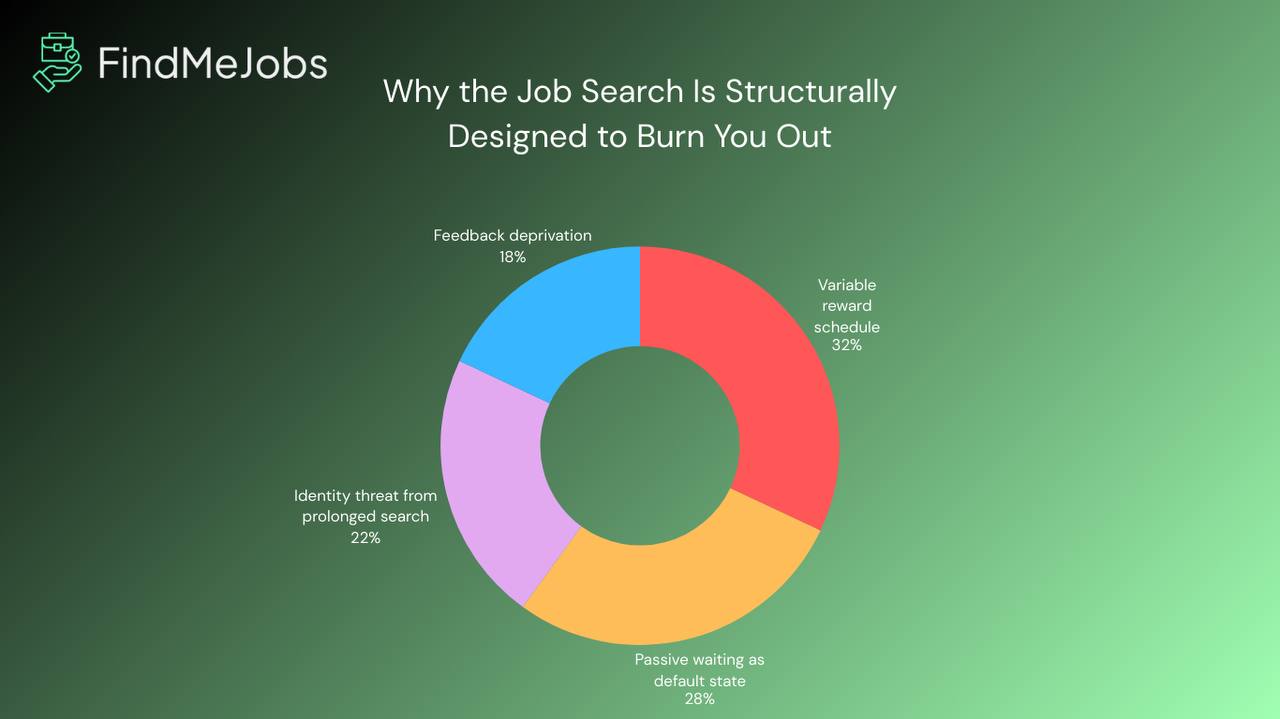
There are four structural features of modern job searching that make burnout nearly inevitable without deliberate countermeasures.
1. Variable Reward Schedules
Behavioural psychology has a well-established concept: variable reward schedules — in which a behaviour is sometimes rewarded and sometimes not, unpredictably — are the most psychologically addictive and, over time, the most exhausting patterns a person can operate under. It is the same mechanism that makes slot machines compelling and social media feeds impossible to put down.
The modern job search is a variable reward schedule operating at the worst possible timescale. You apply. Sometimes you hear back in two days. Sometimes in three weeks. Sometimes never. You send a follow-up. Sometimes it works. Sometimes the role was filled before you applied. Sometimes the recruiter has been out sick. There is no reliable relationship between input and output — which means your brain never stops scanning for the reward signal, even when you're trying to rest.
This is not a personality flaw. It is a neurological response to genuine uncertainty. The exhaustion it produces is real, measurable, and not resolved by being told to "stay positive."
2. Passive Waiting as the Default State
Research tracking active job seekers found that 41% believed fewer than a quarter of their applications were ever seen by a real person. Whether or not that belief is accurate, it describes the experience: you invest significant effort — resume tailoring, cover letter writing, research — and then enter a period of complete passivity where the outcome is entirely out of your hands.
Human psychology handles active problems well. We are genuinely poor at handling passive ones — situations where we have done everything we can do and must now wait for something external to happen. The job search produces this state repeatedly and indefinitely. Applications go out. The waiting begins. The waiting produces anxiety. The anxiety produces more compulsive checking of email and LinkedIn. The compulsive checking produces more exhaustion. And the next application requires effort that is increasingly hard to summon.
3. Identity Threat
Work is not just income for most people. It is a significant part of how they understand themselves — their skills, their status, their contribution to the world. Survey data consistently finds that more than half of adults feel they lose a piece of their identity during their job search, and that the majority experience heightened anxiety and depression while looking for work.
A job search that extends beyond a few weeks begins to feel like a referendum on your value as a professional. Every rejection, every non-response, every day without forward movement becomes data in an internal case that something must be wrong with you specifically. This is the most psychologically damaging feature of a long job search — and it is the one least addressed by "create a routine" advice, because it operates at a deeper level than scheduling.
4. Feedback Deprivation
iHire's research found that 55.3% of job seekers identified waiting to hear back after applying or interviewing as their greatest source of stress — more than the rejections themselves, more than the interview anxiety, more than the resume writing. The silence is more damaging than the "no."
This is a feedback deprivation problem. In most areas of human performance — sport, work, creative practice — feedback is what allows adaptation. You do something, you get a signal about how well it worked, you adjust. The job search almost never provides this feedback. Applications disappear. Rejections arrive with no explanation. Interviewers give non-committal closings. The job seeker has no idea whether they're getting closer or circling the same drain.
Without feedback, effort feels arbitrary. And effort that feels arbitrary is effort that eventually stops.
The Four Stages of Job Search Burnout
Burnout does not arrive all at once. It progresses through identifiable stages, and each stage requires a different response. Understanding where you are is the first step to breaking the cycle.
Stage 1: Frustration (Weeks 1–4)
What it looks like: Applications are going out. You're not hearing back from some — more than you expected. You're confused about what's happening and slightly irritated by the lack of response. Your motivation is intact but your confidence in the process is starting to wobble.
The internal experience: "Why am I not hearing back? My application is strong. Is something wrong with my resume? Should I be applying to different roles? Maybe I should apply to more things."
The risk at this stage: Over-correcting by volume. The frustration of no response triggers a natural impulse to do more — apply to more roles, cast a wider net, submit to anything loosely related. This floods the pipeline with mismatched applications, reduces tailoring quality across the board, and lays the groundwork for deeper exhaustion later.
What actually helps: A specific diagnostic, not increased volume. Review your application materials and identify whether the issue is in resume quality, job title targeting, or application timing. Address the specific problem before applying to more.
Stage 2: Fatigue (Weeks 4–8)
What it looks like: Applications are becoming harder to write. The tailoring that felt energising in week one now feels mechanical and pointless. You're still applying, but each application takes longer, the quality is declining, and the emotional investment is dropping. You're checking email compulsively without expecting good news.
The internal experience: "I don't know what I'm doing wrong. I've applied to dozens of roles and I'm getting almost no traction. Maybe I'm overqualified. Maybe I'm underqualified. Maybe the market is just broken."
The risk at this stage: The quality of your output is degrading at exactly the moment you need it most. Resume Genius's survey of 1,000 active job seekers found 72% report the hunt has negatively impacted their mental health — and Stage 2 is typically where that damage takes root. Resumes become less tailored, cover letters more generic, interview preparation less thorough. The burnout is now actively reducing your interview rate and your interview performance — which extends the search, which deepens the burnout.
What actually helps: A forced reduction in volume and a significant increase in quality. Stop applying to twenty things per week and apply to five, with the level of care and tailoring you had in week one. The short-term discomfort of slower pipeline is outweighed by the quality improvement in each application.
Stage 3: Detachment (Weeks 8–16)
What it looks like: You have become emotionally disconnected from the search. You're applying out of obligation rather than genuine engagement. Job descriptions blur together. Companies you would have been excited about in week one now feel interchangeable. You cancel interviews or attend them half-prepared because the energy required to care fully is no longer available.
The internal experience: "It doesn't matter. None of this is going to work. I should probably take whatever comes along just to end this."
The risk at this stage: This is where most long-term job search damage happens. The detachment that feels protective is actually compounding the problem. Interviewers read flat, disengaged candidates as poor fits regardless of their qualifications. The self-protective emotional withdrawal produces the outcomes it's trying to insulate against. And the "take whatever comes along" instinct leads to accepting roles that are misaligned, which often results in leaving those roles within 12–18 months — and starting the search over.
What actually helps: A genuine pause. Not a "take a few hours off" pause — a three-to-five day complete stop. No applications. No job board browsing. No checking LinkedIn. The goal is to break the habituated dread response and come back to the search with a degree of reset. Pair this with a structural strategy review: are you targeting the right roles, the right companies, the right channels?
Stage 4: Crisis (Weeks 16+)
What it looks like: The search has become a source of persistent dread, hopelessness, or shame. The identity threat described above has taken hold. You are experiencing sleep disruption, appetite changes, social withdrawal, or persistent feelings of worthlessness that are no longer specifically about the job search. The search is affecting your daily functioning in ways that extend well beyond the job search itself.
The internal experience: "Something must be fundamentally wrong with me. I don't think I'm ever going to find something. I don't know why I keep trying."
What actually helps: This stage requires more than a strategy adjustment. If you are experiencing persistent symptoms of depression or anxiety — not just about the job search, but in your daily life — professional support from a therapist or counsellor is the appropriate first step, not more applications. The job search can wait. Your mental health cannot. After stabilisation, a career coach or trusted mentor can help reframe the search and provide the external structure that the search itself refuses to provide.
The System-Level Fixes
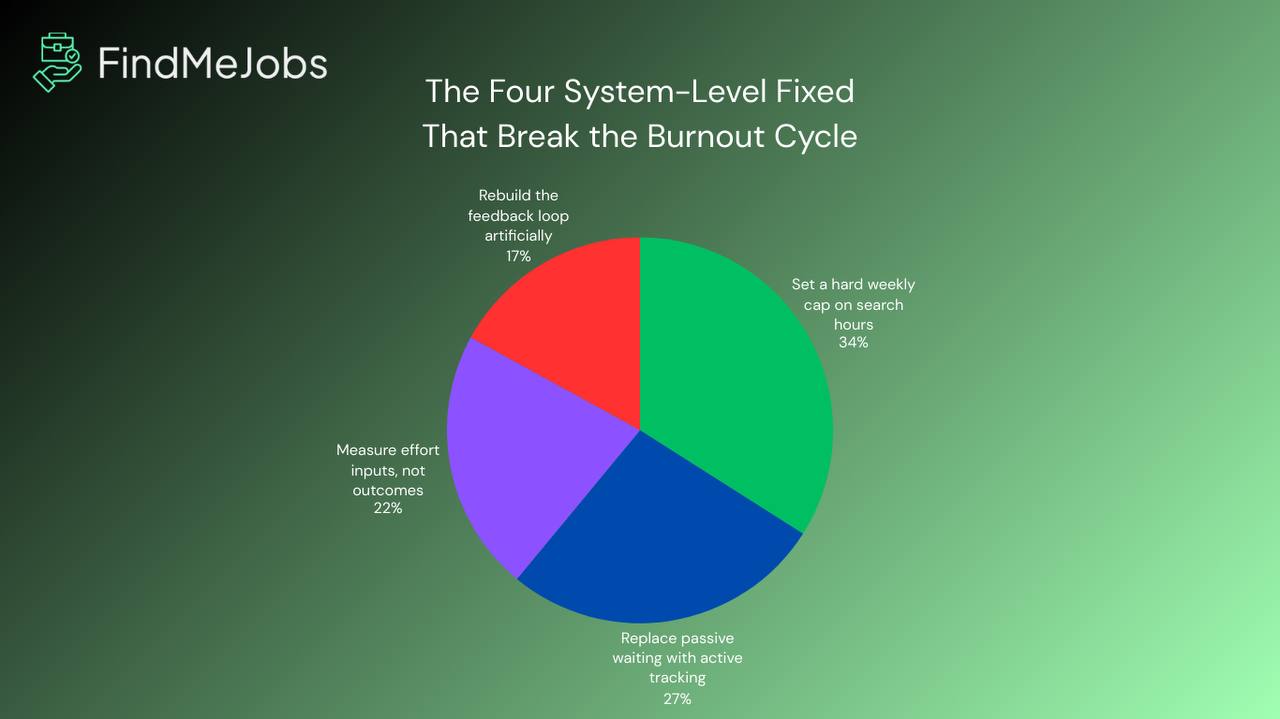
With the structural diagnosis and stage identification complete, here are the specific system-level changes that break the burnout cycle. These are not mindset tips. They are structural changes to how the search operates.
Fix 1: Set a Hard Weekly Ceiling on Search Hours
The most counterintuitive fix in any burnout situation is also the most effective: do less, but protect the quality of what you do.
Analysis of hundreds of thousands of tracked job applications found that the median time to first offer has grown to roughly 68 days — meaning the average job search is now longer than most people plan for. Treating a potentially 10-to-16-week process like a sprint is a structural mistake that produces burnout by design.
The research-consistent target for most job seekers: 20 hours per week, maximum. This is enough for 10 to 15 well-tailored applications, several follow-up communications, 2 to 3 hours of networking, and adequate interview preparation. It is not enough for compulsive email checking, doom-scrolling job boards, or applying to every tangentially related role in sight. Setting the ceiling forces prioritisation and preserves the cognitive and emotional reserves needed to perform well in interviews.
The implementation: Designate specific hours as job search hours. Morning sessions for focused application work. Afternoon for networking calls and research. A hard stop that is genuinely honoured. Outside those hours — no job boards, no email refreshes, no LinkedIn. The compulsive checking that fills the gaps is not productive job searching; it is anxiety-driven behaviour that generates no output and significant exhaustion.
Fix 2: Replace Passive Waiting With Active Tracking
The passive waiting state is where most burnout accumulates. The fix is to convert passive waiting into an active system that gives you something to do with the uncertainty rather than simply absorb it.
A simple tracking system with five columns — Company, Role, Applied Date, Follow-Up Due, Status — transforms the experience of waiting from helpless uncertainty into a managed process. Every application that has been waiting five to seven business days without a response gets a professional follow-up that day. The follow-up is not just good practice for response rates — it is psychologically significant because it gives you an action to take rather than simply wait. Agency, even small agency, is a meaningful buffer against the passivity-induced anxiety described above.
Fix 3: Separate Outcome Metrics From Effort Metrics
The most demoralising feature of job search measurement is that the primary outcome — an offer — is entirely outside your control. Measuring yourself against outcomes you cannot control is a reliable path to learned helplessness.
The fix is to track the inputs you can control and measure success against those. Number of tailored applications per week. Number of follow-ups sent. Number of networking conversations initiated. Number of interview preparation hours logged. These are controllable. They are also leading indicators of outcomes in ways that passive application submission is not.
When you hit your weekly input targets — regardless of what the market returned that week — you have done what can be done. That is a meaningful, truthful thing to recognise. It doesn't eliminate the frustration of waiting, but it prevents the search from being experienced as a referendum on your worth when the market's response is silence.
Fix 4: Rebuild the Feedback Loop Artificially
Since the job search provides almost no natural feedback, build a feedback system outside of it.
Request informational conversations with people in your target roles or companies — not to ask for jobs, but to get market intelligence and have conversations that provide actual data about how your background reads in that context. A 20-minute call with someone working in a role you're targeting will tell you more about whether your positioning is right than 40 applications with no responses.
After every interview, regardless of outcome, write a one-page debrief: what questions were asked, how you answered, what you'd change, what you learned about the company. This converts every interview — including every rejection — into actionable data rather than simply a failed outcome. Over the course of a search, this debrief practice produces a detailed map of exactly how you're reading in the market and what specific adjustments would improve your results.
Fix 5: Protect the Things That Sustain Your Capacity
This is where the "take care of yourself" advice lives — but framed correctly. Sleep, exercise, social contact, and non-job-search activities are not luxuries you add to your schedule when the search is going well. They are inputs that sustain the cognitive and emotional capacity required to do the search well. Cutting them to create more job search hours is a trade that reliably produces worse outcomes over any period longer than two weeks.
The specific evidence: sleep deprivation reduces cognitive performance, emotional regulation, and interpersonal warmth — all of which directly affect interview performance. Social isolation reduces the incidental information flow that produces referrals and opportunities. Exercise is one of the most robustly evidence-based interventions for anxiety reduction. These are not nice-to-haves. They are performance inputs for the search itself.
The practical implication: if your job search schedule has displaced sleep, exercise, or regular social contact, you have optimised for the appearance of effort at the cost of the quality of output. The appearance of effort — hours at the laptop, applications submitted — is not what produces offers. Offer-quality applications, compelling interviews, and strong referral networks are. And those require a person who is functioning well, not just working hard.
The One Thing That Accelerates Recovery Most
Across everything in this guide — the structural diagnosis, the stage identification, the system-level fixes — there is one underlying factor that shortens the burnout cycle more reliably than anything else.
You may find useful:
Reducing the waiting.
The anxiety, the identity threat, the feedback deprivation, the passive waiting — all four structural burnout mechanisms are most intense in the gap between action and outcome. The gap between submitting an application and hearing back. The gap between an interview and a decision. The gap between the active part of the search and the passive part.
That gap is not entirely within your control. But how much of the gap you create is. Candidates who apply within the first 24 hours of a posting — before the shortlist begins to form — spend less time waiting for a response that is already decided. Candidates who follow up consistently spend less time in unresolved uncertainty. Candidates who pursue referrals in parallel with applications receive responses faster than those who rely on cold applications exclusively.
The burnout is, in large part, a function of duration. Every structural choice that shortens the search — earlier applications, better targeting, stronger follow-up, more referrals — is also a mental health intervention. Not because job searching becomes fun. But because the thing that makes it unbearable is its length, and its length is partly a strategy problem with a strategy solution.
Frequently Asked Questions
Is job search burnout normal?
Yes — more normal than most people realise, because it is rarely discussed openly. Research puts the burnout rate among active job seekers at 66%, with a separate survey finding 72% report negative mental health impact. If you are burned out by your job search, you are experiencing what the majority of your peers are experiencing. That doesn't make it less hard, but it does mean it is not evidence of personal failure.
How long does job search burnout last?
It depends on two things: how long the search continues, and whether you make structural changes to the search itself. A search that continues unchanged for months while the candidate becomes progressively more depleted can sustain burnout indefinitely. A search that is restructured — with a volume ceiling, an active tracking system, and deliberate recovery practices — typically sees burnout symptoms reduce within two to three weeks of the structural changes, even before an offer arrives.
Should I take a break from job searching if I'm burnt out?
A genuine short break — three to five days of complete disconnection — is often the most productive thing a Stage 3 or Stage 4 job seeker can do. The break itself doesn't produce offers, but it breaks the cycle of habituated dread that is reducing application quality and interview performance. The risk is in the break becoming permanent. Set a specific return date before you stop, and use the break to do the strategy review described above rather than simply exhausting yourself further.
What's the difference between job search burnout and depression?
Job search burnout is a situational exhaustion caused by the specific stressors of an extended, high-uncertainty, feedback-deprived process. Its symptoms typically include reduced motivation, compulsive checking behaviours, declining application quality, and emotional detachment from the search. Clinical depression is a broader condition that affects daily functioning across multiple domains — sleep, appetite, social relationships, the ability to experience pleasure or satisfaction. If your symptoms are extending significantly beyond the job search into your daily life, and have persisted for more than two weeks, speaking with a mental health professional is the appropriate next step. Your doctor or a therapist can help distinguish between situational burnout and clinical depression and recommend appropriate support.
How do I explain a long job search gap in interviews?
This is a genuine concern for job seekers whose search has extended significantly. The most effective approach is direct and forward-looking: "My search has taken longer than I initially expected because I've been deliberate about finding the right fit rather than simply the next available role." Pair this with something specific you've done during the gap — skills development, freelance work, a professional project, industry engagement — that demonstrates active use of the time. Gaps explained with specificity and confidence land very differently from gaps explained defensively or vaguely.
What is the best daily schedule for a job search to avoid burnout?
The schedule that most consistently avoids burnout is one that treats the search like a part-time job with fixed hours, not a full-time occupation with no boundaries. A recommended structure: focused application and tailoring work in the morning (two to three hours), networking calls and research in early afternoon (one to two hours), follow-up communications and tracking mid-afternoon (one hour), then a hard stop. Four to six productive hours per day produces better outcomes than eight to ten hours of diminishing-quality effort. Evenings and at least one full day per week should be genuinely free of job-search activities.
I've been searching for over six months and I'm completely depleted. What do I do?
First: what you're experiencing is documented and common, and it is not evidence of your value as a professional. Second: at six months, a full strategy review is warranted before continuing the same approach. Is your targeting aligned with the market? Are your application materials current and specific? Are you pursuing referrals and networking in parallel with direct applications? Are you applying within the first 24 to 48 hours of postings? A search that has produced limited results over six months is almost always a strategy problem, not a personal one. Third: if you are experiencing symptoms that extend beyond the job search itself — persistent hopelessness, sleep disruption, social withdrawal — please speak with a healthcare professional. The job search will still be there. Your wellbeing comes first.
Does job searching while employed reduce burnout?
Meaningfully, yes — for one specific reason. The financial and identity pressure that accelerates burnout in an unemployed search is significantly reduced when income and professional status are maintained. The employed job seeker has the luxury of genuine selectivity, which allows them to apply only to roles they genuinely want, which produces better-quality applications and better interview performance. The tradeoff is time: the employed search typically requires 10 to 15 hours per week carved out of evenings and weekends, which is its own form of fatigue. But the reduced psychological pressure makes the process more sustainable for most people.
The Bottom Line
Job search burnout is not a character flaw. It is a predictable response to a process that is structurally designed — through variable reward schedules, passive waiting, feedback deprivation, and identity threat — to deplete the people going through it.
Understanding that structure is not just intellectually satisfying. It is practically useful, because it shows you exactly which levers to pull. Reduce the passive waiting with early applications and consistent follow-up. Convert uncertainty into action with a tracking system. Protect the cognitive and emotional inputs that determine search quality. Set a volume ceiling that sustains effort over the actual duration of the search rather than burning out in the first six weeks.
The job search is hard right now. The market is more competitive than it has been in years. The silence from employers is near-universal and structurally damaging to job seeker wellbeing. None of that is your fault, and none of it is permanent.
The candidates who come out the other side of a long search are rarely the ones who simply worked harder when it got difficult. They are the ones who recognised what was happening early, adjusted their system before the depletion became critical, and protected their capacity to perform well when the opportunities actually arrived.
Links you may find useful:
- How to Job Search While Working Full-Time
- How Many Jobs Should You Apply to Per Week?
- Why You're Not Hearing Back From Job Applications
One of the biggest structural drivers of job search burnout is the gap between action and response — the waiting. findmejobs.co compresses that gap by monitoring job boards 24/7 and alerting you the moment a matching role goes live, so you're always in the first-applicant window, before the shortlist forms. Fewer wasted applications, faster responses, shorter searches. Start your 7-day free trial — no credit card required.