Most people who struggle to find work through networking are not failing at networking. They are failing at a specific, misunderstood version of networking — one that involves attending events they don't enjoy, collecting contacts they never speak to, and sending LinkedIn messages that nobody responds to.
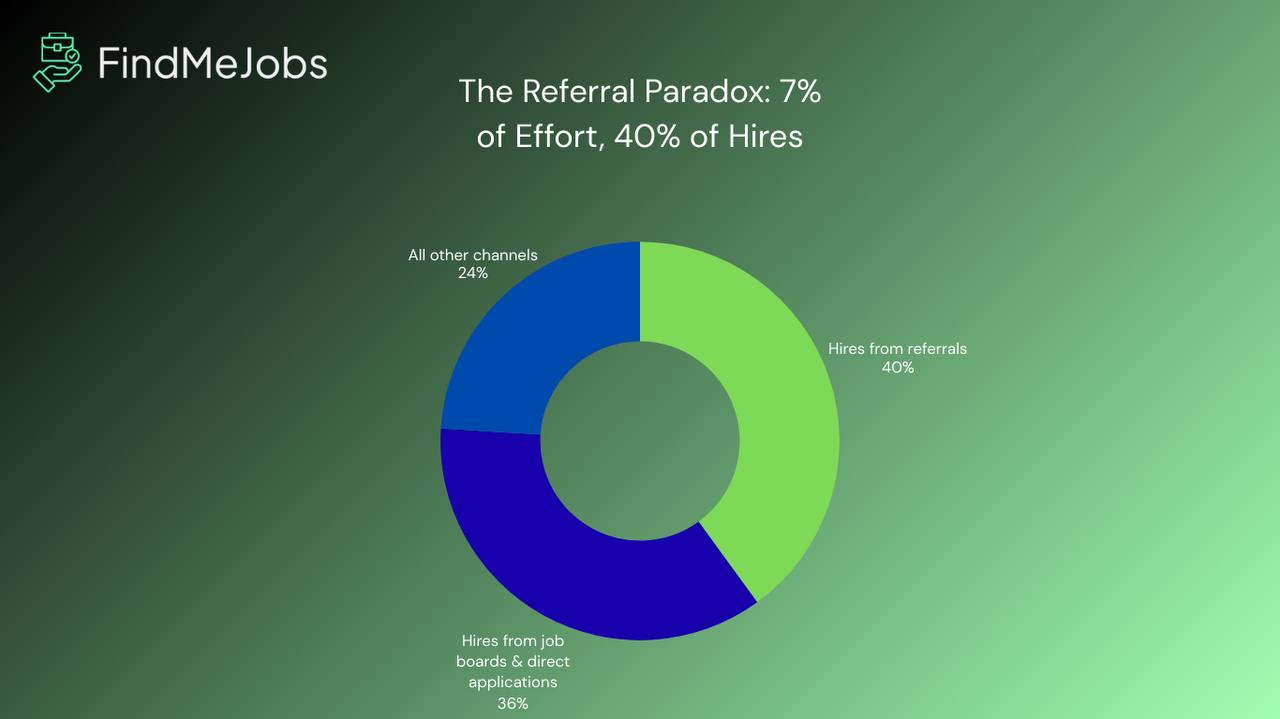
The real picture looks different. In 2025, 54% of U.S. workers reported being hired through a personal connection. That is not a marginal channel — it is how most people get jobs. According to data compiled across major job market research, only 7% of job seekers obtain a referral, yet referrals account for 40% of all new hires. Seven percent of the effort, producing 40% of the outcomes. That asymmetry is the entire argument for taking networking seriously — and for understanding why most people's approach produces so little from such a high-return activity.
This guide explains the structure of networking that actually produces job opportunities, the specific tactics that work at each stage, how to approach it if you're introverted, and what to do when you're starting from a weak or rusty network.
Why Most Job Search Networking Doesn't Work
Before the tactics, the diagnosis — because understanding why standard networking advice fails is what makes the alternative legible.
Most job search networking advice focuses on events: industry conferences, professional association meetups, career fairs. The implied model is: attend event → meet people → one of them offers you a job or tells you about one. This model has two structural problems.
The first is that it is optimised for meeting strangers, when the evidence consistently shows that job opportunities come most reliably from weak ties — people you already know but don't speak to regularly. The concept, from sociologist Mark Granovetter's foundational research, is counterintuitive: your close contacts (strong ties) are embedded in the same information networks as you. They know what you know about job openings because they move in the same circles. Your weak ties — former colleagues, old university friends, acquaintances from a previous industry — are embedded in different networks. They hear about different opportunities. They know different people. Professionals who secured their position through a direct referral or personal connection earn on average 7% more at the time of hire than those who applied through other channels — and many of those referrals come from relationships that are months or years old, not ones formed at last week's networking event.
The second problem is that event networking is optimised for volume rather than depth. A business card exchanged at a conference is not a professional relationship. A relationship is built over multiple interactions, mutual value exchange, and genuine familiarity. The candidates who get jobs through networking are not the ones who met the most people — they are the ones who maintained genuine relationships with a smaller number of people over time, and who were known, trusted, and thought of when an opportunity arose.
This reframe changes the strategy entirely. The goal is not to meet new people. The goal is to reactivate and maintain existing relationships while systematically building new ones through structured, repeatable outreach — not event attendance.
The Hidden Job Market: Why Networking Reaches Roles That Applications Don't
The most frequently cited networking statistic — that 85% of jobs are filled through networking — is contested by some researchers as imprecise. The honest version of the claim, which is both more defensible and more useful, is this: a substantial share of roles are decided before they are ever publicly posted, and a significant additional share go to referred candidates even when they are posted.
The mechanism is straightforward. When a hiring manager needs to fill a role, their first action is almost never to post a job listing. It is to ask their immediate network whether anyone knows a good candidate, to consider internal candidates, and to reach out to people they've met or been referred to directly. If that process produces a strong candidate, the role may never be listed publicly. If it doesn't, the role is then posted — but by that point, one or more candidates already exist who were found through the network and who have a head start in the process.
Referred candidates take an average of just 29 days to hire and onboard, compared to 55 days for candidates from job boards — a 47% decrease in time-to-hire. That gap is not incidental. It reflects a process in which the trust and context that a referral provides eliminates several stages of evaluation that cold applications require. The hiring manager already has a signal about the candidate's quality from the person who referred them. The interview is more of a confirmation than a cold assessment.
For job seekers, the practical implication is this: by the time you see a role posted on a job board, the process may already be underway with referred candidates who entered it weeks earlier. Applying to the posted listing is not pointless — it is part of every sensible job search — but it is the slower, higher-competition path to the same outcome that a referral produces faster and with better odds.
The Five Networking Activities That Actually Produce Jobs
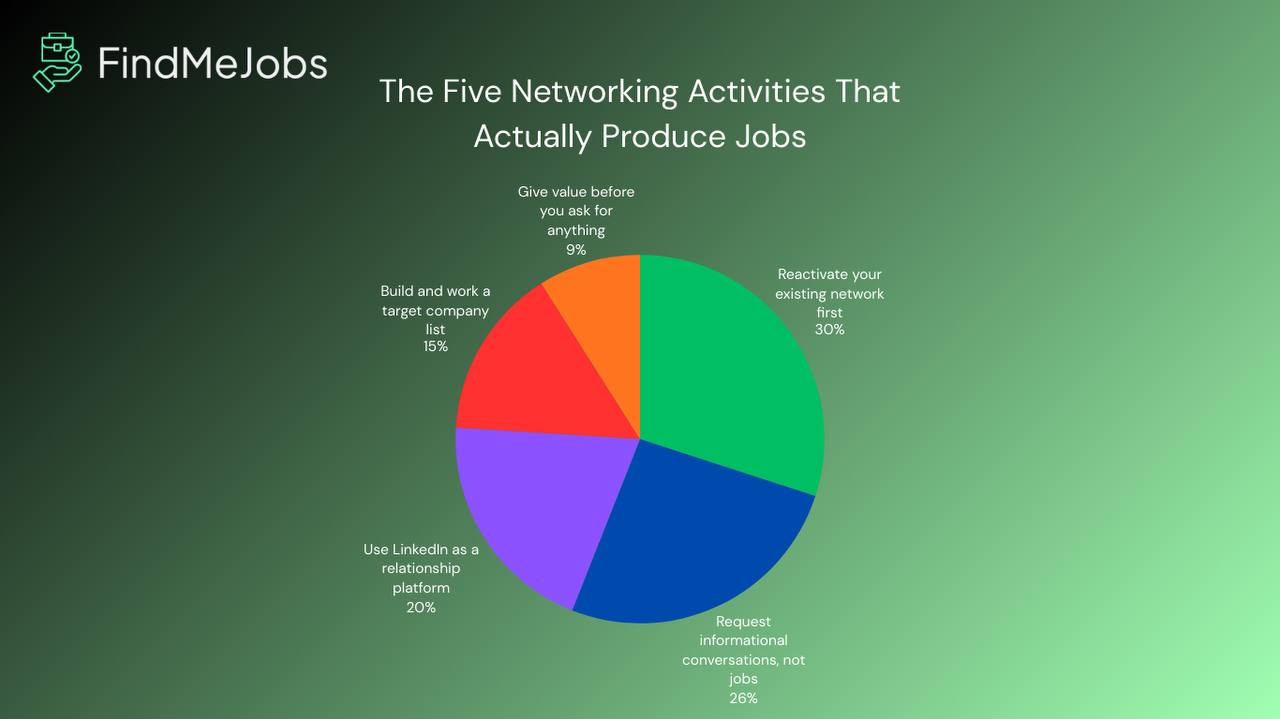 1. Reactivate Your Existing Network Before You Build a New One
The highest-return networking activity for any job seeker is one that costs nothing and takes less time than attending a single event: systematically reconnecting with people they already know.
Start by making a list of 40 to 60 people across your professional history — former managers, colleagues, clients, collaborators, classmates, mentors — without filtering for whether you think they can help you. The filter comes later. The first step is just making the list.
Then segment it into three tiers:
| Tier | Who they are | Reconnection approach |
|---|---|---|
| Tier 1 | Former managers and senior colleagues who know your work well | Direct message or email — personal, specific, no ask yet |
| Tier 2 | Former peers, clients, collaborators you worked closely with | Personal message referencing specific shared context |
| Tier 3 | Acquaintances, classmates, people you've met professionally but don't know well | LinkedIn reconnection with a brief, specific note |
The reconnection message does not ask for anything. It genuinely catches up. Something brief that references a specific shared context ("I saw your company just launched X — looks like a big moment"), expresses genuine interest in what they're doing, and mentions — in passing, not as the headline — that you're currently exploring new opportunities. The job search mention goes at the end of a message that is primarily about them, not at the beginning of a message that is primarily about you.
A reconnection sequence over four to six weeks — working through all three tiers at a pace of five to eight messages per week — will surface more genuine job leads than six months of cold networking at events.
2. Request Informational Conversations, Not Jobs
The single most misunderstood concept in professional networking is the informational conversation. Most job seekers either don't use them at all or misuse them by treating them as hidden job interviews — leading the person they're speaking with to feel deceived when the conversation pivots from "I'd love your perspective on the industry" to "and do you know of any openings?"
An informational conversation is exactly what it says: a 20 to 30 minute conversation in which you ask questions, listen carefully, and gather information. The genuine purpose is to understand how a role, function, company, or industry actually works from someone who is inside it — information you cannot get from a job description or a company website.
The reason informational conversations produce job opportunities is not that you ask for them. It is that they create genuine, positive interactions that cause people to think of you when something relevant arises. In 2025, referral hires had a 1-year retention rate of 40–46%, compared to just 14–32% for hires from other channels. People who make referrals know this intuitively — they refer candidates they genuinely believe will succeed, because their reputation is attached to the recommendation. An informational conversation is how you give someone the information they need to feel confident recommending you.
How to request one: A cold LinkedIn message requesting an informational conversation should be short (under 100 words), specific about why you're reaching out to this particular person ("I've been following your work on [specific thing] for a while"), clear about what you're asking for (20 minutes, happy to meet for coffee or by video call), and not about you asking for a job. The message is about them and what you hope to learn from them.
What to ask in the conversation: What does a good day in this role look like? What's the hardest part of the job that doesn't appear in any job description? What do you wish you'd known before you started? What are the most important capabilities in this function right now? Who else do you think it would be worth my speaking with?
That last question — "who else should I speak with?" — is the networking multiplier. A single well-run informational conversation, ending with that question, can produce two or three warm introductions that each produce two or three more. A network built this way is qualitatively different from one built by accumulating cold connections — it is a web of warm, personally introduced relationships with context attached.
3. LinkedIn as a Networking Tool, Not a Job Board
Most job seekers use LinkedIn as a job board — searching listings and applying. The candidates who get the most from LinkedIn use it as a relationship management and signal platform, not primarily as a search tool.
The specific practices that produce results on LinkedIn for job seekers:
Engage genuinely with content in your target function. Commenting thoughtfully on posts from people in roles or companies you're interested in is the lightest-touch, most scalable form of professional networking available. A comment that adds specific insight or a relevant question — not a generic "great post" — creates a positive impression with the poster and with anyone who reads it. Done consistently over weeks, it builds familiarity with people you've never directly contacted, making a subsequent outreach message much warmer than a cold one.
Post original, specific content occasionally. You do not need to post frequently. One post per month that shares a specific observation, a lesson learned, or a piece of analysis relevant to your field is enough to maintain visibility with your existing network. The purpose is not to go viral — it is to remind people you exist, that you are thinking about things that matter in your field, and that you are professionally active.
Use the connection message. Every LinkedIn connection request should include a personalised note. This is used so rarely that it immediately distinguishes you from the majority of requests people receive. One sentence of specific context ("I've been reading your writing on X and wanted to connect") is enough. The note is not a pitch — it is just the context that makes the connection make sense.
Identify and approach second-degree connections at target companies. When you're interested in a company, search LinkedIn for people in your target function who are second-degree connections — meaning someone you know knows them. Then ask your mutual connection for a specific warm introduction. A warm introduction from a shared contact is categorically more effective than a cold message, and most people are willing to make one if asked directly and given the context they need to do so comfortably.
4. Build a Target Company List and Work It Systematically
Random networking — maintaining vague relationships with many people across many industries — produces vague results. Systematic networking — maintaining specific relationships with people at a defined set of target companies — produces specific ones.
The most effective job-search networking strategy combines a broad relationship maintenance practice (tiers 1-3 above) with a focused, company-specific targeting approach. The targeting approach works like this:
Identify 15 to 25 companies you would genuinely want to work for, based on role relevance, industry interest, company stage, culture signals, and geographic fit. For each company, use LinkedIn to identify one to three people in roles adjacent to or above the one you'd target. Research them specifically — what have they worked on, what do they care about, what's the company doing that's interesting right now.
Then approach one or two contacts per company over a period of weeks, using the informational conversation framework above. The goal is not to get a job at every target company. The goal is to build at least one genuine relationship inside each one — so that when a role opens, you are a known person rather than a cold application.
This approach is slower than mass-applying to job boards. It is also significantly more likely to produce offers, for the reasons described above: job seekers with a referral are four times more likely to receive an interview than those applying through a job board, and referral candidates are hired up to 70% faster than non-referral applicants.
5. Give Before You Ask
The most common networking failure is treating it as a one-directional resource extraction exercise — contacting people only when you need something, with no history of providing value in return.
The relationships that produce job opportunities are built on mutual value. The question to lead every networking interaction with is not "what can this person do for me?" but "what can I genuinely offer this person?" The answer might be: a relevant article or piece of information they'd find useful, an introduction to someone in your network they'd benefit from knowing, specific feedback on something they've shared, a perspective that's genuinely different from what they hear in their own circle.
This principle applies most powerfully to the period before you're actively searching. The best time to invest in your professional network is when you don't need it — because relationships built under zero transactional pressure are qualitatively more robust than relationships initiated with an obvious immediate agenda. Career transitions that happen smoothly, quickly, and into good roles are usually the result of network investments made months or years before the search began.
Networking for Introverts: A Structural Approach
The common framing of networking as something that comes naturally to extroverts and requires performance from introverts misidentifies the problem. The activities that actually produce jobs through networking — writing specific messages, having focused one-on-one conversations, maintaining relationships with a defined set of people — are activities that introverts are often better at than extroverts, not worse.
The activities that are genuinely difficult for introverts — large events, working a room, small talk with strangers — are also the activities that produce the least job-search value. Avoiding them is not a disadvantage. It is a sensible resource allocation.
The introvert-friendly networking toolkit:
Written outreach over event attendance. A well-crafted LinkedIn message or email, sent thoughtfully to a specific person for a specific reason, is more likely to produce a meaningful conversation than a business card collected at a crowded event. It is also easier to write carefully when you're not doing it in real time.
One-on-one over group. Informational conversations are inherently one-on-one — which is the social format most introverts find easiest. Aim for these rather than panel events or group networking sessions.
Quality over quantity. A genuine relationship with 10 people in your field is more productive than a surface-level connection with 200. Introverts typically maintain fewer but deeper relationships — which is exactly the profile that produces referrals, because referrals require trust, and trust is built through depth, not volume.
Online first. LinkedIn engagement, commenting, and posting create familiarity before direct contact — reducing the cold-contact friction that many introverts find most difficult.
Networking With No Experience or a Thin Network
For candidates early in their career, or returning to work after a gap, the network is thinner and the path less obvious. But the structural principles above apply at every career stage — the starting inventory is just different.
Alumni networks are underused at every career stage. Universities maintain active alumni communities specifically to facilitate exactly this kind of professional connection, and most professionals are genuinely willing to speak with alumni from their institution. The shared context lowers the barrier to outreach significantly. If you have a university background, this is your single highest-return starting point for informational conversations.
Former classmates and professors. People you went to school with are now, depending on your age, distributed across industries and organisations. A former classmate now working in a company you're targeting is a Tier 1 contact, not a weak tie. Former professors and academic supervisors often have extensive professional networks and are willing to make introductions.
Volunteer and community involvement. Working alongside people in a non-professional context builds genuine trust and familiarity — and the people you meet through volunteering, community organisations, or hobby groups may have professional networks that overlap significantly with roles you're targeting. This is not a cynical observation about the instrumental value of community involvement; it is a recognition that the relationships that produce job opportunities often have their roots in contexts that are not explicitly professional.
Entry-level industry communities. Every industry has communities — Slack groups, subreddits, Discord servers, LinkedIn groups, newsletters with active comment sections — where practitioners share ideas, ask questions, and build relationships. Contributing genuinely to these communities over weeks and months creates familiarity and reputation-building that produces real opportunities.
What to Say When You Ask for a Referral
Asking for a referral is a specific, high-stakes networking ask that most people either avoid entirely or handle clumsily. The approach that works is neither a vague request for "any help you can offer" nor a specific instruction to submit your CV internally. It is a structured ask that gives the person everything they need to say yes comfortably.
The referral ask has four components:
- Context on the specific role. "I came across [Company]'s opening for [specific role] and it's a strong match for my background — [brief, specific reason]."
- Why you're asking this person. "I know you've been at [Company] for a few years and have a good read on the culture and team."
- The specific ask. "I wanted to ask whether you'd feel comfortable making an introduction or putting my name forward as someone worth speaking with."
- The easy out. "Completely understand if it's not the right time or if the fit seems off from your vantage point — either way, I'd value your honest take."
The easy out is not false modesty. It is the thing that makes the ask comfortable to respond to. A referral request that removes all exit routes puts the person in an uncomfortable position — which makes them less likely to help, not more. The easy out signals that you value the relationship over the transaction, and that a "no" will not damage anything.
You may find this useful:
The Networking Activity Table: What to Do and When
| Activity | Frequency | Expected Outcome | Time Investment |
|---|---|---|---|
| Tier 1 reconnections (former managers, senior colleagues) | Once at search start, then as needed | Job leads, referrals, candid market intel | 15–20 min per message + reply |
| Tier 2 reconnections (former peers, clients) | 5–8 per week across 4–6 weeks | Warm referrals, informational leads, awareness | 10–15 min per message + reply |
| Tier 3 reconnections (acquaintances, LinkedIn dormant) | Ongoing, 3–5 per week | Network breadth, unexpected introductions | 5–10 min per message |
| Informational conversations | 2–3 per week during active search | Role clarity, company intel, warm introductions | 30–45 min per conversation |
| Target company LinkedIn research | 30 min per week | Second-degree contact identification | 30 min/week |
| LinkedIn engagement (commenting, posting) | 3–5 comments per week, 1 post per month | Visibility, familiarity with target contacts | 20–30 min per week |
| Referral asks (when a specific role is identified) | As needed | Direct pipeline for specific applications | 20–30 min per ask |
| Alumni outreach | 2–3 at search start | Informational leads in new companies/industries | 15–20 min per message |
Frequently Asked Questions
How do I start networking for a job if I've never done it before?
Start with the people you already know. Make the list of 40 to 60 people from your professional and educational history, segment them into the three tiers described above, and begin with Tier 1 — former managers and senior colleagues who know your work. The reconnection message is not a job ask. It is a genuine catch-up that mentions your search in passing. Most people find this much more natural than approaching strangers, which is where most networking advice starts. Work the tiers over four to six weeks before you focus on cold outreach.
How do I ask someone on LinkedIn for a job without being awkward?
Don't ask for the job. Ask for 20 minutes of their time to learn about their experience in the role or company. A message that says "I'd love to hear how you got into [field] and what your experience at [company] has been like — would you be open to a quick call?" will get more responses than "I'm looking for a job and would appreciate your help." The informational conversation format converts many of those responses into referrals without your having to ask directly for one.
How many people should I be networking with during a job search?
The research-consistent target for most job seekers: maintain active communication with 20 to 30 people during a search, including the reconnection sequences above, ongoing informational conversations, and follow-up with people you've already spoken with. This is manageable and meaningful. Networking with 200 people simultaneously is neither manageable nor meaningful. The depth of a smaller number of genuine interactions outperforms the breadth of a large number of superficial ones.
Is it okay to network while still employed?
Yes — and it is significantly better to network before you need a job than after. The most sustainable professional networking happens throughout a career, not just during active searches. If you are networking while employed, use discretion about how explicitly you discuss your search. With trusted contacts, you can be direct. With more distant or less trusted ones, the informational conversation format — genuine interest in their experience, no explicit job ask — achieves the same result without the vulnerability of broadly broadcasting that you're looking.
What do I do when a networking contact doesn't respond?
Wait five to seven business days, then send one brief follow-up. Something like "just following up in case my message got buried — happy to chat any time if you're open to it." If there is no response to the follow-up, move on. Not every message produces a response. A 20 to 30% response rate on cold or warm-cold outreach is normal and sufficient — if you're sending enough messages across your tiers, the conversations that do happen are more than enough to produce results.
Does networking actually work for getting a job, or is it just who you know?
Both things are true simultaneously. Networking works for getting a job — the data on referral rates, interview conversion, time-to-hire, and salary outcomes consistently shows it is the most effective channel. And it is about who you know — which is precisely why building and maintaining professional relationships is a career-long investment, not a job-search-specific tactic. "It's who you know" is often said dismissively, as though the system is unfair and networking is cheating. The more productive framing is: relationships are a professional asset that can be built deliberately, by anyone, regardless of starting conditions.
How do I network effectively as an introvert?
Shift the mode: written outreach instead of events, one-on-one informational conversations instead of group networking, online engagement before cold contact. The activities that produce jobs through networking are not inherently extroversion-dependent — they require thoughtfulness and specificity, which introverts typically excel at. The activities that are difficult for introverts (large events, small talk with strangers) are also the activities with the worst return on time in a job search. Avoiding them is not a limitation — it is a reasonable reallocation of effort toward higher-value activities.
How long does it take for networking to produce job leads?
Tier 1 and Tier 2 reconnections can produce relevant conversations within days of the first messages. Informational conversations take a week or two to book and run, with introductions following from there. Target company outreach to cold or warm contacts takes three to six weeks to convert into meaningful connections. In total, a systematic networking campaign started from an existing professional network typically begins producing genuine leads within two to four weeks. A campaign started from scratch — with a thin or rusty network — takes longer but follows the same trajectory with slightly slower timing at each stage.
The Bottom Line
Networking is not a personality trait. It is a skill set — and like every skill set, it improves with a systematic approach and deliberate practice.
The candidates who get jobs through their network are not naturally more social or more confident than those who don't. They are more systematic. They maintain their relationships before they need them. They ask for conversations instead of jobs. They approach the right people at the right companies with specific, well-researched messages. They give before they ask.
None of those behaviours require attending events you hate. They require a contact list, a reconnection message, and a willingness to have genuine conversations about work with people who have relevant experience. That is available to everyone — regardless of personality type, career stage, or the current size of their network.
The asymmetry in the data — 7% of candidates get referrals, producing 40% of all hires — exists because most people are not doing this. Which means the opportunity for those who do is disproportionately large.
Related reading:
- Does Applying to Jobs Early Increase Your Chances?
- Why Your Resume Isn't Getting Responses
- How to Job Search While Working Full Time
The fastest path to the hidden job market is a referral from someone already inside it. But referrals happen faster when you're already known to the right people — and the best way to be known is to be an early applicant at companies you've already researched. FindMeJobs monitors job boards 24/7 and alerts you the moment a matching role posts, so your network and your applications are always working together. Start your 7-day free trial — no credit card required.